Rio de Janeiro State University, Faculty of Nursing. Boulevard 28 de Setembro 157, 7th floor. Vila Isabel, Rio de Janeiro, RJ 20551-030, Brazil.
Federal Fluminense University, Collective Health Institute. Marques do Parana 303, 3th floor, Annex Building, Centro, Niterói, RJ 24033-900, Brazil.
Int J Nurs Stud. 2021 Dec;124:104089. doi: 10.1016/j.ijnurstu.2021.104089. Epub 2021 Sep 9.
Health care personnel (HCP) worldwide are at-risk for contracting the novel Coronavirus disease (COVID-19). Among health care personnel, nurses are at a particularly high risk due to the physical proximity and duration of time spent providing direct care. Documenting accurate rates of COVID-19 infection and deaths among nurses worldwide has been problematic, and many countries such as the USA have no systematic mechanism for collecting this information. Brazil is unique in that it prioritized the implementation of a dedicated database, the Nursing Observatory to collect accurate and timely data regarding COVID-19 and Brazilian nursing personnel.
The aim of this study was to analyze COVID-19 infections and deaths among nurses registered in the centralized and dedicated Brazilian database called the Nursing Observatory.
A cross-sectional study using secondary data from the Brazilian Nursing Observatory was conducted.
Data are reported for two occupational categories: professional Nurse and technical nurse by country regions. All cases or deaths of professional Nurse and technical nurse registered between the 12th and 31st epidemiological weeks of 2020 were included.
From a unique numerical identification, the appropriate records of nursing personnel affected by COVID-19 were entered by the Technical Responsible Nurse for each service, according to the condition regarding COVID-19. All suspected, confirmed or unconfirmed infections were considered "cases", and all confirmed or unconfirmed deceased as "deaths". Cases and deaths were analyzed according to the variables: 1. region of the country where the case occurred, 2. nursing category and 3. epidemiological week. Universal protocols for collecting and cleaning data were used throughout the country. Infection and mortality rates (per 100,000) were obtained from the relationship between deaths registered and the population of nursing personnel by category and region.
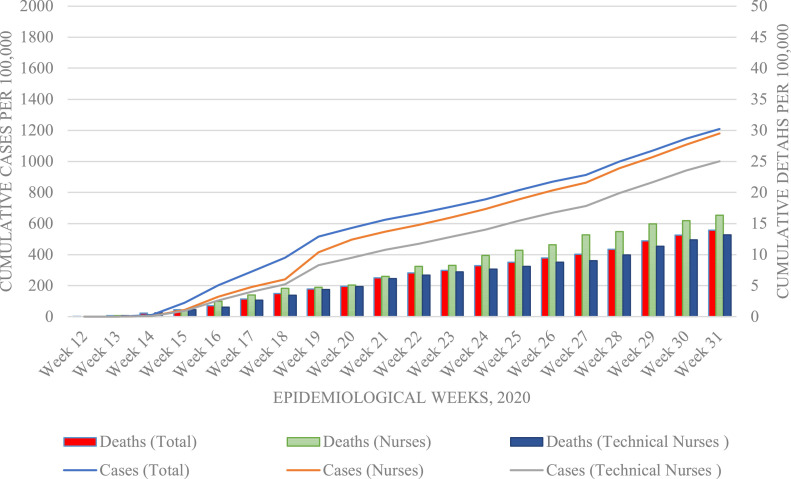
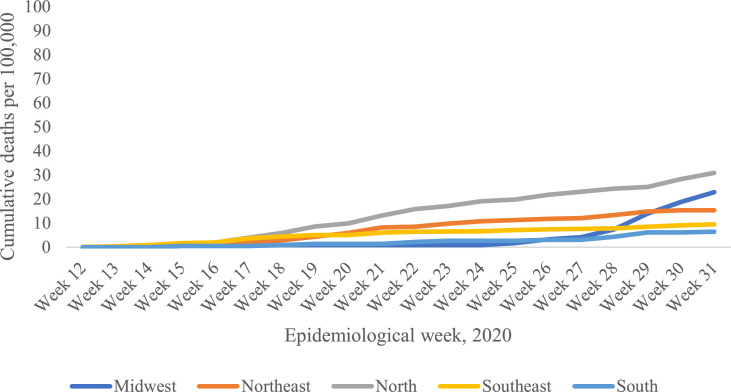
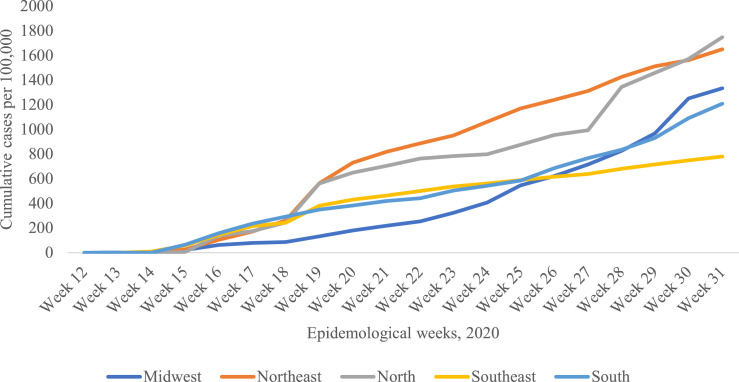
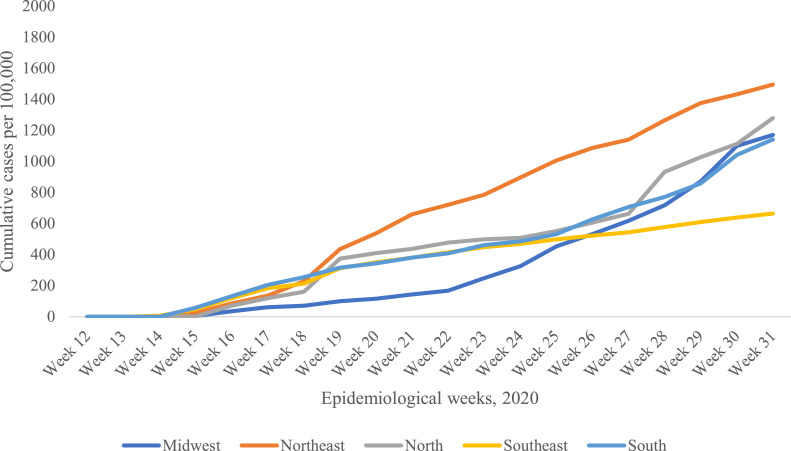
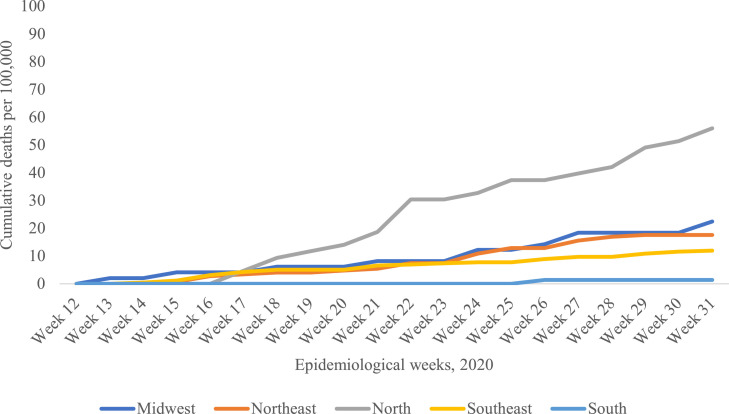
Nursing personnel in the Northern, Northeast and Southeast Regions of Brazil had the highest number of COVID-19 infections and deaths overall with an ascending curve occurring mainly after Epidemiological Week 19. COVID-19 infections and deaths spread later to the Midwest and Southern regions also showing an ascending curve, although the total numbers were less.
All occupational categories of nursing personnel showed higher than expected rates of infection and death. Inequalities and a lack of adequate healthcare resources, hospital beds and Personal Protective Equipment varied by region in Brazil. The politicization of COVID-19 and the lack of a coherent national pandemic plan is a factor to be taken into account. Tweetable abstract: This cross-sectional study shows the evolution of cases and deaths of Brazilian nursing personnel over the first months of the COVID-19 pandemic.
全球卫生保健工作者(HCP)面临感染新型冠状病毒病(COVID-19)的风险。在卫生保健工作者中,护士由于提供直接护理的身体接近度和持续时间而面临特别高的风险。在全球范围内,记录护士 COVID-19 感染和死亡的准确比率一直存在问题,许多国家(如美国)没有系统的机制来收集这些信息。巴西的独特之处在于它优先实施了一个专门的数据库,即护理观察站,以收集有关 COVID-19 和巴西护理人员的准确和及时数据。
本研究旨在分析注册在巴西护理观察站集中和专用数据库中的护士的 COVID-19 感染和死亡情况。
使用巴西护理观察站的二次数据进行了横断面研究。
按国家地区报告了两个职业类别:专业护士和技术护士的数据。所有在 2020 年第 12 至 31 个流行病学周期间登记的专业护士和技术护士的病例或死亡均包括在内。
根据与 COVID-19 相关的情况,由每个服务的技术责任护士从唯一的数字标识中输入受 COVID-19 影响的护理人员的适当记录。所有疑似、确诊或未确诊的感染均被视为“病例”,所有确诊或未确诊的死亡均被视为“死亡”。根据以下变量对病例和死亡进行分析:1. 发生病例的国家地区,2. 护理类别,3. 流行病学周。在全国范围内使用了用于收集和清理数据的通用协议。感染和死亡率(每 10 万人)是根据按类别和地区登记的死亡人数与护理人员人数之间的关系获得的。
巴西北部、东北部和东南部地区的护理人员 COVID-19 感染和死亡人数总体上最多,主要在第 19 周后出现上升曲线。COVID-19 感染和死亡随后传播到中西部和南部地区,也出现了上升曲线,尽管总数较少。
所有护理职业类别的感染和死亡人数均高于预期。巴西各地区的卫生资源不平等以及医院床位和个人防护设备不足。COVID-19 的政治化和缺乏协调一致的国家大流行计划是需要考虑的一个因素。可推文摘要:本横断面研究显示了巴西护理人员在 COVID-19 大流行的头几个月病例和死亡的演变情况。