Department of Biochemistry and Forensic Science, University School of Sciences, Gujarat University, Ahmedabad, Gujarat, 380009, India.
Department of Life Science, University School of Sciences, Gujarat University, Ahmedabad, Gujarat, 380009, India.
J Ovarian Res. 2021 Sep 26;14(1):125. doi: 10.1186/s13048-021-00879-w.
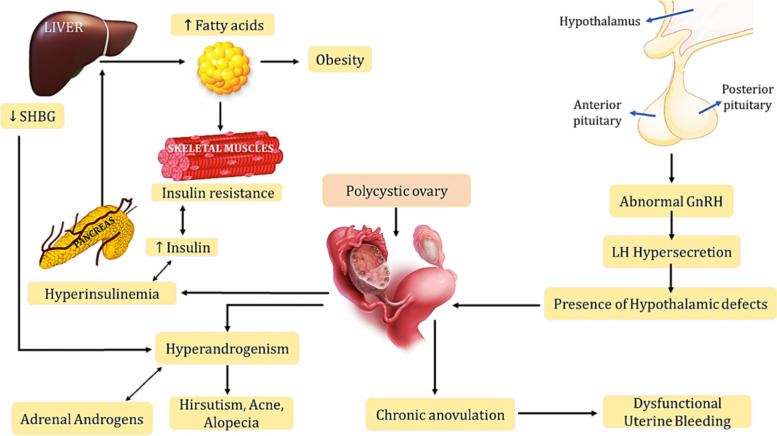
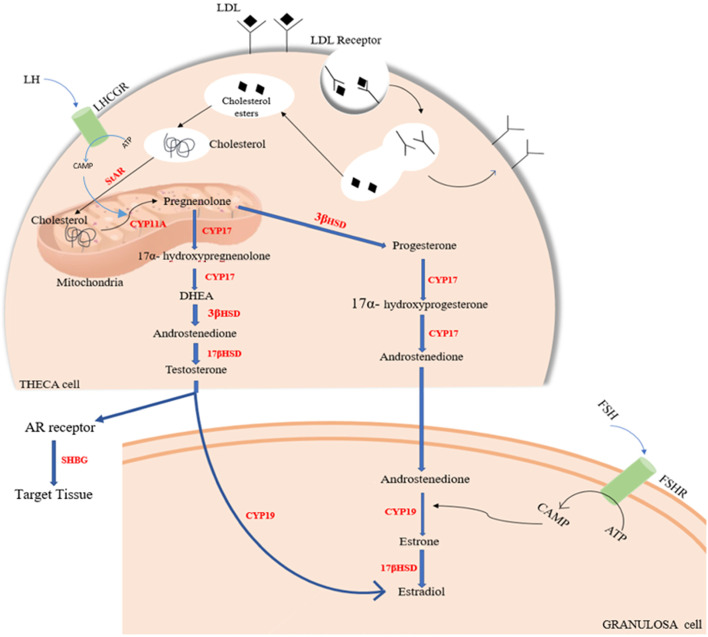
Polycystic ovary syndrome (PCOS) is the most common endocrinopathies affecting the early reproductive age in women, whose pathophysiology perplexes many researchers till today. This syndrome is classically categorized by hyperandrogenism and/or hyperandrogenemia, menstrual and ovulatory dysfunction, bulky multi follicular ovaries on Ultrasonography (USG), and metabolic abnormalities such as hyperinsulinemia, dyslipidemia, obesity. The etiopathogenesis of PCOS is not fully elucidated, but it seems that the hypothalamus-pituitary-ovarian axis, ovarian, and/or adrenal androgen secretion may contribute to developing the syndrome. Infertility and poor reproductive health in women's lives are highly associated with elevated levels of androgens. Studies with ovarian theca cells taken from PCOS women have demonstrated increased androgen production due to augmented ovarian steroidogenesis attributed to mainly altered expression of critical enzymes (Cytochrome P450 enzymes: CYP17, CYP21, CYP19, CYP11A) in the steroid hormone biosynthesis pathway. Despite the heterogeneity of PCOS, candidate gene studies are the widely used technique to delineate the genetic variants and analyze for the correlation of androgen biosynthesis pathway and those affecting the secretion or action of insulin with PCOS etiology. Linkage and association studies have predicted the relationship between genetic variants and PCOS risk among families or populations. Several genes have been proposed as playing a role in the etiopathogenesis of PCOS, and the presence of mutations and/or polymorphisms has been discovered, which suggests that PCOS has a vital heritable component. The following review summarizes the influence of polymorphisms in crucial genes of the steroidogenesis pathway leading to intraovarian hyperandrogenism which can result in PCOS.
多囊卵巢综合征(PCOS)是影响女性早期生殖年龄的最常见内分泌疾病,其病理生理学至今仍困扰着许多研究人员。该综合征经典地表现为高雄激素血症和/或高雄激素血症、月经和排卵功能障碍、超声检查(USG)显示多囊卵巢、以及代谢异常,如高胰岛素血症、血脂异常、肥胖。PCOS 的病因发病机制尚未完全阐明,但似乎下丘脑-垂体-卵巢轴、卵巢和/或肾上腺雄激素分泌可能导致该综合征的发生。女性生活中的不孕和生殖健康不良与雄激素水平升高高度相关。对来自 PCOS 女性的卵巢膜细胞进行的研究表明,由于类固醇激素生物合成途径中关键酶(细胞色素 P450 酶:CYP17、CYP21、CYP19、CYP11A)表达的改变,导致卵巢甾体生成增加,从而导致雄激素产生增加。尽管 PCOS 存在异质性,但候选基因研究是广泛用于描述遗传变异并分析雄激素生物合成途径与影响胰岛素分泌或作用的遗传变异与 PCOS 病因之间相关性的技术。连锁和关联研究预测了遗传变异与家族或人群中 PCOS 风险之间的关系。已经提出了几个基因在 PCOS 的病因发病机制中起作用,并且已经发现了突变和/或多态性,这表明 PCOS 具有重要的遗传性成分。本综述总结了导致卵巢内高雄激素血症的类固醇生成途径中关键基因的多态性对 PCOS 的影响。