Zhang Guolin, Li Mei, Zheng Meifeng, Cai Xiaoqing, Yang Jinyu, Zhang Shengqing, Yilifate Anniwaer, Zheng Yuxin, Lin Qiang, Liang Junjie, Guo Lan, Ou Haining
Department of Cardiac Rehabilitation, Guangdong Provincial People's Hospital, Guangzhou, China.
Department of Rehabilitation Medicine, The Fifth Affiliated Hospital of Guangzhou Medical University, Guangzhou, China.
Front Physiol. 2021 Sep 10;12:710573. doi: 10.3389/fphys.2021.710573. eCollection 2021.
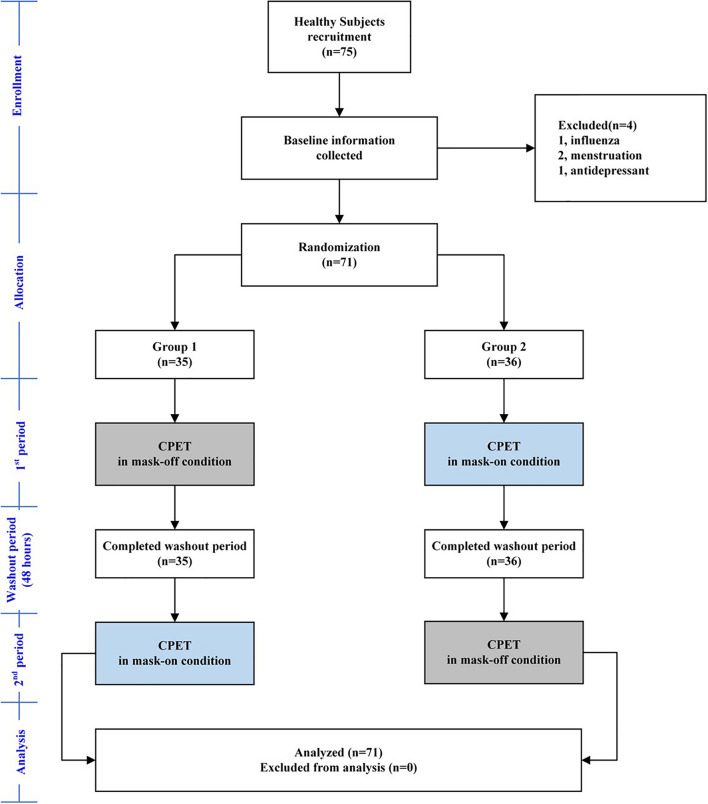
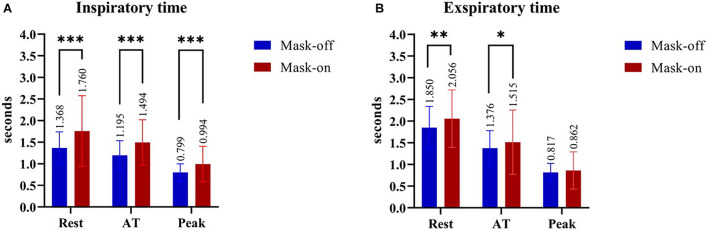
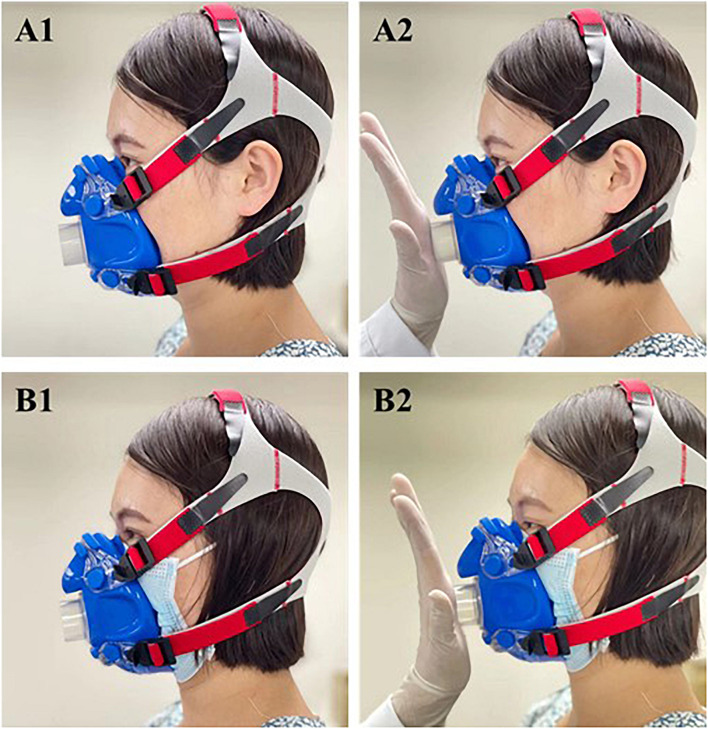
Mask plays an important role in preventing infectious respiratory diseases. The influence of wearing masks in physical exercise on the human body needs to be studied. The purpose of this study is to explore the influence of wearing surgical masks on the cardiopulmonary function of healthy people during exercise. The physiological responses of 71 healthy subjects (35 men and 36 women, age 27.77 ± 7.76 years) to exercises with and without surgical masks (mask-on and mask-off) were analyzed. Cardiopulmonary function and metabolic reaction were measured by the cardiopulmonary exercise test (CPET). All tests were carried out in random sequence and should be completed in 1 week. The CPETs with the mask-on condition were performed undesirably ( < 0.05), and the Borg scale was higher than the mask-off ( < 0.001). Rest oxygen uptake ( ) and carbon dioxide production ( CO) with the mask-on condition were lower than mask-off ( < 0.01), which were more obvious at peak exercise ( O : 1454.8 ± 418.9 vs. 1628.6 ± 447.2 ml/min, < 0.001; CO : 1873.0 ± 578.7 vs. 2169.9 ± 627.8 ml/min, = 0.005), and the anaerobic threshold (AT) brought forward ( < 0.001). At different stages of CPET with the mask-on condition, inspiratory and expiratory time (Te) was longer ( < 0.05), and respiratory frequency (Rf) and minute ventilation ( ) were shorter than mask-off, especially at peak exercise (Rf : 33.8 ± 7.98 vs. 37.91 ± 6.72 b/min, < 0.001; : 55.07 ± 17.28 vs. 66.46 ± 17.93 l/min, < 0.001). was significantly lower than mask-off just at peak exercise (1.66 ± 0.45 vs. 1.79 ± 0.5 l, < 0.001). End-tidal oxygen partial pressure (PetO), end-tidal carbon dioxide partial pressure (PetCO), oxygen ventilation equivalent ( / O), and carbon dioxide ventilation equivalent ( / CO) with mask-on, which reflected pulmonary ventilation efficiency, were significantly different from mask-off at different stages of CPET ( < 0.05), but no significant difference in percutaneous oxygen saturation (SpO) was found. Differences in oxygen pulse ( O/HR), oxygen uptake efficiency slope (OUES), work efficiency (△ O/△W), peak heart rate (HR), and peak systolic blood pressure (BP) existed between two conditions ( < 0.05). Wearing surgical masks during aerobic exercise showed certain negative impacts on cardiopulmonary function, especially during high-intensity exercise in healthy young subjects. These results provide an important recommendation for wearing a mask at a pandemic during exercises of varying intensity. Future research should focus on the response of wearing masks in patients with related cardiopulmonary diseases.
口罩在预防呼吸道传染病方面发挥着重要作用。佩戴口罩对体育锻炼中人体的影响有待研究。本研究旨在探讨佩戴外科口罩对健康人运动时心肺功能的影响。分析了71名健康受试者(35名男性和36名女性,年龄27.77±7.76岁)在佩戴和不佩戴外科口罩(戴口罩和不戴口罩)情况下运动时的生理反应。通过心肺运动试验(CPET)测量心肺功能和代谢反应。所有测试均按随机顺序进行,应在1周内完成。戴口罩情况下的CPET结果不理想(<0.05),Borg量表评分高于不戴口罩时(<0.001)。戴口罩时静息摄氧量( )和二氧化碳产生量( CO)低于不戴口罩时(<0.01),在运动峰值时更为明显( O :1454.8±418.9 vs.1628.6±447.2 ml/min,<0.001; CO :1873.0±578.7 vs.2169.9±627.8 ml/min,=0.005),无氧阈(AT)提前(<0.001)。在戴口罩情况下CPET的不同阶段,吸气和呼气时间(Te)更长(<0.05),呼吸频率(Rf)和分钟通气量( )短于不戴口罩时,尤其是在运动峰值时(Rf :33.8±7.98 vs.37.91±6.72次/分钟,<0.001; :55.07±17.28 vs.66.46±17.93升/分钟,<0.001)。仅在运动峰值时 显著低于不戴口罩时(1.66±0.45 vs.1.79±0.5升,<0.001)。反映肺通气效率的戴口罩时呼气末氧分压(PetO)、呼气末二氧化碳分压(PetCO)、氧通气当量( / O)和二氧化碳通气当量( / CO)在CPET不同阶段与不戴口罩时有显著差异(<0.05),但经皮血氧饱和度(SpO)无显著差异。两种情况下氧脉搏( O/HR)、摄氧效率斜率(OUES)、工作效率(△ O/△W)、心率峰值(HR)和收缩压峰值(BP)存在差异(<0.05)。有氧运动时佩戴外科口罩对心肺功能有一定负面影响,尤其是在健康年轻受试者的高强度运动中。这些结果为在疫情期间不同强度运动时佩戴口罩提供了重要建议。未来研究应关注相关心肺疾病患者佩戴口罩的反应。