Yang Chengmin, Yao Li, Liu Naici, Zhang Wenjing, Tao Bo, Cao Hengyi, Gong Qiyong, Lui Su
Department of Radiology, Huaxi MR Research Center, West China Hospital of Sichuan University, Chengdu, China.
Psychoradiology Research Unit of Chinese Academy of Medical Sciences, Functional and Molecular Imaging Key Laboratory of Sichuan Province, West China Hospital of Sichuan University, Chengdu, China.
Front Neurol. 2021 Sep 9;12:659250. doi: 10.3389/fneur.2021.659250. eCollection 2021.
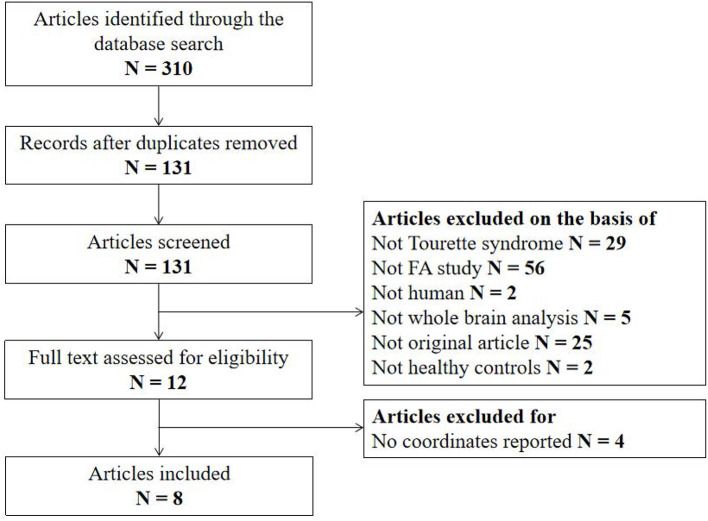
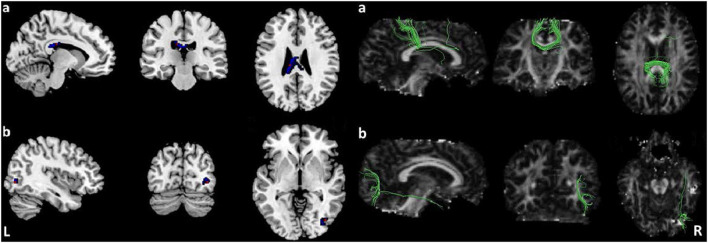
Tourette syndrome (TS) is a neuropsychiatric disorder with multiple motor and vocal tics whose neural basis remains unclear. Diffusion tensor imaging (DTI) studies have demonstrated white matter microstructural alternations in TS, but the findings are inconclusive. In this study, we aimed to elucidate the most consistent white matter deficits in patients with TS. By systematically searching online databases up to December 2020 for all DTI studies comparing fractional anisotropy (FA) between patients with TS and healthy controls (HCs), we conducted anisotropic effect size-signed differential mapping (AES-SDM) meta-analysis to investigate FA differences in TS, as well as performed meta-regression analysis to explore the effects of demographics and clinical characteristics on white matter abnormalities among TS. A total of eight datasets including 168 patients with TS and 163 HCs were identified. We found that TS patients showed robustly decreased FA in the corpus callosum (CC) and right inferior longitudinal fasciculus (ILF) compared with HCs. These two regions preserved significance in the sensitivity analysis. No regions of increased FA were reported. Meta-regression analysis revealed that age, sex, tic severity, or illness duration of patients with TS were not linearly correlated with decreased FA. Patients with TS display deficits of white matter microstructure in the CC and right ILF known to be important for interhemispheric connections as well as long association fiber bundles within one hemisphere. Because the results reported in the primary literature were highly variable, future investigations with large samples would be required to support the identified white matter changes in TS.
抽动秽语综合征(TS)是一种具有多种运动和发声抽动的神经精神疾病,其神经基础尚不清楚。扩散张量成像(DTI)研究已证实TS患者存在白质微观结构改变,但结果尚无定论。在本研究中,我们旨在阐明TS患者中最一致的白质缺陷。通过系统检索截至2020年12月的在线数据库中所有比较TS患者与健康对照(HCs)之间分数各向异性(FA)的DTI研究,我们进行了各向异性效应大小符号差异映射(AES-SDM)荟萃分析,以研究TS患者的FA差异,并进行了荟萃回归分析,以探讨人口统计学和临床特征对TS患者白质异常的影响。共识别出8个数据集,包括168例TS患者和163例HCs。我们发现,与HCs相比,TS患者胼胝体(CC)和右侧下纵束(ILF)的FA显著降低。这两个区域在敏感性分析中保持显著。未报告FA增加的区域。荟萃回归分析显示,TS患者的年龄、性别、抽动严重程度或病程与FA降低无线性相关性。TS患者在CC和右侧ILF中表现出白质微观结构缺陷,已知这些区域对半球间连接以及一个半球内的长联合纤维束很重要。由于原始文献报道的结果高度可变,未来需要大样本研究来支持所确定的TS患者白质变化。