Department of Surgery, Schulze Diabetes Institute, University of Minnesota, Minneapolis, MN, United States.
Division of Solid Organ Transplantation, Department of Surgery, University of Minnesota, Minneapolis, MN, United States.
Front Immunol. 2021 Sep 9;12:730545. doi: 10.3389/fimmu.2021.730545. eCollection 2021.
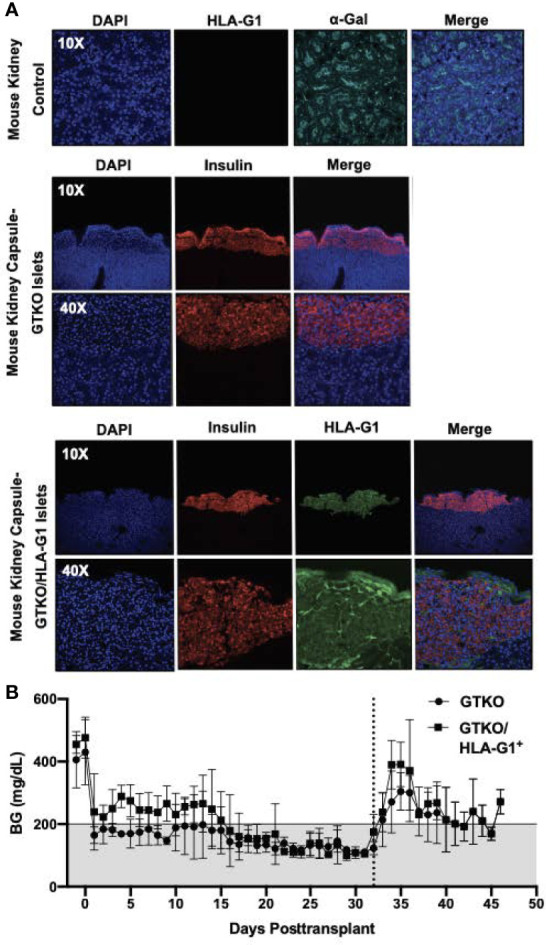
The human leukocyte antigen G1 (HLA-G1), a non-classical class I major histocompatibility complex (MHC-I) protein, is a potent immunomodulatory molecule at the maternal/fetal interface and other environments to regulate the cellular immune response. We created GGTA1/HLAG1 pigs to explore their use as organ and cell donors that may extend xenograft survival and function in both preclinical nonhuman primate (NHP) models and future clinical trials. In the present study, HLA-G1 was expressed from the porcine ROSA26 locus by homology directed repair (HDR) mediated knock-in (KI) with simultaneous deletion of α-1-3-galactotransferase gene (GGTA1; GTKO) using the clustered regularly interspersed palindromic repeats (CRISPR)/CRISPR associated protein 9 (Cas9) (CRISPR/Cas9) gene-editing system. GTKO/HLAG1 pigs showing immune inhibitory functions were generated through somatic cell nuclear transfer (SCNT). The presence of HLA-G1 at the ROSA26 locus and the deletion of GGTA1 were confirmed by next generation sequencing (NGS) and Sanger's sequencing. Fibroblasts from piglets, biopsies from transplantable organs, and islets were positive for HLA-G1 expression by confocal microscopy, flow cytometry, or q-PCR. The expression of cell surface HLA-G1 molecule associated with endogenous β2-microglobulin (β2m) was confirmed by staining genetically engineered cells with fluorescently labeled recombinant ILT2 protein. Fibroblasts obtained from GTKO/HLAG1 pigs were shown to modulate the immune response by lowering IFN-γ production by T cells and proliferation of CD4 and CD8 T cells, B cells and natural killer (NK) cells, as well as by augmenting phosphorylation of Src homology region 2 domain-containing phosphatase-2 (SHP-2), which plays a central role in immune suppression. Islets isolated from GTKO/HLA-G1 genetically engineered pigs and transplanted into streptozotocin-diabetic nude mice restored normoglycemia, suggesting that the expression of HLA-G1 did not interfere with their ability to reverse diabetes. The findings presented here suggest that the HLA-G1 transgene can be stably expressed from the ROSA26 locus of non-fetal maternal tissue at the cell surface. By providing an immunomodulatory signal, expression of HLA-G1 may extend survival of porcine pancreatic islet and organ xenografts.
人类白细胞抗原 G1(HLA-G1)是一种非经典的 I 类主要组织相容性复合体(MHC-I)蛋白,在母体/胎儿界面和其他环境中是一种有效的免疫调节分子,可调节细胞免疫反应。我们创建了 GGTA1/HLAG1 猪,以探索它们作为器官和细胞供体的用途,这些供体可能延长异种移植物在临床前非人类灵长类动物(NHP)模型和未来临床试验中的存活和功能。在本研究中,通过同源定向修复(HDR)介导的基因敲入(KI),使用成簇规律间隔短回文重复(CRISPR)/CRISPR 相关蛋白 9(Cas9)(CRISPR/Cas9)基因编辑系统,在猪 ROSA26 基因座上表达 HLA-G1,同时删除α-1-3-半乳糖基转移酶基因(GGTA1;GTKO)。通过体细胞核移植(SCNT)产生具有免疫抑制功能的 GTKO/HLAG1 猪。通过下一代测序(NGS)和 Sanger 测序证实了 HLA-G1 在 ROSA26 基因座上的存在和 GGTA1 的缺失。通过共聚焦显微镜、流式细胞术或 q-PCR 证实仔猪成纤维细胞、可移植器官活检和胰岛均表达 HLA-G1。通过用荧光标记的重组 ILT2 蛋白染色基因工程细胞,证实了与内源性β2-微球蛋白(β2m)相关的细胞表面 HLA-G1 分子的表达。结果表明,GTKO/HLAG1 猪的成纤维细胞通过降低 T 细胞 IFN-γ的产生以及 CD4 和 CD8 T 细胞、B 细胞和自然杀伤(NK)细胞的增殖来调节免疫反应,同时还增强了Src 同源性区域 2 域包含磷酸酶-2(SHP-2)的磷酸化,这在免疫抑制中起着核心作用。从 GTKO/HLA-G1 基因工程猪中分离的胰岛并移植到链脲佐菌素诱导的糖尿病裸鼠中可恢复正常血糖水平,这表明 HLA-G1 的表达并未干扰其逆转糖尿病的能力。本研究结果表明,HLA-G1 转基因可稳定表达于非胎儿母体组织的 ROSA26 基因座上的细胞表面。通过提供免疫调节信号,HLA-G1 的表达可能延长猪胰岛和器官异种移植物的存活时间。