Wang Yaqing, Wang Li, Guo Yaqiong, Zhu Yujuan, Qin Jianhua
Division of Biotechnology, Dalian Institute of Chemical Physics, Chinese Academy of Sciences 457 Zhongshan Road Dalian 116023 China
University of Chinese Academy of Sciences Beijing 100049 China.
RSC Adv. 2018 Jan 5;8(3):1677-1685. doi: 10.1039/c7ra11714k. eCollection 2018 Jan 2.
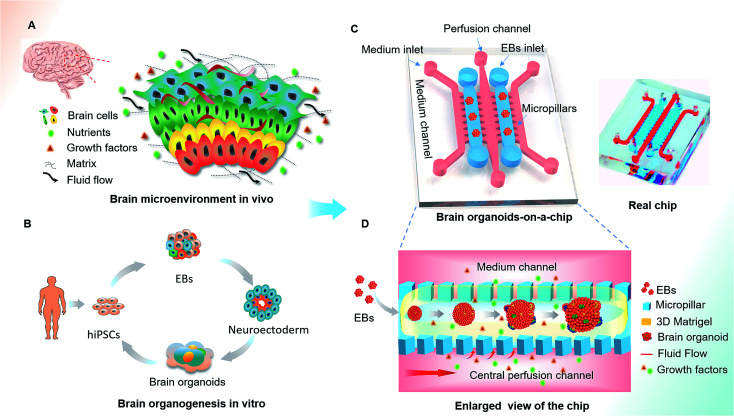
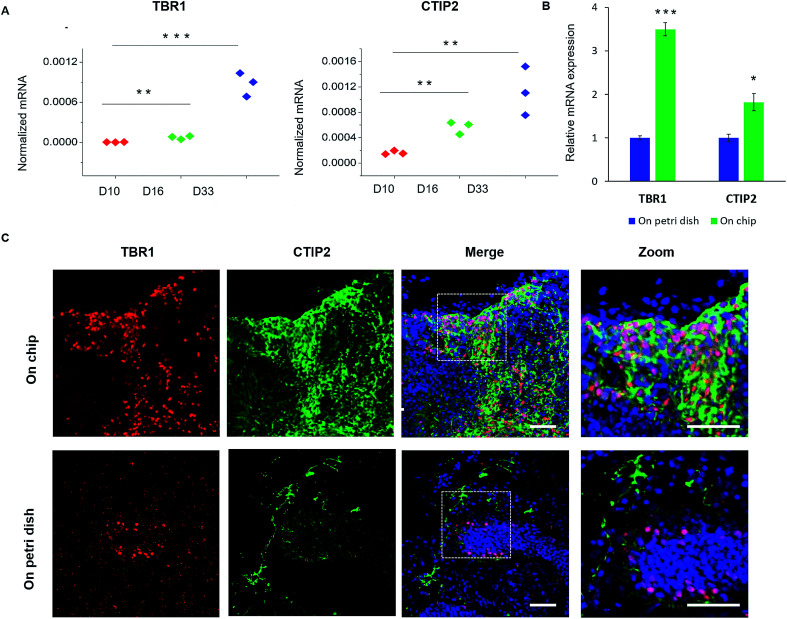
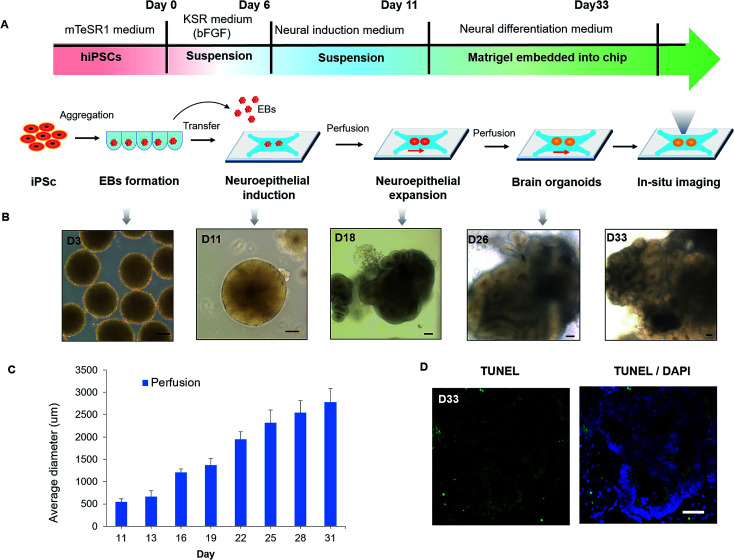
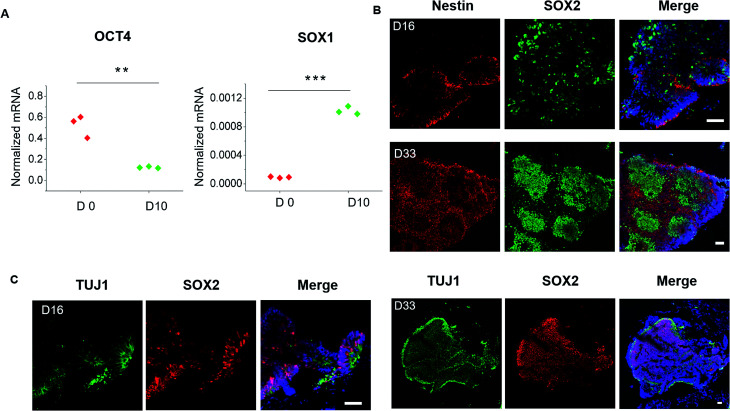
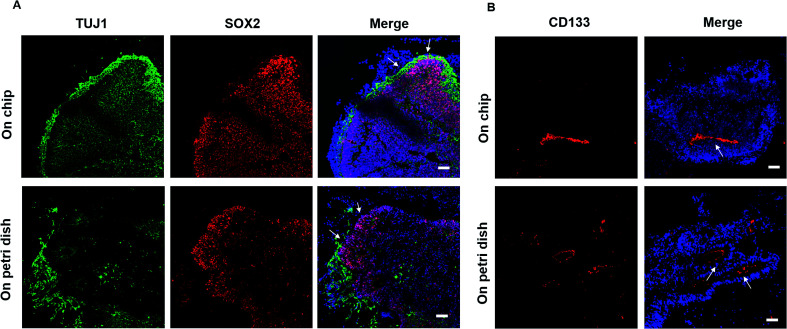
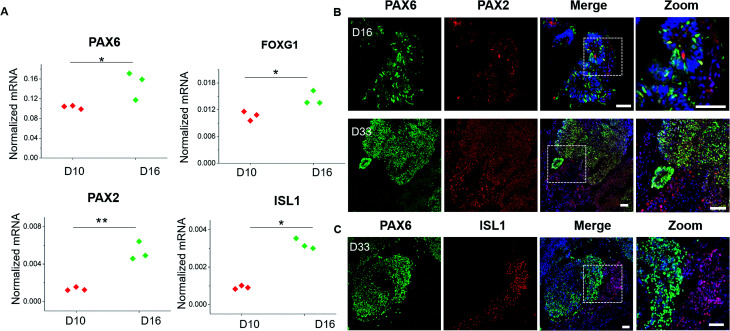
Brain organoids derived from the self-organization of human induced pluripotent stem cells (hiPSCs) represent a new class of organ system for modeling brain development and diseases. However, engineering brain organoids in a biomimetic environment that is favorable for brain development remains challenging. In this work, we present a new strategy to generate hiPSCs-derived 3D brain organoids using an organ-on-a-chip system in a controlled manner. This system provides a biomimetic brain microenvironment by incorporating three-dimensional (3D) Matrigel, fluid flow and multicellular architectures of tissues that allows for extended 3D culture, neural differentiation, and organization of brain organoids on a single device. The generated brain organoids display well-defined neural differentiation, regionalization and cortical organization under perfused culture conditions, which recapitulate the key features of early human brain development. Moreover, the brain organoids exhibit an enhanced expression of cortical layer markers (TBR1 and CTIP2) under perfused cultures as compared to that under static cultures on a Petri dish, indicating the role of mechanical fluid flow in promoting brain organogenesis. The simple and robust brain organoids-on-a-chip system may open new avenues for various stem cell-based organoids engineering and its application in developmental biology and human disease studies.
源自人类诱导多能干细胞(hiPSC)自组织的脑类器官代表了一类用于模拟大脑发育和疾病的新型器官系统。然而,在有利于大脑发育的仿生环境中构建脑类器官仍然具有挑战性。在这项工作中,我们提出了一种新策略,以可控方式使用芯片上器官系统生成源自hiPSC的3D脑类器官。该系统通过整合三维(3D)基质胶、流体流动和组织的多细胞结构来提供仿生脑微环境,从而允许在单个装置上进行扩展的3D培养、神经分化和脑类器官的组织构建。所生成的脑类器官在灌注培养条件下表现出明确的神经分化、区域化和皮质组织构建,概括了早期人类大脑发育的关键特征。此外,与在培养皿上的静态培养相比,脑类器官在灌注培养下表现出皮质层标记物(TBR1和CTIP2)的表达增强,表明机械流体流动在促进脑器官发生中的作用。这种简单且强大的芯片上脑类器官系统可能为各种基于干细胞的类器官工程及其在发育生物学和人类疾病研究中的应用开辟新途径。