Alves Fernanda Moreira, Rangel Diana Azeredo, Vilar Emmanuel Messias, Pavan Márcio Galvão, Moratelli Ricardo, Roque André Luiz Rodrigues, Jansen Ana Maria
Laboratory of Trypanosomatid Biology, Oswaldo Cruz Institute, Oswaldo Cruz Foundation, Rio de Janeiro, Rio de Janeiro, Brazil.
Post-Graduate Program in Parasite Biology, Oswaldo Cruz Institute, Rio de Janeiro, Rio de Janeiro, Brazil.
Int J Parasitol Parasites Wildl. 2021 Sep 10;16:145-152. doi: 10.1016/j.ijppaw.2021.09.003. eCollection 2021 Dec.
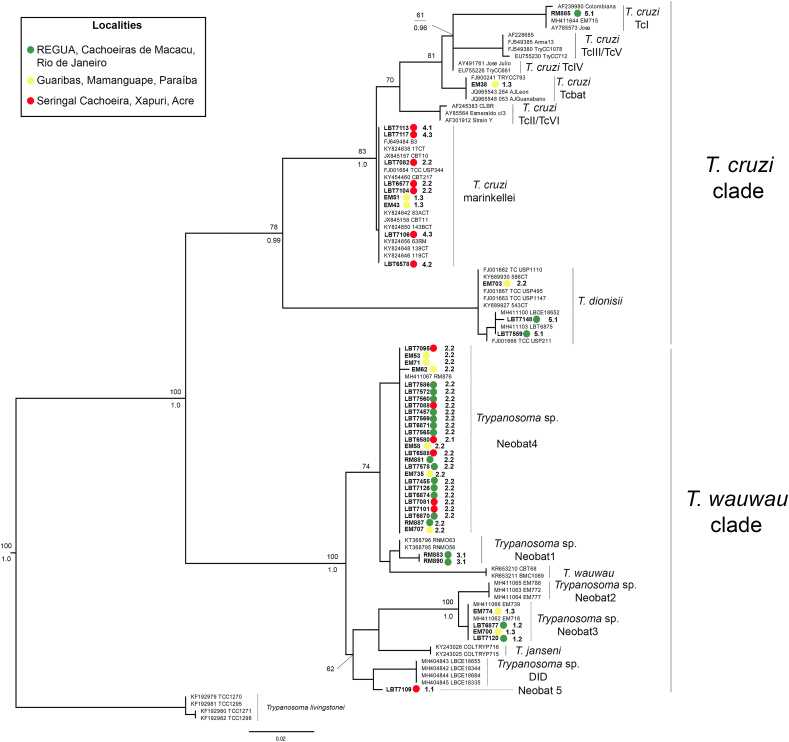
Bats are infected with several trypanosomatid species; however, assessing the diversity of this interaction remains challenging since there are species apparently unable to grow in conventional culture media. Accordingly, the ecology and biology of the Molecular Operational Taxonomic Units (MOTUs) spp. Neobats are unknown. Therefore, we performed the molecular characterization targeting the 18S small subunit rDNA from the blood clot of 280 bats of three Brazilian regions (Paraíba, Rio de Janeiro and Acre states), bypassing the selective pressure of hemoculture. From 68 (24%) positive blood clot samples, we obtained 49 satisfactory sequences. Of these successfully sequenced results, spp. Neobats (1, 3 and 4) represented 67%, with the most abundant . sp. Neobat 4 (53%). Our results show: (1) high abundance and wide geographic range of sp. Neobat 4, restricted to bats; (2) high infection rate of . sp. Neobat 4 in populations (mean 26%); (3) infection with the monoxenous ; and (4) a new MOTU (. sp. Neobat 5) in , positioning in the clade. These data corroborate the importance of bats as hosts of many species and . They also show that the diversity of the clade is underestimated and warn about the high magnitude of trypanosomes we overpass with the hemoculture. Our findings combined with previous data show that spp. Neobats include host-specific and host-generalist species, probably playing different ecological roles: . sp. Neobat 1 shows broad host range; . spp. Neobat 3 and 4 are restricted to and , respectively. Finally, . Neobat 4 seems to be a well-succeeded parasite, especially within metapopulations across a wide geographical distribution. This work is a step forward to understand the biology and life history of spp. Neobats.
蝙蝠感染了多种锥虫物种;然而,评估这种相互作用的多样性仍然具有挑战性,因为有些物种显然无法在传统培养基中生长。因此,新蝙蝠属物种的分子操作分类单元(MOTUs)的生态学和生物学尚不清楚。所以,我们针对来自巴西三个地区(帕拉伊巴州、里约热内卢州和阿克里州)的280只蝙蝠血凝块中的18S小亚基rDNA进行了分子特征分析,绕过了血培养的选择压力。从68个(24%)阳性血凝块样本中,我们获得了49个令人满意的序列。在这些成功测序的结果中,新蝙蝠属物种(1、3和4)占67%,其中最丰富的是新蝙蝠属物种4(53%)。我们的结果表明:(1)新蝙蝠属物种4在蝙蝠中丰度高且地理分布广泛;(2)新蝙蝠属物种4在种群中的感染率高(平均26%);(3)感染单宿主锥虫;(4)在新蝙蝠属中有一个新的MOTU(新蝙蝠属物种5),位于锥虫进化枝中。这些数据证实了蝙蝠作为许多锥虫物种宿主的重要性。它们还表明锥虫进化枝的多样性被低估了,并警示我们血培养会遗漏大量锥虫。我们的发现与先前的数据相结合表明,新蝙蝠属物种包括宿主特异性和宿主泛化性物种,可能发挥不同的生态作用:新蝙蝠属物种1显示出广泛的宿主范围;新蝙蝠属物种3和4分别局限于特定蝙蝠种类。最后,新蝙蝠属物种4似乎是一种非常成功的寄生虫,尤其是在广泛地理分布的复合种群中。这项工作是了解新蝙蝠属物种生物学和生活史的重要一步。