Division of Imaging Sciences and Biomedical Engineering, King's College London, 4th Floor North, Wing, St. Thomas', Hospital, London SE1 7EH, UK.
Department of Cardiology, Guy's and St Thomas' NHS Foundation Trust, UK.
Eur Heart J Cardiovasc Imaging. 2022 Aug 22;23(9):1231-1239. doi: 10.1093/ehjci/jeab188.
Atrial septal defects (ASD) are associated with atrial arrhythmias, but the arrhythmia substrate in these patients is poorly defined. We hypothesized that bi-atrial fibrosis is present and that right atrial fibrosis is associated with atrial arrhythmias in ASD patients. We aimed to evaluate the extent of bi-atrial fibrosis in ASD patients and to investigate the relationships between bi-atrial fibrosis, atrial arrhythmias, shunt fraction, and age.
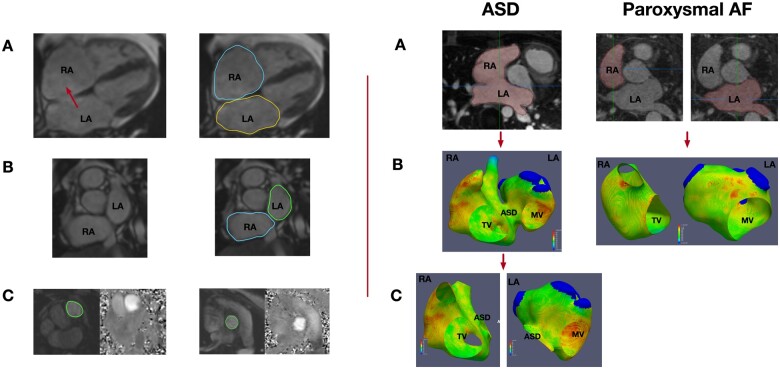
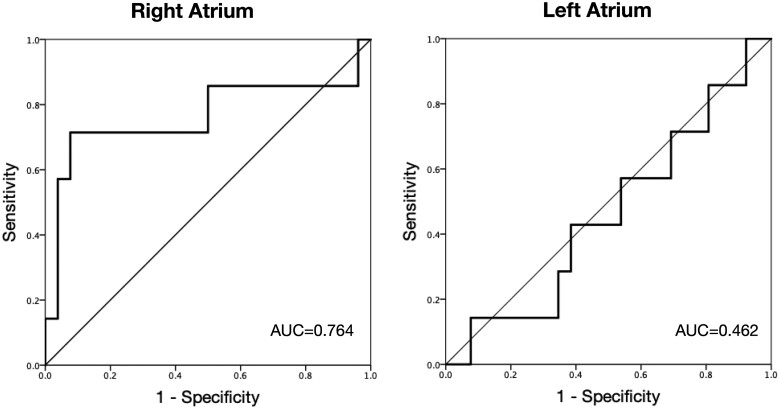
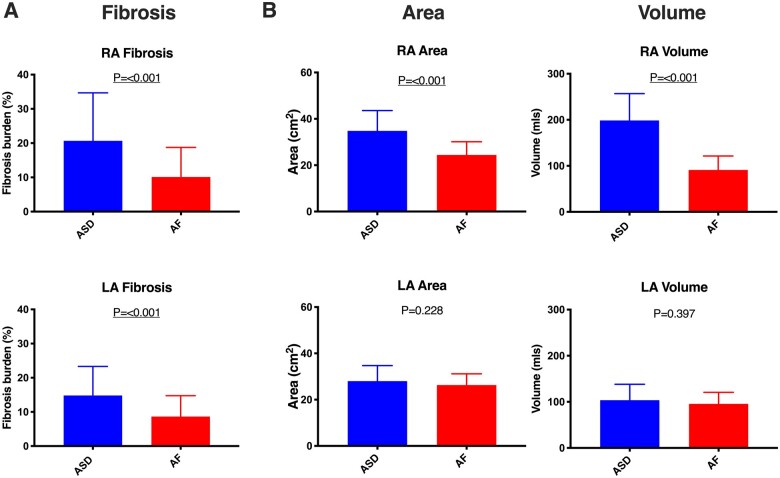
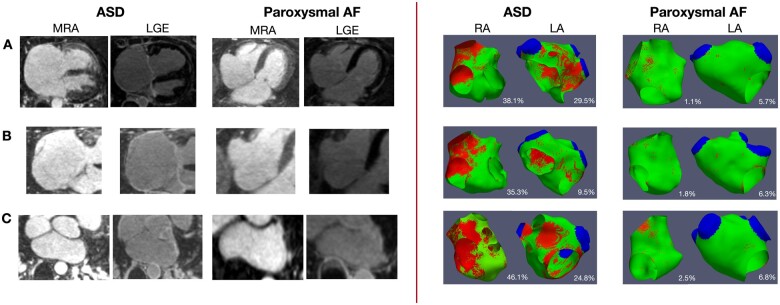
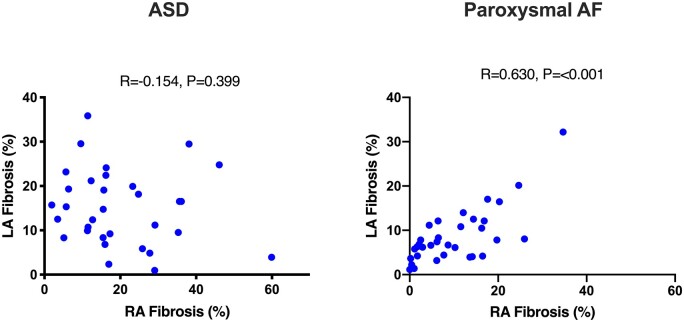
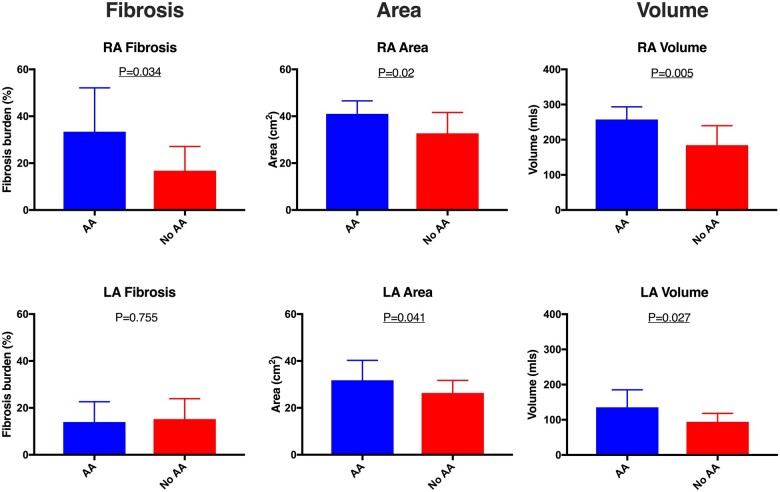
Patients with uncorrected secundum ASDs (n = 36; 50.4 ± 13.6 years) underwent cardiac magnetic resonance imaging with atrial late gadolinium enhancement. Comparison was made to non-congenital heart disease patients (n = 36; 60.3 ± 10.5 years) with paroxysmal atrial fibrillation (AF). Cardiac magnetic resonance parameters associated with atrial arrhythmias were identified and the relationship between bi-atrial structure, age, and shunt fraction studied. Bi-atrial fibrosis burden was greater in ASD patients than paroxysmal AF patients (20.7 ± 14% vs. 10.1 ± 8.6% and 14.8 ± 8.5% vs. 8.6 ± 6.1% for right and left atria respectively, P = 0.001 for both). In ASD patients, right atrial fibrosis burden was greater in those with than without atrial arrhythmias (33.4 ± 18.7% vs. 16.8 ± 10.3%, P = 0.034). On receiver operating characteristic analysis, a right atrial fibrosis burden of 32% had a 92% specificity and 71% sensitivity for predicting the presence of atrial arrhythmias. Neither age nor shunt fraction was associated with bi-atrial fibrosis burden.
Bi-atrial fibrosis burden is greater in ASD patients than non-congenital heart disease patients with paroxysmal AF. Right atrial fibrosis is associated with the presence of atrial arrhythmias in ASD patients. These findings highlight the importance of right atrial fibrosis to atrial arrhythmogenesis in ASD patients.
房间隔缺损(ASD)与房性心律失常相关,但这些患者的心律失常基质定义不佳。我们假设双心房纤维化存在,并且右心房纤维化与 ASD 患者的房性心律失常相关。我们旨在评估 ASD 患者的双心房纤维化程度,并研究双心房纤维化、房性心律失常、分流分数和年龄之间的关系。
未矫正的继发 ASD 患者(n=36;50.4±13.6 岁)接受心脏磁共振成像检查,包括心房晚期钆增强。与阵发性心房颤动(AF)的非先天性心脏病患者(n=36;60.3±10.5 岁)进行比较。确定与心房心律失常相关的心脏磁共振参数,并研究双心房结构、年龄和分流分数之间的关系。ASD 患者的双心房纤维化负担大于阵发性 AF 患者(右心房分别为 20.7±14%比 10.1±8.6%和 14.8±8.5%比 8.6±6.1%,左心房分别为 20.7±14%比 10.1±8.6%和 14.8±8.5%比 8.6±6.1%,P 均=0.001)。在 ASD 患者中,有房性心律失常的患者右心房纤维化负担大于无房性心律失常的患者(33.4±18.7%比 16.8±10.3%,P=0.034)。在受试者工作特征分析中,右心房纤维化负担 32%对预测房性心律失常的存在具有 92%的特异性和 71%的敏感性。年龄和分流分数均与双心房纤维化负担无关。
与阵发性 AF 的非先天性心脏病患者相比,ASD 患者的双心房纤维化负担更大。右心房纤维化与 ASD 患者房性心律失常的发生相关。这些发现强调了右心房纤维化在 ASD 患者心房心律失常发生中的重要性。