• 文献检索
  • 文档翻译
  • 深度研究
  • 学术资讯
  • Suppr Zotero 插件Zotero 插件
  • 邀请有礼
  • 套餐&价格
  • 历史记录
应用&插件
Suppr Zotero 插件Zotero 插件浏览器插件Mac 客户端Windows 客户端微信小程序
定价
高级版会员购买积分包购买API积分包
服务
文献检索文档翻译深度研究API 文档MCP 服务
关于我们
关于 Suppr公司介绍联系我们用户协议隐私条款
关注我们

Suppr 超能文献

核心技术专利:CN118964589B侵权必究
粤ICP备2023148730 号-1Suppr @ 2026

文献检索

告别复杂PubMed语法,用中文像聊天一样搜索,搜遍4000万医学文献。AI智能推荐,让科研检索更轻松。

立即免费搜索

文件翻译

保留排版,准确专业,支持PDF/Word/PPT等文件格式,支持 12+语言互译。

免费翻译文档

深度研究

AI帮你快速写综述,25分钟生成高质量综述,智能提取关键信息,辅助科研写作。

立即免费体验

为了提高 SARS-CoV-2 的检测效果,增强近源污水监测,我们需要构建有关大学校园人群动态的知识体系。

Building knowledge of university campus population dynamics to enhance near-to-source sewage surveillance for SARS-CoV-2 detection.

机构信息

Joint Biosecurity Centre, Department of Health and Social Care, Windsor House, Victoria Street, London SW1H 0TL, United Kingdom; Centre for Water Systems, College of Engineering, Mathematics and Physical Sciences, University of Exeter, Exeter EX4 4QF, United Kingdom.

Centre for Water Systems, College of Engineering, Mathematics and Physical Sciences, University of Exeter, Exeter EX4 4QF, United Kingdom.

出版信息

Sci Total Environ. 2022 Feb 1;806(Pt 1):150406. doi: 10.1016/j.scitotenv.2021.150406. Epub 2021 Sep 20.

DOI:10.1016/j.scitotenv.2021.150406
PMID:34571237
原文链接:https://pmc.ncbi.nlm.nih.gov/articles/PMC8450208/
Abstract

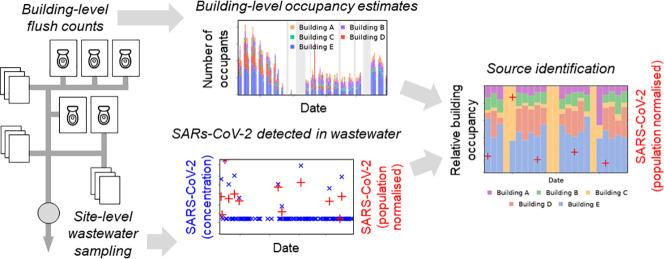
Wastewater surveillance has been widely implemented for monitoring of SARS-CoV-2 during the global COVID-19 pandemic, and near-to-source monitoring is of particular interest for outbreak management in discrete populations. However, variation in population size poses a challenge to the triggering of public health interventions using wastewater SARS-CoV-2 concentrations. This is especially important for near-to-source sites that are subject to significant daily variability in upstream populations. Focusing on a university campus in England, this study investigates methods to account for variation in upstream populations at a site with highly transient footfall and provides a better understanding of the impact of variable populations on the SARS-CoV-2 trends provided by wastewater-based epidemiology. The potential for complementary data to help direct response activities within the near-to-source population is also explored, and potential concerns arising due to the presence of heavily diluted samples during wet weather are addressed. Using wastewater biomarkers, it is demonstrated that population normalisation can reveal significant differences between days where SARS-CoV-2 concentrations are very similar. Confidence in the trends identified is strongest when samples are collected during dry weather periods; however, wet weather samples can still provide valuable information. It is also shown that building-level occupancy estimates based on complementary data aid identification of potential sources of SARS-CoV-2 and can enable targeted actions to be taken to identify and manage potential sources of pathogen transmission in localised communities.

摘要

污水监测在全球 COVID-19 大流行期间已广泛用于监测 SARS-CoV-2,而对于离散人群的暴发管理,近源监测尤其受到关注。然而,人口规模的变化给使用污水 SARS-CoV-2 浓度触发公共卫生干预措施带来了挑战。对于上游人口每天变化很大的近源地点来说,这一点尤为重要。本研究以英国的一个大学校园为重点,调查了在一个流动人口高度瞬态的地点,针对上游人口变化进行核算的方法,并更好地了解了可变人口对基于污水的流行病学提供的 SARS-CoV-2 趋势的影响。还探讨了补充数据帮助指导近源人群内的应对活动的潜力,并解决了在多雨天气下存在严重稀释样本所带来的潜在问题。利用污水生物标志物,研究表明,人口归一化可以揭示在 SARS-CoV-2 浓度非常相似的日子之间的显著差异。当在干燥天气期间采集样本时,所识别趋势的可信度最强;但是,多雨天气的样本仍然可以提供有价值的信息。研究还表明,基于补充数据的建筑物入住率估算有助于确定 SARS-CoV-2 的潜在来源,并能够采取有针对性的行动,以识别和管理局部社区中病原体传播的潜在来源。
https://cdn.ncbi.nlm.nih.gov/pmc/blobs/0045/8450208/7208f20dfe0c/gr8_lrg.jpg
https://cdn.ncbi.nlm.nih.gov/pmc/blobs/0045/8450208/0f2d17e96e74/ga1_lrg.jpg
https://cdn.ncbi.nlm.nih.gov/pmc/blobs/0045/8450208/3b2c09dd54dc/gr1_lrg.jpg
https://cdn.ncbi.nlm.nih.gov/pmc/blobs/0045/8450208/2029457a625a/gr2_lrg.jpg
https://cdn.ncbi.nlm.nih.gov/pmc/blobs/0045/8450208/903d933f18a0/gr3_lrg.jpg
https://cdn.ncbi.nlm.nih.gov/pmc/blobs/0045/8450208/0830cb19cbb1/gr4_lrg.jpg
https://cdn.ncbi.nlm.nih.gov/pmc/blobs/0045/8450208/080b118537cf/gr5_lrg.jpg
https://cdn.ncbi.nlm.nih.gov/pmc/blobs/0045/8450208/01d3bfa7d6bc/gr6_lrg.jpg
https://cdn.ncbi.nlm.nih.gov/pmc/blobs/0045/8450208/46e95056a9ae/gr7_lrg.jpg
https://cdn.ncbi.nlm.nih.gov/pmc/blobs/0045/8450208/7208f20dfe0c/gr8_lrg.jpg
https://cdn.ncbi.nlm.nih.gov/pmc/blobs/0045/8450208/0f2d17e96e74/ga1_lrg.jpg
https://cdn.ncbi.nlm.nih.gov/pmc/blobs/0045/8450208/3b2c09dd54dc/gr1_lrg.jpg
https://cdn.ncbi.nlm.nih.gov/pmc/blobs/0045/8450208/2029457a625a/gr2_lrg.jpg
https://cdn.ncbi.nlm.nih.gov/pmc/blobs/0045/8450208/903d933f18a0/gr3_lrg.jpg
https://cdn.ncbi.nlm.nih.gov/pmc/blobs/0045/8450208/0830cb19cbb1/gr4_lrg.jpg
https://cdn.ncbi.nlm.nih.gov/pmc/blobs/0045/8450208/080b118537cf/gr5_lrg.jpg
https://cdn.ncbi.nlm.nih.gov/pmc/blobs/0045/8450208/01d3bfa7d6bc/gr6_lrg.jpg
https://cdn.ncbi.nlm.nih.gov/pmc/blobs/0045/8450208/46e95056a9ae/gr7_lrg.jpg
https://cdn.ncbi.nlm.nih.gov/pmc/blobs/0045/8450208/7208f20dfe0c/gr8_lrg.jpg

相似文献

1
Building knowledge of university campus population dynamics to enhance near-to-source sewage surveillance for SARS-CoV-2 detection.为了提高 SARS-CoV-2 的检测效果,增强近源污水监测,我们需要构建有关大学校园人群动态的知识体系。
Sci Total Environ. 2022 Feb 1;806(Pt 1):150406. doi: 10.1016/j.scitotenv.2021.150406. Epub 2021 Sep 20.
2
Targeted wastewater surveillance of SARS-CoV-2 on a university campus for COVID-19 outbreak detection and mitigation.针对 SARS-CoV-2 的靶向废水监测,以用于新冠疫情的检测和缓解。
Environ Res. 2021 Sep;200:111374. doi: 10.1016/j.envres.2021.111374. Epub 2021 May 29.
3
A State-of-the-Art Scoping Review on SARS-CoV-2 in Sewage Focusing on the Potential of Wastewater Surveillance for the Monitoring of the COVID-19 Pandemic.关于污水中 SARS-CoV-2 的最新范围界定综述,重点关注利用污水监测新冠疫情的潜力。
Food Environ Virol. 2022 Dec;14(4):315-354. doi: 10.1007/s12560-021-09498-6. Epub 2021 Nov 2.
4
Comparison of high-frequency in-pipe SARS-CoV-2 wastewater-based surveillance to concurrent COVID-19 random clinical testing on a public U.S. university campus.美国一公立大学校园内高频污水 SARS-CoV-2 监测与同期 COVID-19 随机临床检测比较。
Sci Total Environ. 2022 May 10;820:152877. doi: 10.1016/j.scitotenv.2021.152877. Epub 2022 Jan 6.
5
Averting an Outbreak of SARS-CoV-2 in a University Residence Hall through Wastewater Surveillance.通过污水监测避免 SARS-CoV-2 在大学校园宿舍爆发。
Microbiol Spectr. 2021 Oct 31;9(2):e0079221. doi: 10.1128/Spectrum.00792-21. Epub 2021 Oct 6.
6
Monitoring the evolution of SARS-CoV-2 on a Spanish university campus through wastewater analysis: A pilot project for the reopening strategy.通过污水分析监测西班牙大学校园内 SARS-CoV-2 的演变:重新开放策略的试点项目。
Sci Total Environ. 2022 Nov 1;845:157370. doi: 10.1016/j.scitotenv.2022.157370. Epub 2022 Jul 14.
7
Sewage surveillance of SARS-CoV-2 at student campus residences in the Western Cape, South Africa.南非西开普省学生校园宿舍的 SARS-CoV-2 污水监测。
Sci Total Environ. 2022 Dec 10;851(Pt 1):158028. doi: 10.1016/j.scitotenv.2022.158028. Epub 2022 Aug 13.
8
Wastewater Genomic Surveillance Captures Early Detection of Omicron in Utah.废水基因组监测捕捉到奥密克戎在犹他州的早期检测。
Microbiol Spectr. 2023 Jun 15;11(3):e0039123. doi: 10.1128/spectrum.00391-23. Epub 2023 May 8.
9
Implementing an adaptive, two-tiered SARS-CoV-2 wastewater surveillance program on a university campus using passive sampling.在大学校园使用被动采样实施适应性、两级 SARS-CoV-2 废水监测计划。
Sci Total Environ. 2024 Feb 20;912:168998. doi: 10.1016/j.scitotenv.2023.168998. Epub 2023 Nov 29.
10
Whole campus wastewater surveillance of SARS-CoV-2 for COVID-19 outbreak management.针对新冠疫情管理进行校园范围内的新冠病毒废水监测。
Water Sci Technol. 2023 Feb;87(4):910-923. doi: 10.2166/wst.2023.030.

引用本文的文献

1
The influence of environmental factors on the detection and quantification of SARS-CoV-2 variants in dormitory wastewater at a primarily undergraduate institution.环境因素对一所主要为本科院校宿舍废水中SARS-CoV-2变体检测和定量的影响。
Microbiol Spectr. 2025 Feb 4;13(2):e0200324. doi: 10.1128/spectrum.02003-24. Epub 2025 Jan 10.
2
Campus source to sink wastewater surveillance of severe acute respiratory syndrome coronavirus-2 (SARS-CoV-2).校园内严重急性呼吸综合征冠状病毒2型(SARS-CoV-2)的源到汇废水监测
Curr Res Microb Sci. 2024 May 6;6:100240. doi: 10.1016/j.crmicr.2024.100240. eCollection 2024.
3

本文引用的文献

1
Presence of SARS-Coronavirus-2 RNA in Sewage and Correlation with Reported COVID-19 Prevalence in the Early Stage of the Epidemic in The Netherlands.荷兰疫情早期污水中严重急性呼吸综合征冠状病毒2(SARS-CoV-2)RNA的存在及其与报告的COVID-19患病率的相关性
Environ Sci Technol Lett. 2020 May 20;7(7):511-516. doi: 10.1021/acs.estlett.0c00357. eCollection 2020 Jul 14.
2
Understanding and managing uncertainty and variability for wastewater monitoring beyond the pandemic: Lessons learned from the United Kingdom national COVID-19 surveillance programmes.了解和管理大流行后污水监测中的不确定性和变异性:英国国家 COVID-19 监测计划的经验教训。
J Hazard Mater. 2022 Feb 15;424(Pt B):127456. doi: 10.1016/j.jhazmat.2021.127456. Epub 2021 Oct 8.
3
Evaluating various composite sampling modes for detecting pathogenic SARS-CoV-2 virus in raw sewage.
评估用于检测未经处理污水中致病性严重急性呼吸综合征冠状病毒2(SARS-CoV-2)的各种混合采样模式。
Front Microbiol. 2023 Nov 23;14:1305967. doi: 10.3389/fmicb.2023.1305967. eCollection 2023.
4
Long-term monitoring of COVID-19 prevalence in raw and treated wastewater in Salvador, the largest capital of the Brazilian Northeast.巴西东北部最大首府萨尔瓦多的原生污水和处理污水中 COVID-19 流行的长期监测。
Sci Rep. 2023 Sep 14;13(1):15238. doi: 10.1038/s41598-023-41060-1.
5
Structured Ethical Review for Wastewater-Based Testing in Support of Public Health.基于废水的测试的结构化伦理审查,以支持公共卫生。
Environ Sci Technol. 2023 Sep 5;57(35):12969-12980. doi: 10.1021/acs.est.3c04529. Epub 2023 Aug 23.
6
Structured Ethical Review for Wastewater-Based Testing.基于废水检测的结构化伦理审查
medRxiv. 2023 Jun 14:2023.06.12.23291231. doi: 10.1101/2023.06.12.23291231.
7
Wastewater monitoring for detection of public health markers during the COVID-19 pandemic: Near-source monitoring of schools in England over an academic year.新冠疫情期间通过污水监测检测公共卫生标志物:英格兰一学年期间学校的近源监测。
PLoS One. 2023 May 30;18(5):e0286259. doi: 10.1371/journal.pone.0286259. eCollection 2023.
8
A multistate assessment of population normalization factors for wastewater-based epidemiology of COVID-19.基于污水的 COVID-19 流行病学的人群标准化因子的多州评估。
PLoS One. 2023 Apr 12;18(4):e0284370. doi: 10.1371/journal.pone.0284370. eCollection 2023.
9
The Inhibition and Variability of Two Different RT-qPCR Assays Used for Quantifying SARS-CoV-2 RNA in Wastewater.两种不同 RT-qPCR assays 用于定量污水中 SARS-CoV-2 RNA 的抑制和变异性。
Food Environ Virol. 2023 Mar;15(1):71-81. doi: 10.1007/s12560-022-09542-z. Epub 2023 Feb 15.
10
Normalisation of SARS-CoV-2 concentrations in wastewater: The use of flow, electrical conductivity and crAssphage.污水中 SARS-CoV-2 浓度的归一化:流量、电导率和 crAssphage 的使用。
Sci Total Environ. 2023 Mar 20;865:161196. doi: 10.1016/j.scitotenv.2022.161196. Epub 2022 Dec 26.
Technical framework for wastewater-based epidemiology of SARS-CoV-2.基于污水的 SARS-CoV-2 流行病学技术框架。
Sci Total Environ. 2021 Oct 15;791:148271. doi: 10.1016/j.scitotenv.2021.148271. Epub 2021 Jun 12.
4
Implementing building-level SARS-CoV-2 wastewater surveillance on a university campus.在大学校园内实施建筑层面 SARS-CoV-2 污水监测。
Sci Total Environ. 2021 Aug 15;782:146749. doi: 10.1016/j.scitotenv.2021.146749. Epub 2021 Mar 30.
5
Concentration and Quantification of SARS-CoV-2 RNA in Wastewater Using Polyethylene Glycol-Based Concentration and qRT-PCR.使用基于聚乙二醇的浓缩方法和定量逆转录聚合酶链反应对废水中的严重急性呼吸综合征冠状病毒2(SARS-CoV-2)RNA进行浓缩和定量
Methods Protoc. 2021 Feb 23;4(1):17. doi: 10.3390/mps4010017.
6
High-Throughput Wastewater SARS-CoV-2 Detection Enables Forecasting of Community Infection Dynamics in San Diego County.高通量废水严重急性呼吸综合征冠状病毒2检测可预测圣地亚哥县的社区感染动态。
mSystems. 2021 Mar 2;6(2):e00045-21. doi: 10.1128/mSystems.00045-21.
7
Uncertainties in estimating SARS-CoV-2 prevalence by wastewater-based epidemiology.基于废水的流行病学方法在估算新冠病毒流行率方面的不确定性。
Chem Eng J. 2021 Jul 1;415:129039. doi: 10.1016/j.cej.2021.129039. Epub 2021 Feb 20.
8
COVID-19 (SARS-CoV-2) outbreak monitoring using wastewater-based epidemiology in Qatar.利用基于污水的流行病学在卡塔尔监测 COVID-19(SARS-CoV-2)疫情。
Sci Total Environ. 2021 Jun 20;774:145608. doi: 10.1016/j.scitotenv.2021.145608. Epub 2021 Feb 9.
9
Wastewater-based epidemiology as a useful tool to track SARS-CoV-2 and support public health policies at municipal level in Brazil.基于污水的流行病学作为一种有用的工具,可用于追踪 SARS-CoV-2 病毒,并为巴西市级公共卫生政策提供支持。
Water Res. 2021 Mar 1;191:116810. doi: 10.1016/j.watres.2021.116810. Epub 2021 Jan 5.
10
Making waves: Wastewater-based epidemiology for COVID-19 - approaches and challenges for surveillance and prediction.掀起波澜:基于污水的 COVID-19 流行病学——监测和预测的方法和挑战。
Water Res. 2020 Nov 1;186:116404. doi: 10.1016/j.watres.2020.116404. Epub 2020 Sep 9.