Laboratory of Ischemic and Neurodegenerative Brain Research, Mossakowski Medical Research Institute, Polish Academy of Sciences, 5 Str. Pawińskiego, 02-106 Warsaw, Poland.
Department of Pathophysiology, Medical University of Lublin, 8b Str. Jaczewskiego, 20-090 Lublin, Poland.
Cells. 2021 Aug 27;10(9):2213. doi: 10.3390/cells10092213.
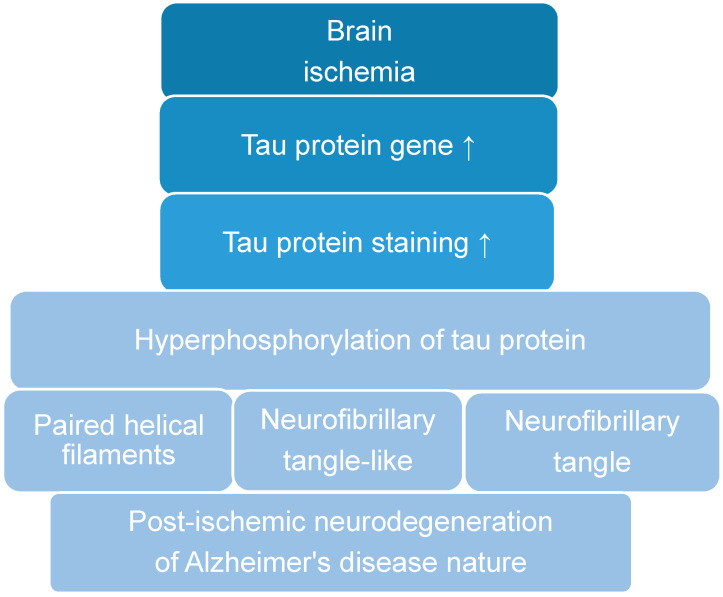
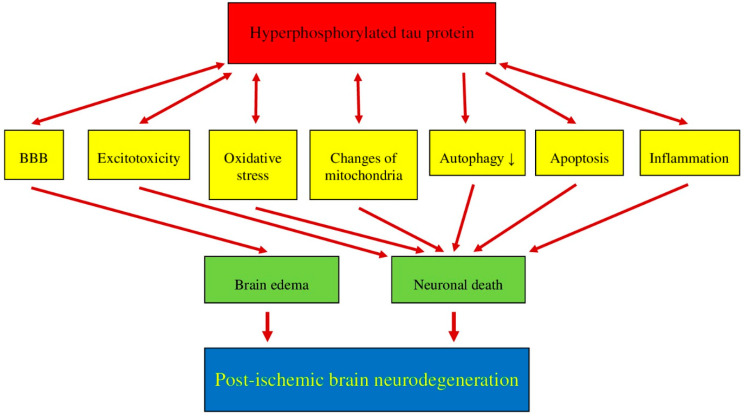
Recent data suggest that post-ischemic brain neurodegeneration in humans and animals is associated with the modified tau protein in a manner typical of Alzheimer's disease neuropathology. Pathological changes in the tau protein, at the gene and protein level due to cerebral ischemia, can lead to the development of Alzheimer's disease-type neuropathology and dementia. Some studies have shown increased tau protein staining and gene expression in neurons following ischemia-reperfusion brain injury. Recent studies have found the tau protein to be associated with oxidative stress, apoptosis, autophagy, excitotoxicity, neuroinflammation, blood-brain barrier permeability, mitochondrial dysfunction, and impaired neuronal function. In this review, we discuss the interrelationship of these phenomena with post-ischemic changes in the tau protein in the brain. The tau protein may be at the intersection of many pathological mechanisms due to severe neuropathological changes in the brain following ischemia. The data indicate that an episode of cerebral ischemia activates the damage and death of neurons in the hippocampus in a tau protein-dependent manner, thus determining a novel and important mechanism for the survival and/or death of neuronal cells following ischemia. In this review, we update our understanding of proteomic and genomic changes in the tau protein in post-ischemic brain injury and present the relationship between the modified tau protein and post-ischemic neuropathology and present a positive correlation between the modified tau protein and a post-ischemic neuropathology that has characteristics of Alzheimer's disease-type neurodegeneration.
最近的数据表明,人类和动物的缺血性脑神经退行性变与修饰后的 tau 蛋白有关,其方式类似于阿尔茨海默病的神经病理学。由于脑缺血,tau 蛋白在基因和蛋白质水平上的病理性改变,可导致阿尔茨海默病型神经病理学和痴呆的发生。一些研究表明,在缺血再灌注脑损伤后,神经元中的 tau 蛋白染色和基因表达增加。最近的研究发现,tau 蛋白与氧化应激、细胞凋亡、自噬、兴奋毒性、神经炎症、血脑屏障通透性、线粒体功能障碍和神经元功能障碍有关。在这篇综述中,我们讨论了这些现象与脑内缺血后 tau 蛋白变化的相互关系。由于脑缺血后严重的神经病理学变化,tau 蛋白可能处于许多病理机制的交汇点。数据表明,脑缺血后的单个事件以 tau 蛋白依赖的方式激活海马神经元的损伤和死亡,从而确定了缺血后神经元细胞存活和/或死亡的新的重要机制。在这篇综述中,我们更新了对缺血性脑损伤后 tau 蛋白的蛋白质组学和基因组学变化的理解,并提出了修饰后的 tau 蛋白与缺血后神经病理学之间的关系,并提出了修饰后的 tau 蛋白与具有阿尔茨海默病型神经退行性变特征的缺血后神经病理学之间的正相关关系。