Department of Biology, University of Texas Rio Grande Valley, Edinburg, TX 78539, USA.
School of Biological Sciences, Nanyang Technological University, 60 Nanyang Drive, Singapore 637551, Singapore.
Cells. 2021 Aug 27;10(9):2219. doi: 10.3390/cells10092219.
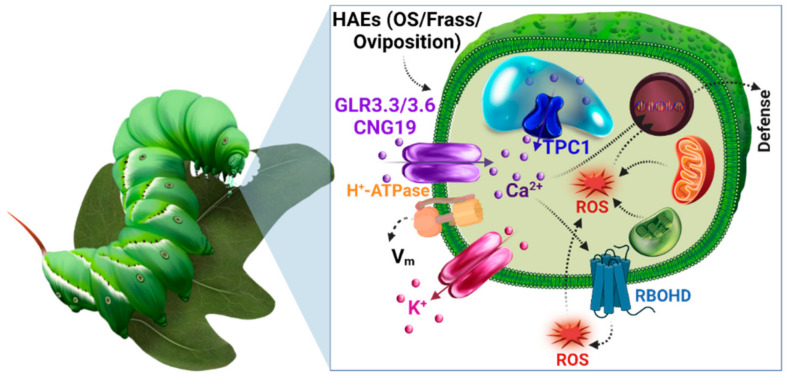
Plants and insect herbivores are in a relentless battle to outwit each other. Plants have evolved various strategies to detect herbivores and mount an effective defense system against them. These defenses include physical and structural barriers such as spines, trichomes, cuticle, or chemical compounds, including secondary metabolites such as phenolics and terpenes. Plants perceive herbivory by both mechanical and chemical means. Mechanical sensing can occur through the perception of insect biting, piercing, or chewing, while chemical signaling occurs through the perception of various herbivore-derived compounds such as oral secretions (OS) or regurgitant, insect excreta (frass), or oviposition fluids. Interestingly, ion channels or transporters are the first responders for the perception of these mechanical and chemical cues. These transmembrane pore proteins can play an important role in plant defense through the induction of early signaling components such as plasma transmembrane potential (V) fluctuation, intracellular calcium (Ca), and reactive oxygen species (ROS) generation, followed by defense gene expression, and, ultimately, plant defense responses. In recent years, studies on early plant defense signaling in response to herbivory have been gaining momentum with the application of genetically encoded GFP-based sensors for real-time monitoring of early signaling events and genetic tools to manipulate ion channels involved in plant-herbivore interactions. In this review, we provide an update on recent developments and advances on early signaling events in plant-herbivore interactions, with an emphasis on the role of ion channels in early plant defense signaling.
植物和昆虫食草动物之间是一场永无休止的智斗。植物进化出了各种策略来检测食草动物,并建立有效的防御系统来抵御它们。这些防御措施包括物理和结构屏障,如刺、毛状体、表皮或化学化合物,包括酚类和萜类等次生代谢物。植物通过机械和化学手段感知食草动物的侵害。机械感应可以通过感知昆虫的叮咬、刺穿或咀嚼来实现,而化学信号则通过感知各种源自食草动物的化合物来实现,如口部分泌物(OS)或排遗物、昆虫粪便或产卵液。有趣的是,离子通道或转运蛋白是感知这些机械和化学线索的第一反应者。这些跨膜孔蛋白可以通过诱导早期信号成分(如质膜电位(V)波动、细胞内钙(Ca)和活性氧物种(ROS)的产生),从而在植物防御中发挥重要作用,随后是防御基因的表达,最终导致植物防御反应。近年来,随着基于 GFP 的遗传编码传感器在实时监测早期信号事件以及遗传工具在操纵参与植物-食草动物相互作用的离子通道方面的应用,研究植物对食草动物侵害的早期防御信号的研究取得了进展。在这篇综述中,我们提供了植物-食草动物相互作用中早期信号事件的最新进展和进展情况的更新,重点介绍了离子通道在早期植物防御信号中的作用。