Institute of Biomedical Problems, Russian Academy of Sciences, Khoroshevskoye Shosse 76a, 123007 Moscow, Russia.
Cells. 2021 Aug 27;10(9):2226. doi: 10.3390/cells10092226.
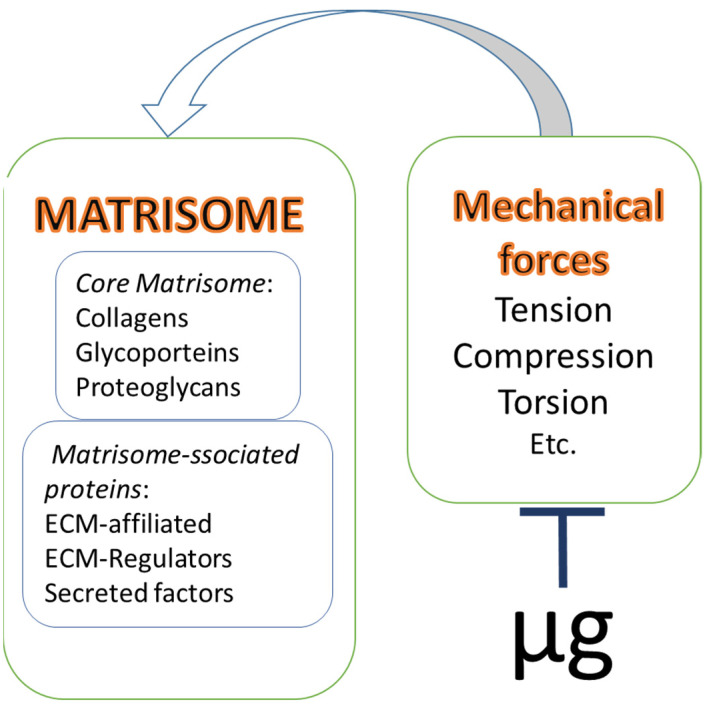
Gravity is fundamental factor determining all processes of development and vital activity on Earth. During evolution, a complex mechanism of response to gravity alterations was formed in multicellular organisms. It includes the "gravisensors" in extracellular and intracellular spaces. Inside the cells, the cytoskeleton molecules are the principal gravity-sensitive structures, and outside the cells these are extracellular matrix (ECM) components. The cooperation between the intracellular and extracellular compartments is implemented through specialized protein structures, integrins. The gravity-sensitive complex is a kind of molecular hub that coordinates the functions of various tissues and organs in the gravitational environment. The functioning of this system is of particular importance under extremal conditions, such as spaceflight microgravity. This review covers the current understanding of ECM and associated molecules as the matrisome, the features of the above components in connective tissues, and the role of the latter in the cell and tissue responses to the gravity alterations. Special attention is paid to contemporary methodological approaches to the matrisome composition analysis under real space flights and ground-based simulation of its effects on Earth.
重力是决定地球上所有发展过程和生命活动的基本因素。在进化过程中,多细胞生物形成了一种复杂的应对重力变化的反应机制。它包括细胞外和细胞内空间中的“重传感器”。在细胞内,细胞骨架分子是主要的重力敏感结构,而在细胞外,这些是细胞外基质(ECM)成分。细胞内和细胞外隔室之间的合作是通过专门的蛋白质结构整合素来实现的。重力敏感复合物是一种分子枢纽,协调着在重力环境下各种组织和器官的功能。在极端条件下,如太空飞行微重力,该系统的功能尤为重要。本综述涵盖了对细胞外基质和相关分子作为基质组的当前理解,以及上述连接组织成分的特征,以及它们在细胞和组织对重力变化的反应中的作用。特别关注在真实空间飞行和地面模拟条件下对基质组组成分析的现代方法学方法及其对地球的影响。