Department of Drug Sciences, Pharmacology Section, University of Pavia, Viale Taramelli 14, 27100 Pavia, Italy.
Cells. 2021 Sep 12;10(9):2394. doi: 10.3390/cells10092394.
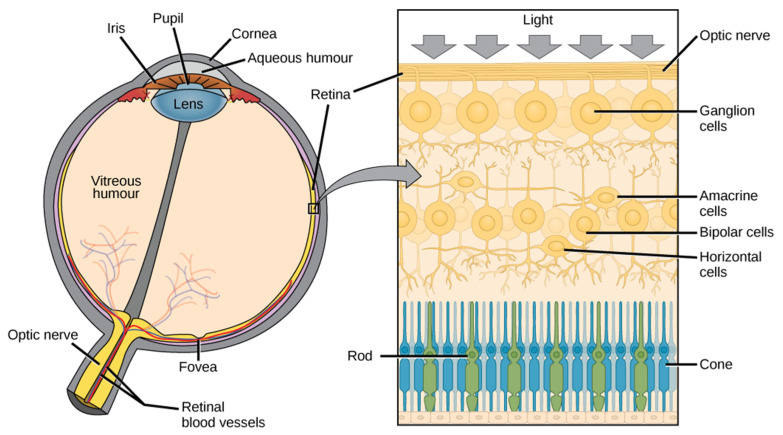
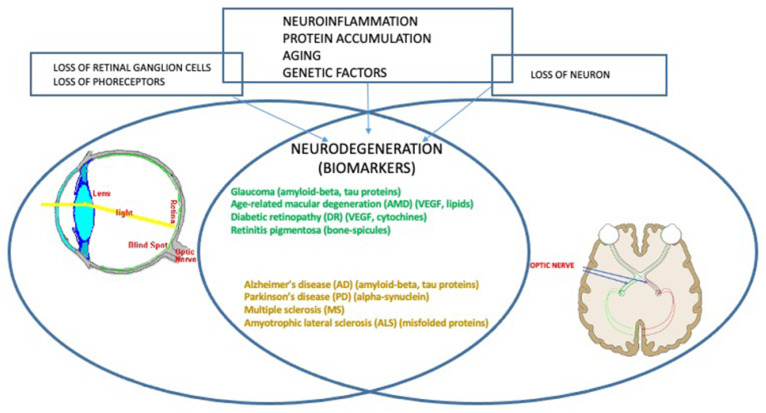
The possible interconnection between the eye and central nervous system (CNS) has been a topic of discussion for several years just based on fact that the eye is properly considered an extension of the brain. Both organs consist of neurons and derived from a neural tube. The visual process involves photoreceptors that receive light stimulus from the external environment and send it to retinal ganglionic cells (RGC), one of the cell types of which the retina is composed. The retina, the internal visual membrane of the eye, processes the visual stimuli in electric stimuli to transfer it to the brain, through the optic nerve. Retinal chronic progressive neurodegeneration, which may occur among the elderly, can lead to different disorders of the eye such as glaucoma, age-related macular degeneration (AMD), and diabetic retinopathy (DR). Mainly in the elderly population, but also among younger people, such ocular pathologies are the cause of irreversible blindness or impaired, reduced vision. Typical neurodegenerative diseases of the CSN are a group of pathologies with common characteristics and etiology not fully understood; some risk factors have been identified, but they are not enough to justify all the cases observed. Furthermore, several studies have shown that also ocular disorders present characteristics of neurodegenerative diseases and, on the other hand, CNS pathologies, i.e., Alzheimer disease (AD) and Parkinson disease (PD), which are causes of morbidity and mortality worldwide, show peculiar alterations at the ocular level. The knowledge of possible correlations could help to understand the mechanisms of onset. Moreover, the underlying mechanisms of these heterogeneous disorders are still debated. This review discusses the characteristics of the ocular illnesses, focusing on the relationship between the eye and the brain. A better comprehension could help in future new therapies, thus reducing or avoiding loss of vision and improve quality of life.
眼睛与中枢神经系统(CNS)之间可能存在联系,这一观点已经讨论了好几年,其依据仅仅是眼睛被认为是大脑的延伸。这两个器官都由神经元组成,并且都来源于神经管。视觉过程涉及到光感受器,光感受器从外部环境接收光刺激,并将其发送到视网膜神经节细胞(RGC),视网膜是由 RGC 等细胞类型组成的。视网膜是眼睛的内部视觉膜,它将视觉刺激处理为电刺激,通过视神经将其传输到大脑。视网膜的慢性进行性神经退行性变,可能发生在老年人中,可导致眼部出现不同的疾病,如青光眼、年龄相关性黄斑变性(AMD)和糖尿病性视网膜病变(DR)。这些眼部疾病主要发生在老年人群中,但也发生在年轻人中,是导致不可逆转的失明或视力受损、降低的原因。中枢神经系统的典型神经退行性疾病是一组具有共同特征和病因不完全清楚的疾病;已经确定了一些危险因素,但这些危险因素不足以解释所有观察到的病例。此外,几项研究表明,眼部疾病也具有神经退行性疾病的特征,另一方面,中枢神经系统疾病,即阿尔茨海默病(AD)和帕金森病(PD),这两种疾病是全球发病率和死亡率的原因,在眼部水平表现出特殊的改变。了解可能存在的相关性有助于理解发病机制。此外,这些异质性疾病的潜在机制仍存在争议。本文讨论了眼部疾病的特征,重点讨论了眼睛与大脑之间的关系。更好地理解这一关系有助于未来开发新的治疗方法,从而减少或避免视力丧失,并提高生活质量。