Ramirez Ana I, de Hoz Rosa, Salobrar-Garcia Elena, Salazar Juan J, Rojas Blanca, Ajoy Daniel, López-Cuenca Inés, Rojas Pilar, Triviño Alberto, Ramírez José M
Instituto de Investigaciones Oftalmológicas Ramón Castroviejo. Universidad Complutense de MadridMadrid, Spain.
Departamento de Oftalmología y ORL, Facultad de Óptica y Optometría, Universidad Complutense de Madrid (UCM)Madrid, Spain.
Front Aging Neurosci. 2017 Jul 6;9:214. doi: 10.3389/fnagi.2017.00214. eCollection 2017.
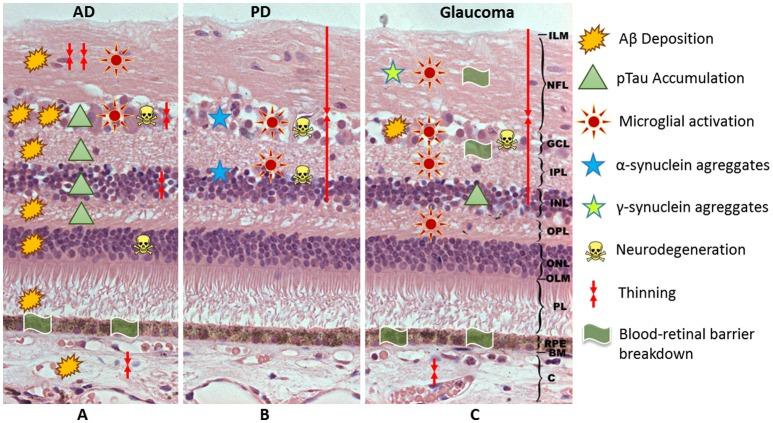
Microglia, the immunocompetent cells of the central nervous system (CNS), act as neuropathology sensors and are neuroprotective under physiological conditions. Microglia react to injury and degeneration with immune-phenotypic and morphological changes, proliferation, migration, and inflammatory cytokine production. An uncontrolled microglial response secondary to sustained CNS damage can put neuronal survival at risk due to excessive inflammation. A neuroinflammatory response is considered among the etiological factors of the major aged-related neurodegenerative diseases of the CNS, and microglial cells are key players in these neurodegenerative lesions. The retina is an extension of the brain and therefore the inflammatory response in the brain can occur in the retina. The brain and retina are affected in several neurodegenerative diseases, including Alzheimer's disease (AD), Parkinson's disease (PD), and glaucoma. AD is an age-related neurodegeneration of the CNS characterized by neuronal and synaptic loss in the cerebral cortex, resulting in cognitive deficit and dementia. The extracellular deposits of beta-amyloid (Aβ) and intraneuronal accumulations of hyperphosphorylated tau protein (pTau) are the hallmarks of this disease. These deposits are also found in the retina and optic nerve. PD is a neurodegenerative locomotor disorder with the progressive loss of dopaminergic neurons in the substantia nigra. This is accompanied by Lewy body inclusion composed of α-synuclein (α-syn) aggregates. PD also involves retinal dopaminergic cell degeneration. Glaucoma is a multifactorial neurodegenerative disease of the optic nerve, characterized by retinal ganglion cell loss. In this pathology, deposition of Aβ, synuclein, and pTau has also been detected in retina. These neurodegenerative diseases share a common pathogenic mechanism, the neuroinflammation, in which microglia play an important role. Microglial activation has been reported in AD, PD, and glaucoma in relation to protein aggregates and degenerated neurons. The activated microglia can release pro-inflammatory cytokines which can aggravate and propagate neuroinflammation, thereby degenerating neurons and impairing brain as well as retinal function. The aim of the present review is to describe the contribution in retina to microglial-mediated neuroinflammation in AD, PD, and glaucomatous neurodegeneration.
Front Aging Neurosci. 2017-7-6
Eur J Med Chem. 2019-3-8
Balkan Med J. 2022-9-9
Acta Neuropathol Commun. 2020-12-3
J Neuroinflammation. 2022-6-6
Graefes Arch Clin Exp Ophthalmol. 2025-9-1
Mar Drugs. 2025-7-31
Inflammopharmacology. 2025-4-21
Neurol Clin Pract. 2015-10
Am J Pathol. 2017-7
J Neuropathol Exp Neurol. 2017-5-1
Exp Eye Res. 2017-4
Biomol Concepts. 2017-3-1
Curr Alzheimer Res. 2017-2-20
Invest Ophthalmol Vis Sci. 2017-2-1
Nature. 2017-1-26
Surv Ophthalmol. 2017

 Zotero 插件