González-Sala Francisco, Gómez-Marí Irene, Tárraga-Mínguez Raúl, Vicente-Carvajal Alba, Pastor-Cerezuela Gemma
Department of Developmental and Educational Psychology, University of Valencia, 46010 València, Spain.
Department of Education and School Management, University of Valencia, 46010 València, Spain.
Children (Basel). 2021 Sep 12;8(9):801. doi: 10.3390/children8090801.
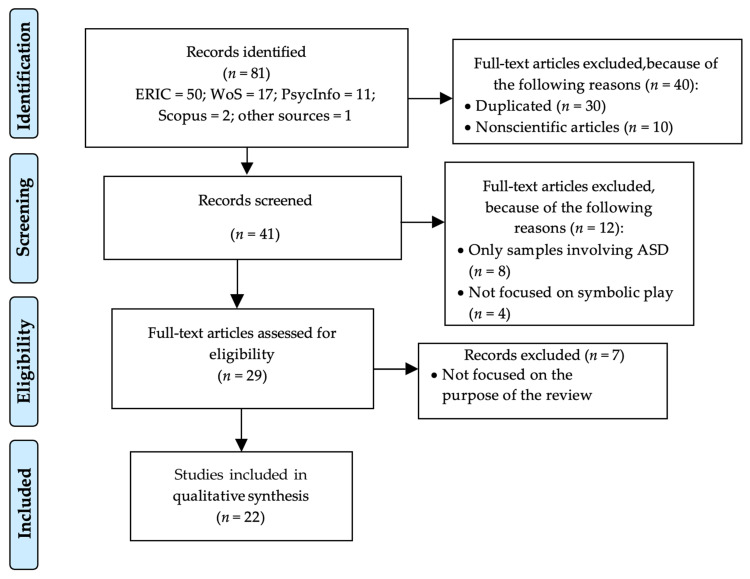
Symbolic play is considered an early indicator in the diagnosis of autism spectrum disorder (ASD) and its assessment. The objective of this study was to analyze the difficulties in symbolic play experienced by children with ASD and to determine the existence of differences in symbolic play among children with ASD, children with other neurodevelopmental disorders and children with typical development. A scoping review was carried out in the Web of Science (WoS), Scopus, ERIC, and PsycInfo databases, following the extension for scoping reviews of the Preferred Reporting Items for Systematic Reviews and Meta-Analyses (PRISMA) statement. The number of papers included in the review was 22. The results confirm that children with ASD have greater difficulties with symbolic play than children with other neurodevelopmental disorders and children with typical development, even when controlling for their verbal age. Difficulties are greater in situations of free or spontaneous play. Results evidenced that the absence or deficiency in the symbolic play can serve as an early indicator of ASD between the first and second year of life, the developmental moment in which this type of play begins.
象征性游戏被认为是自闭症谱系障碍(ASD)诊断及其评估的早期指标。本研究的目的是分析自闭症谱系障碍儿童在象征性游戏中遇到的困难,并确定自闭症谱系障碍儿童、其他神经发育障碍儿童和发育正常儿童在象征性游戏方面是否存在差异。按照系统评价与Meta分析的首选报告项目(PRISMA)声明的范围综述扩展版,在科学网(WoS)、Scopus、教育资源信息中心(ERIC)和心理学文摘数据库(PsycInfo)中进行了一项范围综述。纳入综述的论文数量为22篇。结果证实,即使在控制了语言年龄的情况下,自闭症谱系障碍儿童在象征性游戏方面比其他神经发育障碍儿童和发育正常儿童有更大的困难。在自由或自发游戏的情况下困难更大。结果表明,象征性游戏的缺失或不足可作为生命第一年至第二年(这种游戏开始的发育阶段)自闭症谱系障碍的早期指标。