Thompson Andrew N, Bowen Elise, Keiller John, Pegler Don, Kearney Gavin, Rosales-Nieto Cesar A
Centre for Animal Production and Health, Murdoch University, Murdoch, WA 6150, Australia.
Cashmore Park, 114 Wilmots Road, Cashmore, VIC 3305, Australia.
Animals (Basel). 2021 Sep 18;11(9):2733. doi: 10.3390/ani11092733.
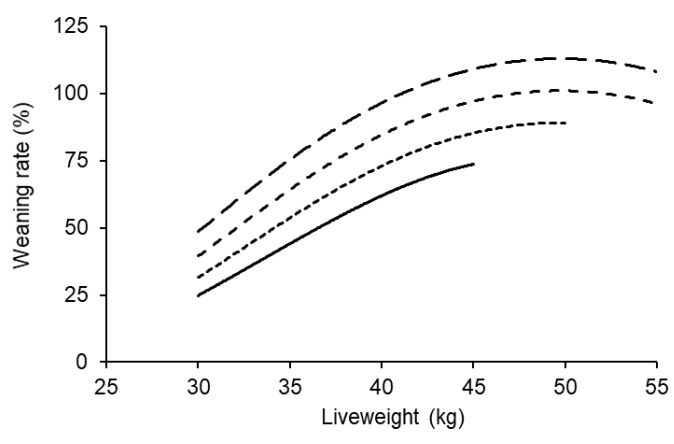
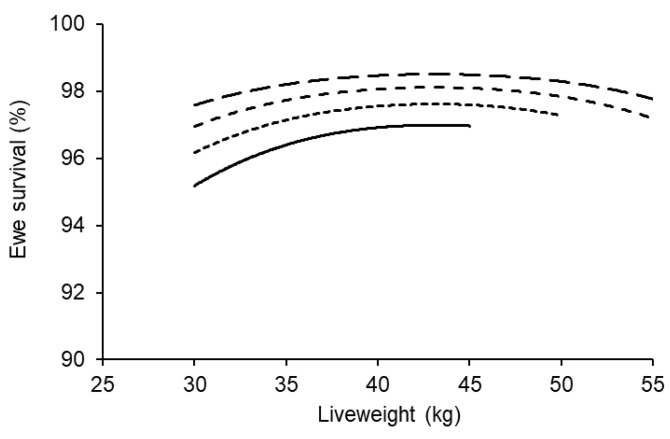
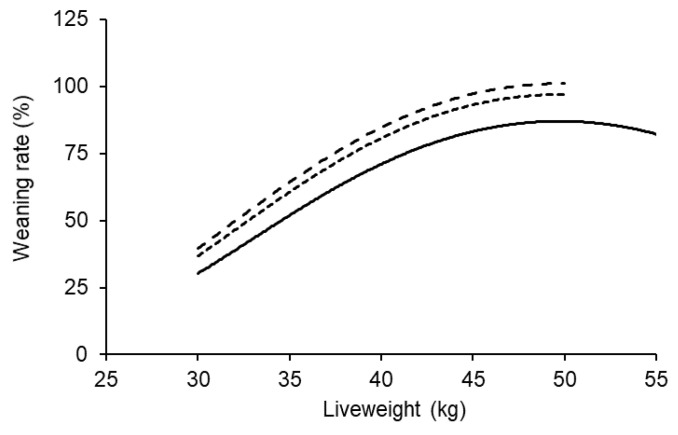
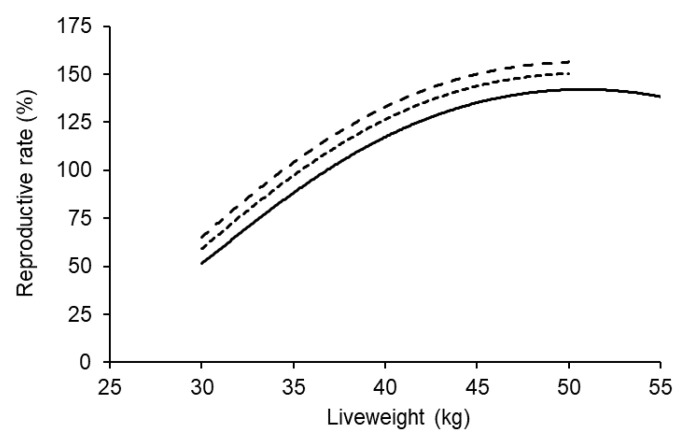
In this paper, we tested the hypothesis that ewe lambs that are heavier and older at breeding will wean more offspring, due to increased reproductive rate and offspring survival and lower maternal mortality. To test this hypothesis, we analyzed data from more than 11,500 maternal composite ewe lambs collected over eight years. The ewe lambs had full pedigree records including birth type, age and liveweight at breeding plus records of the birthweight and survival of their offspring and the dam. The average liveweight and age at breeding was 40.2 kg and 228 days. The reproductive rate and weaning rate responses to liveweight at breeding were curvilinear ( < 0.001), and if ewe lambs achieved 45 kg by the start of breeding, their reproductive rate and weaning rate were within 5% of their maximum. By contrast, the effects of age at breeding on weaning rate was linear and increased by 0.4% per day, despite a quadratic ( < 0.01) effect of age at breeding on reproductive rate which increased only marginally when ewe lambs were older than 8 months at breeding. Increasing liveweight ( < 0.05) or age ( < 0.001) at breeding increased survival of their offspring, however an extra 10 kg of liveweight or 30 days of age at breeding increased offspring survival by less than 5%. Both liveweight ( < 0.001) and age ( < 0.01) at breeding also influenced survival of the ewe lamb dam but survival rates exceeded 95% across the range in liveweights from 30 to 55 kg and ages from 6 to 9 months. This understanding of the trade-off between age and liveweight at breeding will assist farmers to optimize the management of their ewe lambs, given the earlier they can be bred successfully the easier they can be integrated with the breeding of the adult ewe flock the following year.
在本文中,我们检验了这样一个假设:繁殖时体重更重、年龄更大的母羊羔会断奶更多后代,这是由于繁殖率提高、后代存活率增加以及母羊死亡率降低。为了验证这一假设,我们分析了八年间收集的超过11500只母羊杂交羊羔的数据。这些母羊羔有完整的系谱记录,包括出生类型、繁殖时的年龄和体重,以及它们后代和母羊的出生体重和存活情况记录。繁殖时的平均体重和年龄分别为40.2千克和228天。繁殖时体重对繁殖率和断奶率的反应呈曲线关系(<0.001),如果母羊羔在繁殖开始时达到45千克,其繁殖率和断奶率将在最大值的5%以内。相比之下,繁殖时年龄对断奶率的影响是线性的,每天增加0.4%,尽管繁殖时年龄对繁殖率有二次效应(<0.01),但当母羊羔在繁殖时超过8个月大时,繁殖率仅略有增加。繁殖时体重增加(<0.05)或年龄增加(<0.001)会提高其后代的存活率,然而繁殖时体重额外增加10千克或年龄增加30天,后代存活率的提高不到5%。繁殖时的体重(<0.001)和年龄(<0.01)也会影响母羊羔的存活情况,但在体重从30千克到55千克、年龄从6个月到9个月的范围内,存活率超过95%。鉴于母羊羔越早成功繁殖,就越容易与次年成年母羊群的繁殖整合,对繁殖时年龄和体重之间权衡的这种理解将有助于农民优化对母羊羔的管理。