Chen Wei-Cheng, Lin Meng-Hsuan, Chen Chieh-Lung, Lai Yi-Ching, Chen Chih-Yu, Lin Yu-Chao, Hung Chin-Chuan
Graduate Institute of Biomedical Sciences, China Medical University, 91 Hsueh-Shih Road, Taichung 404333, Taiwan.
Division of Pulmonary and Critical Care Medicine, Department of Internal Medicine, China Medical University Hospital, 2 Yude Road, North Dist., Taichung 404332, Taiwan.
J Clin Med. 2021 Sep 13;10(18):4120. doi: 10.3390/jcm10184120.
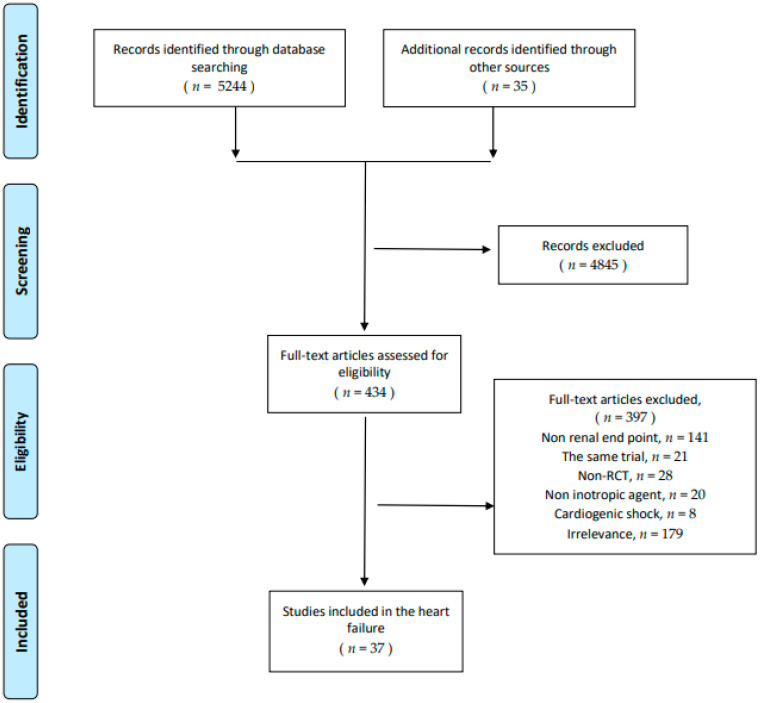
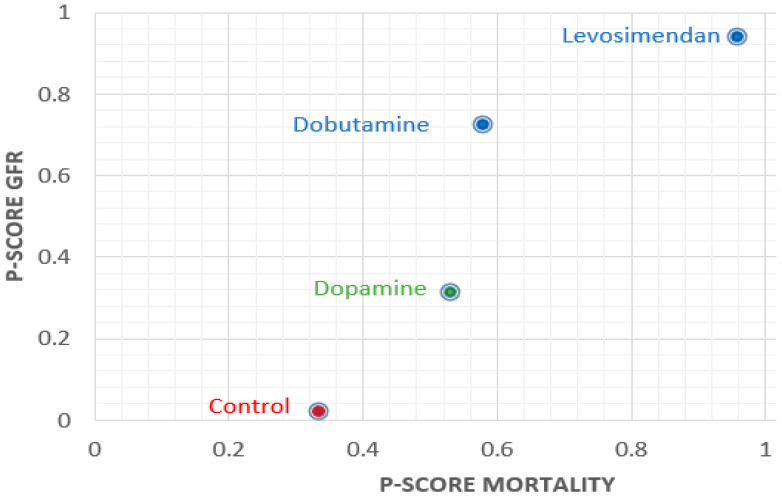
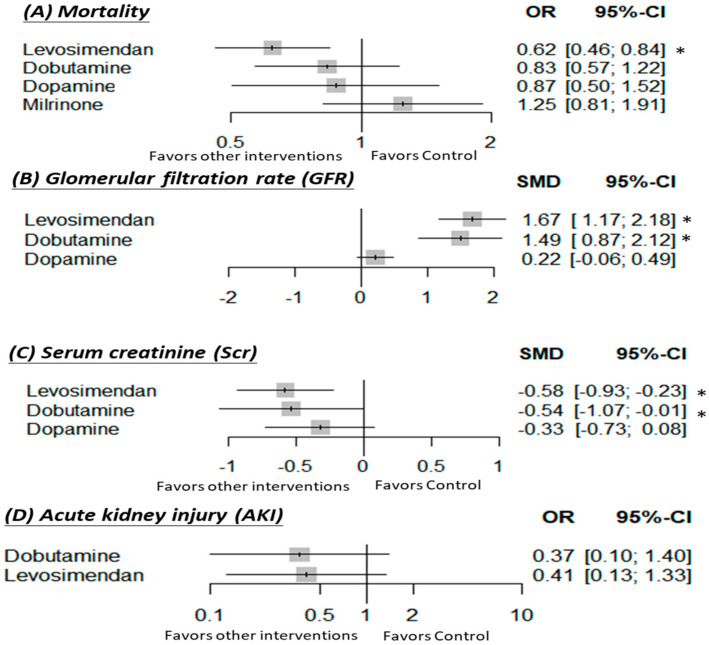
Prevention of cardiorenal syndrome through treatment with inotropic agents remains challenging. This network meta-analysis evaluated the safety and renoprotective effects of inotropes on patients with advanced heart failure (HF) using a frequentist random-effects model. A systematic database search was performed until 31 January 2021, and a total of 37 trials were included. Inconsistency, publication bias, and subgroup analyses were conducted. The levosimendan group exhibited significantly decreased mortality compared with the control (odds ratio (OR): 0.62; 95% confidence interval (CI): 0.46-0.84), milrinone (OR: 0.50; 95% CI: 0.30-0.84), and dobutamine (OR: 0.75; 95% CI: 0.57-0.97) groups. In terms of renal protection, levosimendan (standardized mean difference (SMD): 1.67; 95% CI: 1.17-2.18) and dobutamine (SMD: 1.49; 95% CI: 0.87-2.12) more favorably improved the glomerular filtration rate (GFR) than the control treatment did, but they did not significantly reduce the incidence of acute kidney injury. Furthermore, levosimendan had the highest P-score, indicating that it most effectively reduced mortality and improved renal function (e.g., GFR and serum creatinine level), even in patients with renal insufficiency. In conclusion, levosimendan is a safe alternative for protecting renal function on cardiorenal syndrome in patients with advanced HF.
使用正性肌力药物预防心肾综合征仍然具有挑战性。这项网络荟萃分析使用频率随机效应模型评估了正性肌力药物对晚期心力衰竭(HF)患者的安全性和肾脏保护作用。进行了系统的数据库检索,直至2021年1月31日,共纳入37项试验。进行了不一致性、发表偏倚和亚组分析。与对照组(优势比(OR):0.62;95%置信区间(CI):0.46-0.84)、米力农组(OR:0.50;95%CI:0.30-0.84)和多巴酚丁胺组(OR:0.75;95%CI:0.57-0.97)相比,左西孟旦组的死亡率显著降低。在肾脏保护方面,与对照治疗相比,左西孟旦(标准化均数差(SMD):1.67;95%CI:1.17-2.18)和多巴酚丁胺(SMD:1.49;95%CI:0.87-2.12)更有利于改善肾小球滤过率(GFR),但它们并未显著降低急性肾损伤的发生率。此外,左西孟旦的P值最高,表明即使在肾功能不全的患者中,它也最有效地降低了死亡率并改善了肾功能(如GFR和血清肌酐水平)。总之,左西孟旦是保护晚期HF患者心肾综合征肾功能的安全选择。