Yoon Jungpil, Jung Jaewan, Ahn Youngick, Oh Jimi
Department of Anesthesiology and Pain Medicine, Asan Medical Center, University of Ulsan College of Medicine, Seoul 138736, Korea.
Department of Internal Medicine, Wonkwang University Hospital, Iksan 54538, Korea.
J Clin Med. 2021 Sep 14;10(18):4147. doi: 10.3390/jcm10184147.
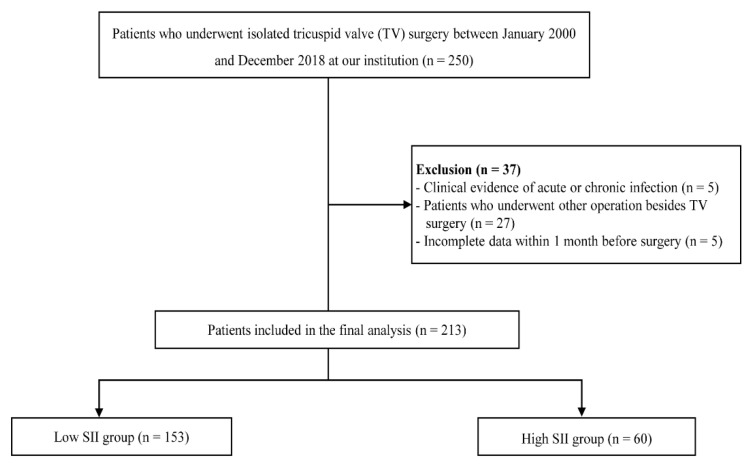
Systemic immune-inflammation index (SII, platelet × neutrophil/lymphocyte ratio) has recently been identified as an inflammatory marker. We aimed to evaluate the prognostic implications of preoperative SII in patients undergoing isolated tricuspid valve (TV) surgery. In total, 213 patients who underwent isolated TV surgery between January 2000 and December 2018 were enrolled. They were divided into two groups, as follows: low SII (<455.6 × 10/L), and high SII (≥455.6 × 10/L). The correlation between SII and clinical outcomes was analyzed via the Cox regression and the Kaplan-Meier analyses. The primary outcomes considered were all-cause mortality and major postoperative complications within a 30-day period after isolated TV surgery, including major adverse cardiovascular or cerebrovascular events, pulmonary and renal complications, stroke, sepsis, multi-organ failure, wound, and gastrointestinal complications. In total, 82 (38.5%) patients experienced postoperative complications. Multivariable analyses revealed that high preoperative SII values were independently associated with the major 30-day postoperative complications (hazard ratio 3.58, 95% confidence interval 1.62-7.95, = 0.001). Additionally, Kaplan-Meier analysis revealed that the probability of undergoing major 30-day postoperative complications was significantly elevated in patients with high versus low SII values ( < 0.001). These results indicate that SII, a readily available parameter, is significantly associated with poor outcomes in patients undergoing isolated TV surgery.
全身免疫炎症指数(SII,血小板×中性粒细胞/淋巴细胞比值)最近被确定为一种炎症标志物。我们旨在评估术前SII对接受单纯三尖瓣(TV)手术患者的预后影响。总共纳入了2000年1月至2018年12月期间接受单纯TV手术的213例患者。他们被分为两组,如下:低SII组(<455.6×10/L)和高SII组(≥455.6×10/L)。通过Cox回归和Kaplan-Meier分析来分析SII与临床结局之间的相关性。所考虑的主要结局为单纯TV手术后30天内的全因死亡率和主要术后并发症,包括主要不良心血管或脑血管事件、肺部和肾脏并发症、中风、败血症、多器官功能衰竭、伤口及胃肠道并发症。共有82例(38.5%)患者发生术后并发症。多变量分析显示,术前高SII值与术后30天主要并发症独立相关(风险比3.58,95%置信区间1.62 - 7.95,P = 0.001)。此外,Kaplan-Meier分析显示,高SII值患者术后30天发生主要并发症的概率显著高于低SII值患者(P < 0.001)。这些结果表明,SII作为一个易于获得的参数,与接受单纯TV手术患者的不良结局显著相关。