Choi Jeong-Myeong, Seo Soo-Young, Kim Pum-Jun, Kim Yu-Seop, Lee Sang-Hwa, Sohn Jong-Hee, Kim Dong-Kyu, Lee Jae-Jun, Kim Chulho
Department of Convergence Software, Hallym University, Chuncheon 24252, Korea.
Institute of New Frontier Research Team, Hallym University College of Medicine, Chuncheon 24252, Korea.
J Pers Med. 2021 Aug 30;11(9):863. doi: 10.3390/jpm11090863.
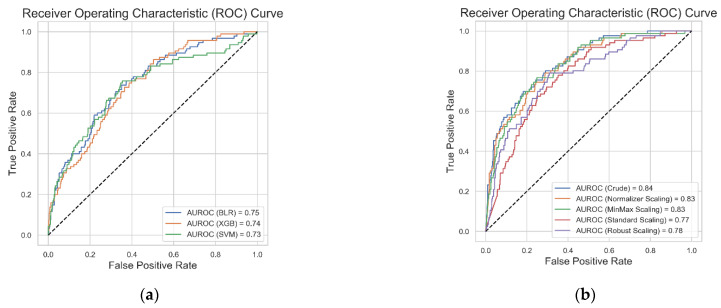
Hemorrhagic transformation (HT) is one of the leading causes of a poor prognostic marker after acute ischemic stroke (AIS). We compared the performances of the several machine learning (ML) algorithms to predict HT after AIS using only structured data. A total of 2028 patients with AIS, who were admitted within seven days of symptoms onset, were included in this analysis. HT was defined based on the criteria of the European Co-operative Acute Stroke Study-II trial. The whole dataset was randomly divided into a training and a test dataset with a 7:3 ratio. Binary logistic regression, support vector machine, extreme gradient boosting, and artificial neural network (ANN) algorithms were used to assess the performance of predicting the HT occurrence after AIS. Five-fold cross validation and a grid search technique were used to optimize the hyperparameters of each ML model, which had its performance measured by the area under the receiver operating characteristic (AUROC) curve. Among the included AIS patients, the mean age and number of male subjects were 69.6 years and 1183 (58.3%), respectively. HT was observed in 318 subjects (15.7%). There were no significant differences in corresponding variables between the training and test dataset. Among all the ML algorithms, the ANN algorithm showed the best performance in terms of predicting the occurrence of HT in our dataset (0.844). Feature scaling including standardization and normalization, and the resampling strategy showed no additional improvement of the ANN's performance. The ANN-based prediction of HT after AIS showed better performance than the conventional ML algorithms. Deep learning may be used to predict important outcomes for structured data-based prediction.
出血性转化(HT)是急性缺血性卒中(AIS)后预后不良标志物的主要原因之一。我们比较了几种机器学习(ML)算法仅使用结构化数据预测AIS后HT的性能。本分析纳入了总共2028例症状发作后7天内入院的AIS患者。HT根据欧洲急性卒中协作研究-II试验的标准定义。整个数据集以7:3的比例随机分为训练数据集和测试数据集。使用二元逻辑回归、支持向量机、极端梯度提升和人工神经网络(ANN)算法评估预测AIS后HT发生的性能。采用五折交叉验证和网格搜索技术优化每个ML模型的超参数,其性能通过受试者操作特征(AUROC)曲线下面积来衡量。在纳入的AIS患者中,平均年龄和男性受试者数量分别为69.6岁和1183例(58.3%)。318名受试者(15.7%)观察到HT。训练数据集和测试数据集之间的相应变量无显著差异。在所有ML算法中,ANN算法在预测我们数据集中HT的发生方面表现最佳(0.844)。包括标准化和归一化在内的特征缩放以及重采样策略未显示ANN性能有额外改善。基于ANN对AIS后HT的预测表现优于传统ML算法。深度学习可用于基于结构化数据预测的重要结局预测。