Koller Garrit, Schürholz Eva, Ziebart Thomas, Neff Andreas, Frankenberger Roland, Bartsch Jörg W
Department of Neurosurgery, Philipps University Marburg, Baldingerstr, 35033 Marburg, Germany.
Centre for Host-Microbiome Interactions, Faculty of Dental, Oral and Craniofacial Sciences, King's College London, Guy's Tower, Floor 17, London SE1 9RT, UK.
J Pers Med. 2021 Aug 30;11(9):866. doi: 10.3390/jpm11090866.
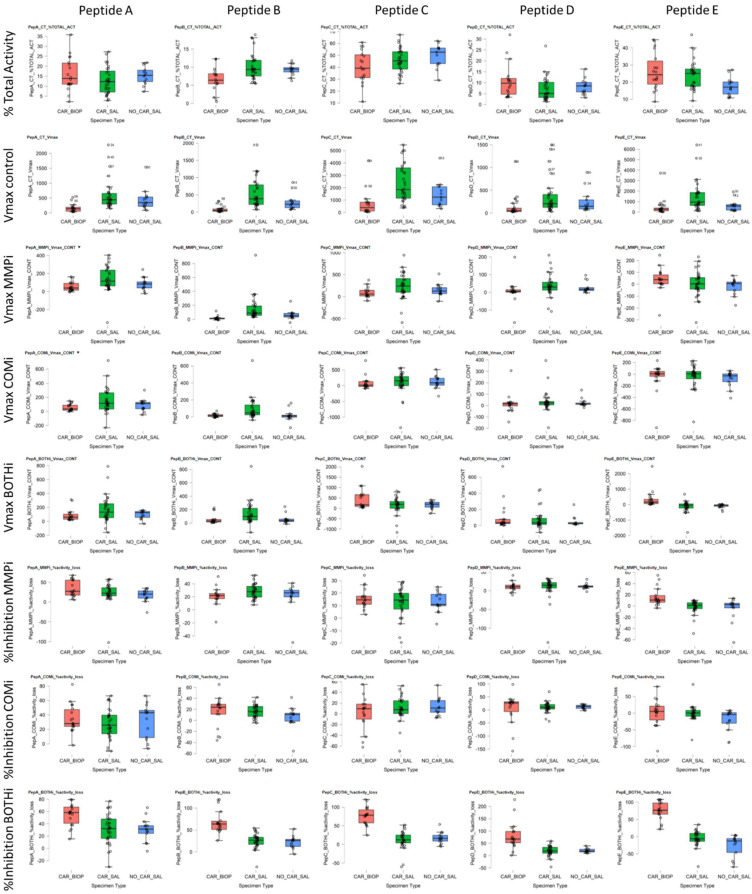
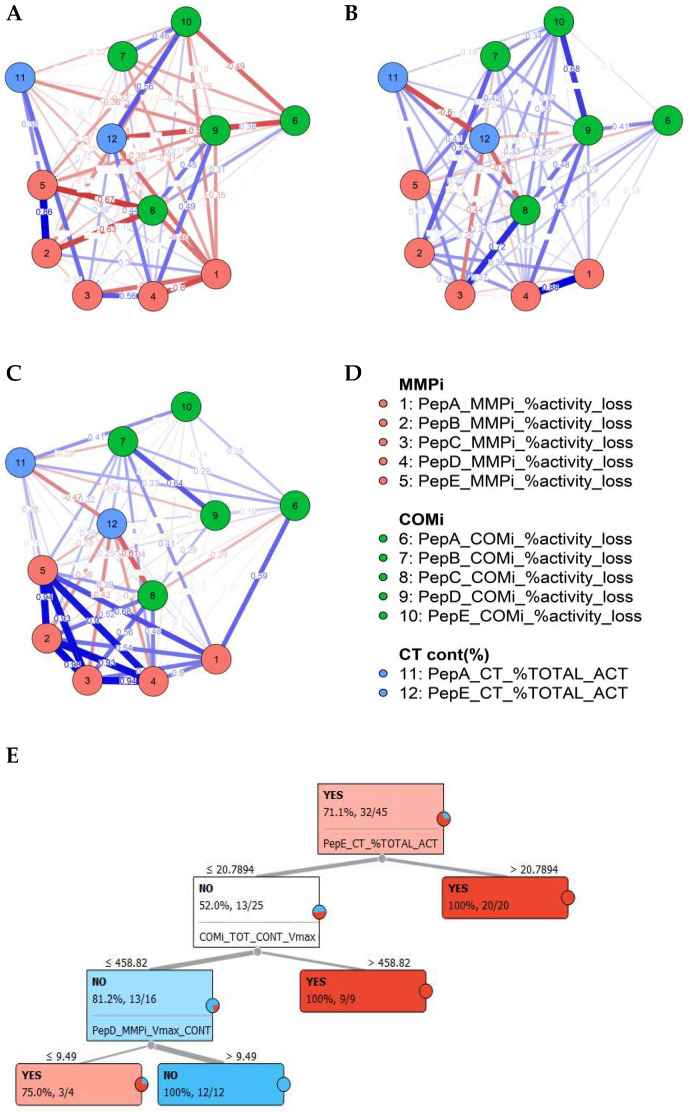
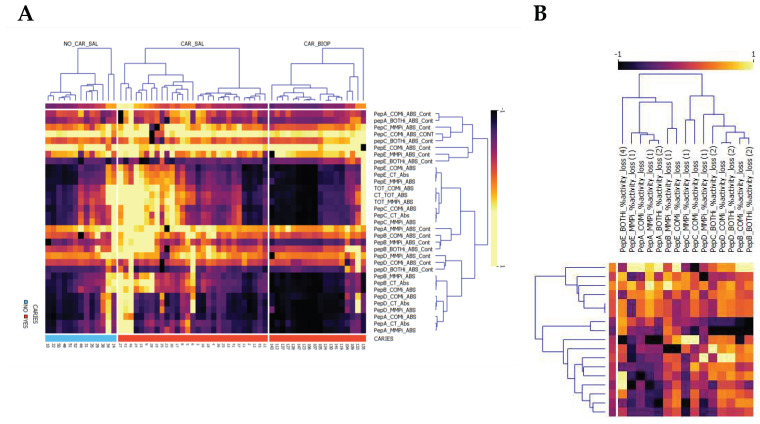
Dental decay (Caries) and periodontal disease are globally prevalent diseases with significant clinical need for improved diagnosis. As mediators of dental disease-specific extracellular matrix degradation, proteases are promising analytes. We hypothesized that dysregulation of active proteases can be functionally linked to oral disease status and may be used for diagnosis. To address this, we examined a total of 52 patients with varying oral disease states, including healthy controls. Whole mouth saliva samples and caries biopsies were collected and subjected to analysis. Overall proteolytic and substrate specific activities were assessed using five multiplexed, fluorogenic peptides. Peptide cleavage was further described by inhibitors targeting matrix metalloproteases (MMPs) and cysteine, serine, calpain proteases (CSC). Proteolytic fingerprints, supported by supervised machine-learning analysis, were delineated by total proteolytic activity (PepE) and substrate preference combined with inhibition profiles. Caries and peridontitis showed increased enzymatic activities of MMPs with common (PepA) and divergent substrate cleavage patterns (PepE), suggesting different MMP contribution in particular disease states. Overall, sensitivity and specificity values of 84.6% and 90.0%, respectively, were attained. Thus, a combined analysis of protease derived individual and arrayed substrate cleavage rates in conjunction with inhibitor profiles may represent a sensitive and specific tool for oral disease detection.
龋齿和牙周病是全球普遍流行的疾病,临床上对改进诊断有重大需求。作为牙齿疾病特异性细胞外基质降解的介质,蛋白酶是很有前景的分析物。我们假设活性蛋白酶的失调可能在功能上与口腔疾病状态相关联,并且可用于诊断。为了验证这一点,我们总共检查了52名患有不同口腔疾病状态的患者,包括健康对照者。收集全口唾液样本和龋齿活检样本并进行分析。使用五种多重荧光肽评估总体蛋白水解活性和底物特异性活性。通过靶向基质金属蛋白酶(MMP)以及半胱氨酸、丝氨酸、钙蛋白酶(CSC)的抑制剂进一步描述肽的裂解情况。在监督机器学习分析的支持下,蛋白水解指纹图谱通过总蛋白水解活性(PepE)、底物偏好以及抑制谱来描绘。龋齿和牙周炎显示出MMP的酶活性增加,具有共同的(PepA)和不同的底物裂解模式(PepE),表明在特定疾病状态下MMP的贡献不同。总体而言,敏感性和特异性值分别达到84.6%和90.0%。因此,结合蛋白酶衍生的个体和阵列底物裂解率以及抑制剂谱进行分析,可能是一种用于口腔疾病检测的灵敏且特异的工具。