Department of NanoEngineering, University of California, San Diego, CA 92093, USA.
Department of Bioengineering, University of California, San Diego, CA 92093, USA.
Int J Mol Sci. 2021 Sep 8;22(18):9733. doi: 10.3390/ijms22189733.
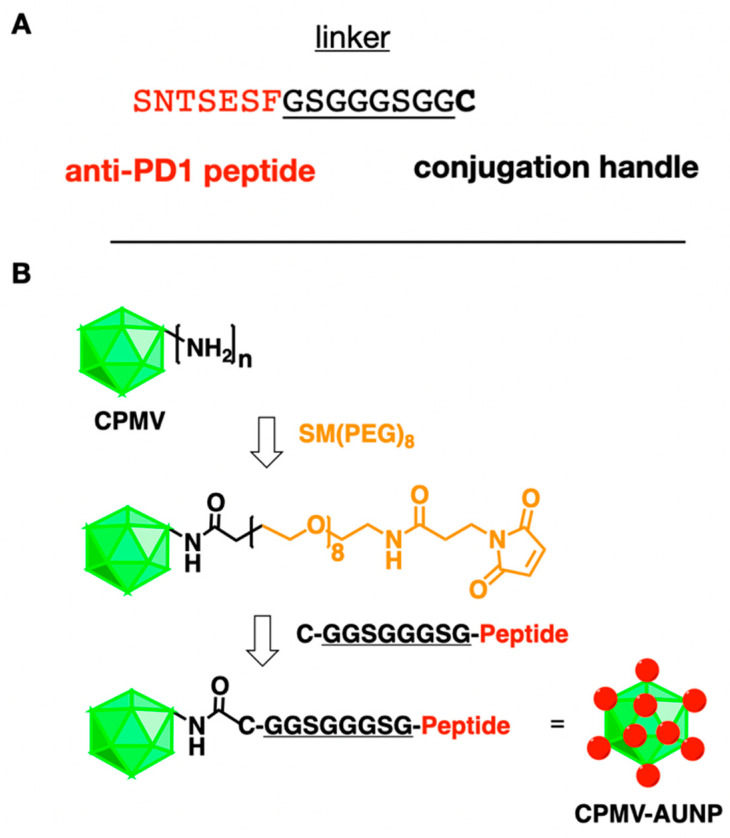
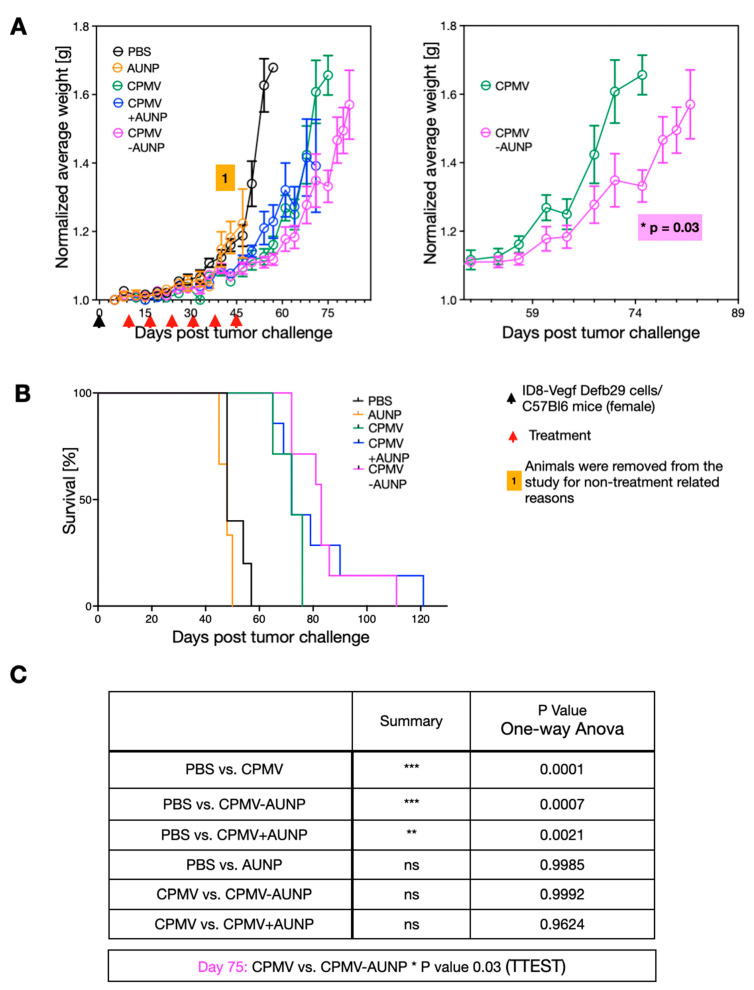
Immunotherapy holds tremendous potential in cancer therapy, in particular, when treatment regimens are combined to achieve synergy between pathways along the cancer immunity cycle. In previous works, we demonstrated that in situ vaccination with the plant virus cowpea mosaic virus (CPMV) activates and recruits innate immune cells, therefore reprogramming the immunosuppressive tumor microenvironment toward an immune-activated state, leading to potent anti-tumor immunity in tumor mouse models and canine patients. CPMV therapy also increases the expression of checkpoint regulators on effector T cells in the tumor microenvironment, such as PD-1/PD-L1, and we demonstrated that combination with immune checkpoint therapy improves therapeutic outcomes further. In the present work, we tested the hypothesis that CPMV could be combined with anti-PD-1 peptides to replace expensive antibody therapies. Specifically, we set out to test whether a multivalent display of anti-PD-1 peptides (SNTSESF) would enhance efficacy over a combination of CPMV and soluble peptide. Efficacy of the approaches were tested using a syngeneic mouse model of intraperitoneal ovarian cancer. CPMV combination with anti-PD-1 peptides (SNTSESF) resulted in increased efficacy; however, increased potency against metastatic ovarian cancer was only observed when SNTSESF was conjugated to CPMV, and not added as a free peptide. This can be explained by the differences in the in vivo fates of the nanoparticle formulation vs. the free peptide; the larger nanoparticles are expected to exhibit prolonged tumor residence and favorable intratumoral distribution. Our study provides new design principles for plant virus-based in situ vaccination strategies.
免疫疗法在癌症治疗中具有巨大的潜力,特别是当治疗方案联合使用以实现癌症免疫周期途径之间的协同作用时。在以前的工作中,我们证明了用植物病毒豇豆花叶病毒(CPMV)进行原位疫苗接种可激活和募集先天免疫细胞,从而使免疫抑制性肿瘤微环境向免疫激活状态重新编程,导致肿瘤小鼠模型和犬科患者产生强大的抗肿瘤免疫。CPMV 疗法还增加了肿瘤微环境中效应 T 细胞上的检查点调节剂的表达,如 PD-1/PD-L1,我们证明与免疫检查点疗法联合使用可进一步提高治疗效果。在本工作中,我们检验了以下假设,即 CPMV 可以与抗 PD-1 肽结合使用,以替代昂贵的抗体疗法。具体而言,我们着手测试多价展示抗 PD-1 肽(SNTSESF)是否会比 CPMV 与可溶性肽的组合更有效。采用腹腔卵巢癌的同源小鼠模型测试了这些方法的疗效。CPMV 与抗 PD-1 肽(SNTSESF)的组合可提高疗效;然而,只有当 SNTSESF 与 CPMV 缀合而不是添加为游离肽时,才观察到对转移性卵巢癌的效力增强。这可以通过纳米颗粒制剂与游离肽的体内命运差异来解释;预计较大的纳米颗粒将表现出延长的肿瘤停留时间和有利的肿瘤内分布。我们的研究为基于植物病毒的原位疫苗接种策略提供了新的设计原则。