Lim Zhong Ri, Vassilev Svetlan, Leong Yew Wai, Hang Jing Wen, Rénia Laurent, Malleret Benoit, Oh Steve Kah-Weng
Stem Cell Bioprocessing, Bioprocessing Technology Institute, Agency for Science, Technology and Research, Singapore 138668, Singapore.
Agency for Science, Technology and Research Infectious Diseases Laboratories (A*STAR ID Labs), Immunos, Biopolis, Singapore 138648, Singapore.
Int J Mol Sci. 2021 Sep 10;22(18):9808. doi: 10.3390/ijms22189808.
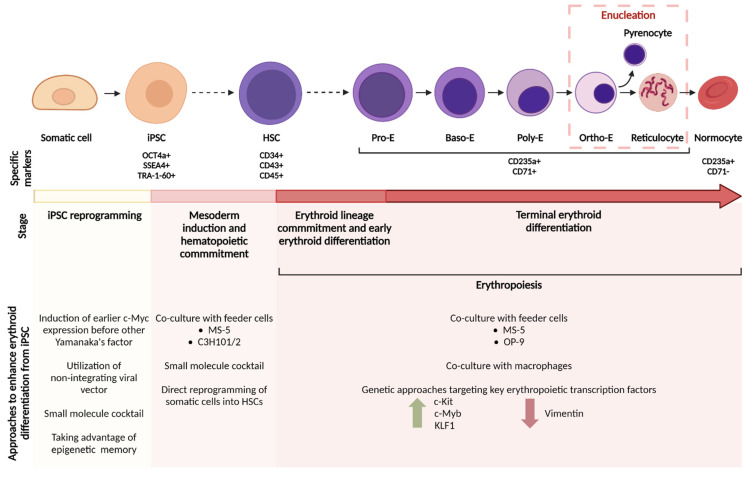
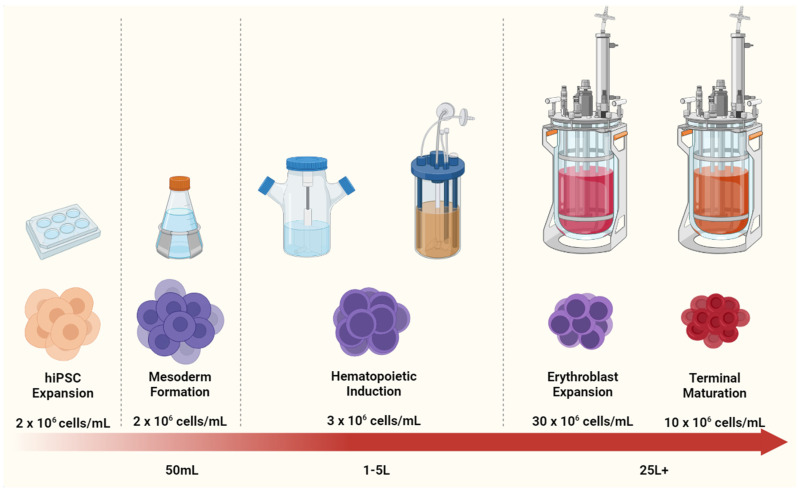
Amidst the global shortfalls in blood supply, storage limitations of donor blood and the availability of potential blood substitutes for transfusion applications, society has pivoted towards in vitro generation of red blood cells (RBCs) as a means to solve these issues. Many conventional research studies over the past few decades have found success in differentiating hematopoietic stem and progenitor cells (HSPCs) from cord blood, adult bone marrow and peripheral blood sources. More recently, techniques that involve immortalization of erythroblast sources have also gained traction in tackling this problem. However, the RBCs generated from human induced pluripotent stem cells (hiPSCs) still remain as the most favorable solution due to many of its added advantages. In this review, we focus on the breakthroughs for high-density cultures of hiPSC-derived RBCs, and highlight the major challenges and prospective solutions throughout the whole process of erythropoiesis for hiPSC-derived RBCs. Furthermore, we elaborate on the recent advances and techniques used to achieve cost-effective, high-density cultures of GMP-compliant RBCs, and on their relevant novel applications after downstream processing and purification.
在全球血液供应短缺、献血储存受限以及输血应用中潜在血液替代品可用性的背景下,社会已转向体外生成红细胞(RBCs)作为解决这些问题的一种手段。在过去几十年里,许多传统研究已成功地从脐带血、成人骨髓和外周血来源中分化出造血干细胞和祖细胞(HSPCs)。最近,涉及成红细胞来源永生化的技术在解决这一问题方面也受到了关注。然而,由于人类诱导多能干细胞(hiPSCs)生成的红细胞具有许多额外优势,它仍然是最理想的解决方案。在这篇综述中,我们重点关注hiPSC来源红细胞高密度培养的突破,并强调hiPSC来源红细胞整个红细胞生成过程中的主要挑战和潜在解决方案。此外,我们详细阐述了用于实现符合GMP标准的红细胞经济高效、高密度培养的最新进展和技术,以及下游加工和纯化后它们的相关新应用。