
植物化学物质靶向缺氧诱导因子-1α的抗癌活性。
Anti-Cancer Activity of Phytochemicals Targeting Hypoxia-Inducible Factor-1 Alpha.
机构信息
Department of Biomedical Science and Research Institute for Bioscience & Biotechnology, Hallym University, Chunchon 24252, Korea.
Department of Medical Life Sciences, College of Medicine, The Catholic University of Korea, Seoul 06591, Korea.
出版信息
Int J Mol Sci. 2021 Sep 10;22(18):9819. doi: 10.3390/ijms22189819.
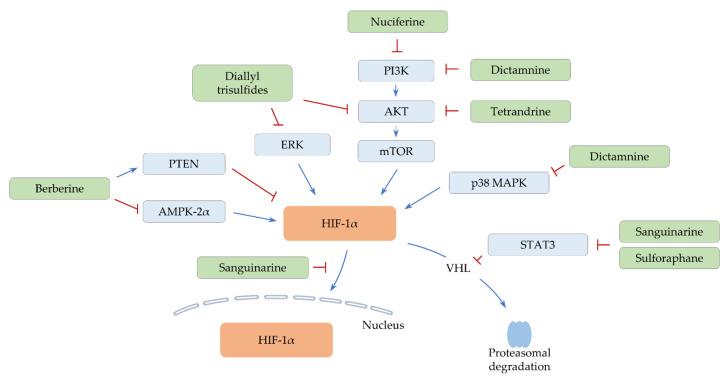
Hypoxia-inducible factor-1 alpha (HIF-1α) is overexpressed in cancer, leading to a poor prognosis in patients. Diverse cellular factors are able to regulate HIF-1α expression in hypoxia and even in non-hypoxic conditions, affecting its progression and malignant characteristics by regulating the expression of the HIF-1α target genes that are involved in cell survival, angiogenesis, metabolism, therapeutic resistance, et cetera. Numerous studies have exhibited the anti-cancer effect of HIF-1α inhibition itself and the augmentation of anti-cancer treatment efficacy by interfering with HIF-1α-mediated signaling. The anti-cancer effect of plant-derived phytochemicals has been evaluated, and they have been found to possess significant therapeutic potentials against numerous cancer types. A better understanding of phytochemicals is indispensable for establishing advanced strategies for cancer therapy. This article reviews the anti-cancer effect of phytochemicals in connection with HIF-1α regulation.
缺氧诱导因子-1 阿尔法(HIF-1α)在癌症中过度表达,导致患者预后不良。许多细胞因子能够在缺氧条件下甚至在非缺氧条件下调节 HIF-1α 的表达,通过调节 HIF-1α 靶基因的表达来影响其进展和恶性特征,这些靶基因涉及细胞存活、血管生成、代谢、治疗抵抗等。许多研究表明 HIF-1α 抑制本身具有抗癌作用,并通过干扰 HIF-1α 介导的信号转导增强抗癌治疗的疗效。植物源性植物化学物质的抗癌作用已经得到评估,它们对许多癌症类型具有显著的治疗潜力。更好地了解植物化学物质对于制定癌症治疗的先进策略是必不可少的。本文综述了植物化学物质与 HIF-1α 调节相关的抗癌作用。


 Zotero 插件