Department of Life Sciences, Graduate School of Arts and Sciences, The University of Tokyo, 3-8-1 Komaba, Meguro, Tokyo 153-8902, Japan.
Department of Physical Therapy, Tokyo University of Technology, Ota, Tokyo 144-8535, Japan.
Sensors (Basel). 2021 Sep 15;21(18):6186. doi: 10.3390/s21186186.
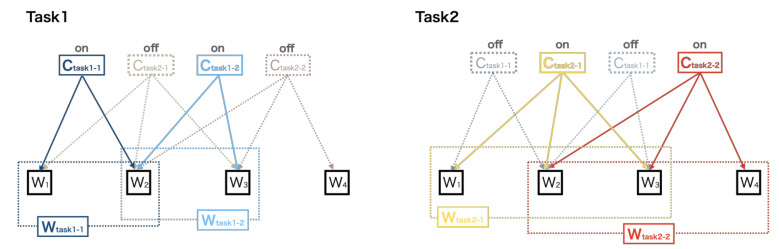
The extent to which muscle synergies represent the neural control of human behavior remains unknown. Here, we tested whether certain sets of muscle synergies that are fundamentally necessary across behaviors exist. We measured the electromyographic activities of 26 muscles, including bilateral trunk and lower limb muscles, during 24 locomotion, dynamic and static stability tasks, and we extracted the muscle synergies using non-negative matrix factorization. Our results show that 13 muscle synergies that may have unique functional roles accounted for almost all 24 tasks by combinations of single and/or merging of synergies. Therefore, our results may support the notion of the low dimensionality in motor outputs, in which the central nervous system flexibly recruits fundamental muscle synergies to execute diverse human behaviors. Further studies are required to validate the neural representation of the fundamental components of muscle synergies.
肌肉协同作用在多大程度上代表人类行为的神经控制尚不清楚。在这里,我们测试了某些在行为中基本必需的肌肉协同作用是否存在。我们测量了 26 块肌肉的肌电图活动,包括双侧躯干和下肢肌肉,在 24 种运动、动态和静态稳定性任务中,并使用非负矩阵分解提取了肌肉协同作用。我们的结果表明,13 种可能具有独特功能作用的肌肉协同作用通过协同作用的单一和/或合并组合,几乎可以解释所有 24 种任务。因此,我们的结果可能支持运动输出的低维性的概念,即中枢神经系统灵活地招募基本的肌肉协同作用来执行各种人类行为。需要进一步的研究来验证肌肉协同作用基本成分的神经表示。