
AI 辅助的内部电源监测用于检测老年人的认知障碍。
AI-Assisted In-House Power Monitoring for the Detection of Cognitive Impairment in Older Adults.
机构信息
Department of Preventive Medicine and Epidemiology, National Cerebral and Cardiovascular Center, Suita 564-8565, Japan.
Division of Epidemiology, Kobe University Graduate School of Medicine, Kobe 650-0017, Japan.
出版信息
Sensors (Basel). 2021 Sep 17;21(18):6249. doi: 10.3390/s21186249.
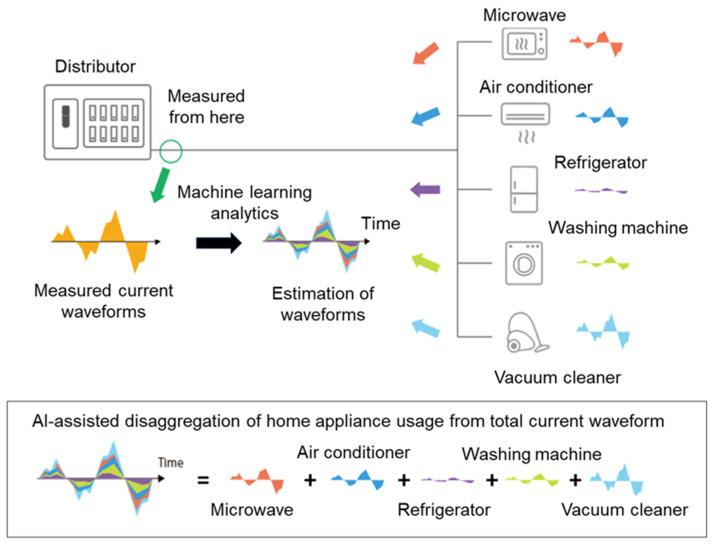
In-home monitoring systems have been used to detect cognitive decline in older adults by allowing continuous monitoring of routine activities. In this study, we investigated whether unobtrusive in-house power monitoring technologies could be used to predict cognitive impairment. A total of 94 older adults aged ≥65 years were enrolled in this study. Generalized linear mixed models with subject-specific random intercepts were used to evaluate differences in the usage time of home appliances between people with and without cognitive impairment. Three independent power monitoring parameters representing activity behavior were found to be associated with cognitive impairment. Representative values of mean differences between those with cognitive impairment relative to those without were -13.5 min for induction heating in the spring, -1.80 min for microwave oven in the winter, and -0.82 h for air conditioner in the winter. We developed two prediction models for cognitive impairment, one with power monitoring data and the other without, and found that the former had better predictive ability (accuracy, 0.82; sensitivity, 0.48; specificity, 0.96) compared to the latter (accuracy, 0.76; sensitivity, 0.30; specificity, 0.95). In summary, in-house power monitoring technologies can be used to detect cognitive impairment.
家庭内监测系统可通过持续监测日常活动来检测老年人的认知能力下降。在这项研究中,我们探讨了非侵入性的家庭电力监测技术是否可用于预测认知障碍。共有 94 名年龄≥65 岁的老年人参与了这项研究。采用具有个体随机截距的广义线性混合模型来评估认知障碍者和无认知障碍者之间家用电器使用时间的差异。发现三个独立的代表活动行为的电力监测参数与认知障碍相关。有认知障碍者相对于无认知障碍者的平均差异的代表值为:春季感应加热减少 13.5 分钟,冬季微波炉减少 1.80 分钟,冬季空调减少 0.82 小时。我们开发了两个认知障碍预测模型,一个基于电力监测数据,另一个不基于电力监测数据,发现前者(准确性为 0.82、敏感性为 0.48、特异性为 0.96)比后者(准确性为 0.76、敏感性为 0.30、特异性为 0.95)具有更好的预测能力。总之,家庭电力监测技术可用于检测认知障碍。



 Zotero 插件