Department of Biochemistry and Molecular Biology, College of Medicine, Chang Gung University, Kweishan, Taoyuan 33302, Taiwan.
Graduate Institute of Natural Products, College of Medicine, Chang Gung University, Taoyuan 33302, Taiwan.
Viruses. 2021 Sep 2;13(9):1756. doi: 10.3390/v13091756.
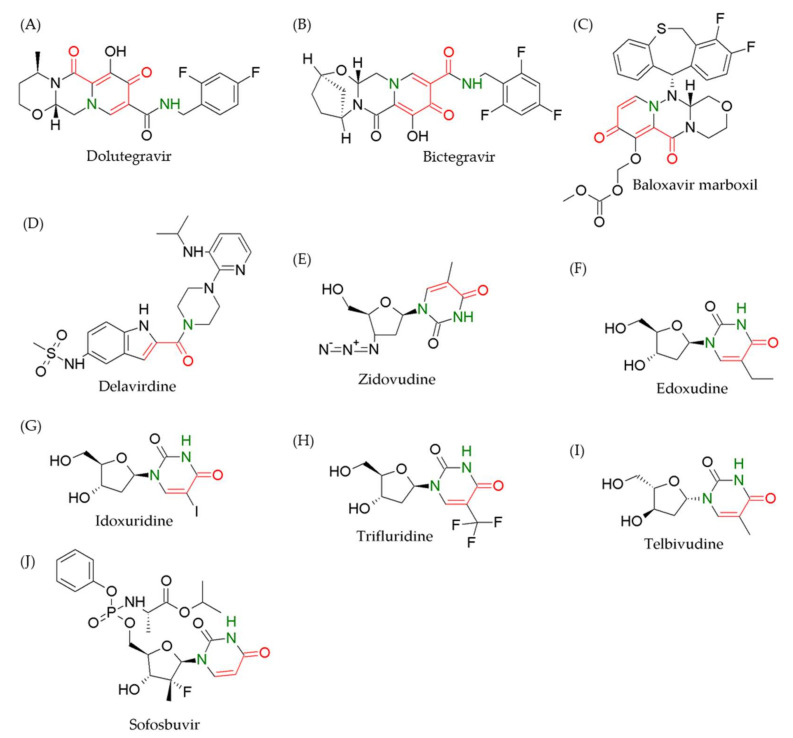
The Michael addition reaction is a spontaneous and quick chemical reaction that is widely applied in various fields. This reaction is performed by conjugating an addition of nucleophiles with α, β-unsaturated carbonyl compounds, resulting in the bond formation of C-N, C-S, C-O, and so on. In the development of molecular materials, the Michael addition is not only used to synthesize chemical compounds but is also involved in the mechanism of drug action. Several covalent drugs that bond via Michael addition are regarded as anticarcinogens and anti-inflammatory drugs. Although drug development is mainly focused on pharmaceutical drug discovery, target-based discovery can provide a different perspective for drug usage. However, considerable time and labor are required to define a molecular target through molecular biological experiments. In this review, we systematically examine the chemical structures of current FDA-approved antiviral drugs for potential Michael addition moieties with α, β-unsaturated carbonyl groups, which may exert an unidentified broad-spectrum inhibitory mechanism to target viral or host factors. We thus propose that profiling the targets of antiviral agents, such as Michael addition products, can be achieved by employing a high-throughput LC-MS approach to comprehensively analyze the interaction between drugs and targets, and the subsequent drug responses in the cellular environment to facilitate drug repurposing and/or identify potential adverse effects, with a particular emphasis on the pros and cons of this shotgun proteomic approach.
迈克尔加成反应是一种自发且快速的化学反应,广泛应用于各个领域。该反应通过使亲核试剂与α,β-不饱和羰基化合物加成来进行,从而形成 C-N、C-S、C-O 等键。在分子材料的开发中,迈克尔加成不仅用于合成化合物,还涉及药物作用机制。几种通过迈克尔加成键合的共价药物被认为是抗癌药和消炎药。尽管药物开发主要集中在药物发现上,但基于靶点的发现可以为药物用途提供不同的视角。然而,通过分子生物学实验定义分子靶点需要相当多的时间和精力。在这篇综述中,我们系统地检查了当前 FDA 批准的抗病毒药物的化学结构,以寻找具有α,β-不饱和羰基的潜在迈克尔加成部分,这些部分可能对病毒或宿主因素发挥未被识别的广谱抑制作用机制。因此,我们提出可以通过高通量 LC-MS 方法来分析药物与靶点的相互作用以及药物在细胞环境中的后续反应,从而对抗病毒药物(如迈克尔加成产物)的靶点进行分析,以促进药物再利用和/或识别潜在的不良反应,特别强调这种鸟枪法蛋白质组学方法的优缺点。