Department of Immunology, St. Jude Children's Research Hospital, Memphis, TN 38105, USA.
St. Jude Graduate School of Biomedical Sciences, Memphis, TN 38105, USA.
Viruses. 2021 Sep 7;13(9):1786. doi: 10.3390/v13091786.
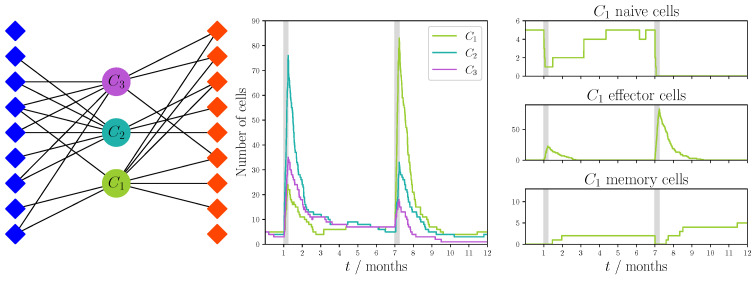
If viral strains are sufficiently similar in their immunodominant epitopes, then populations of cross-reactive T cells may be boosted by exposure to one strain and provide protection against infection by another at a later date. This type of pre-existing immunity may be important in the adaptive immune response to influenza and to coronaviruses. Patterns of recognition of epitopes by T cell clonotypes (a set of cells sharing the same T cell receptor) are represented as edges on a bipartite network. We describe different methods of constructing bipartite networks that exhibit cross-reactivity, and the dynamics of the T cell repertoire in conditions of homeostasis, infection and re-infection. Cross-reactivity may arise simply by chance, or because immunodominant epitopes of different strains are structurally similar. We introduce a circular space of epitopes, so that T cell cross-reactivity is a quantitative measure of the overlap between clonotypes that recognize similar (that is, close in epitope space) epitopes.
如果病毒株在其免疫优势表位上足够相似,那么交叉反应性 T 细胞群体可能会因接触一种毒株而得到增强,并在以后提供针对另一种毒株感染的保护。这种类型的预先存在的免疫可能对流感和冠状病毒的适应性免疫反应很重要。T 细胞克隆型(一组具有相同 T 细胞受体的细胞)识别表位的模式表示为二部网络的边。我们描述了构建表现出交叉反应性的二部网络的不同方法,以及在稳态、感染和再感染条件下 T 细胞库的动态。交叉反应性可能是偶然产生的,也可能是因为不同毒株的免疫优势表位在结构上相似。我们引入了一个表位的循环空间,因此 T 细胞交叉反应性是识别相似(即在表位空间中接近)表位的克隆型之间重叠的定量度量。