Department of Virology and Parasitology, Fujita Health University School of Medicine, Toyoake 470-1192, Japan.
Viruses. 2021 Sep 8;13(9):1791. doi: 10.3390/v13091791.
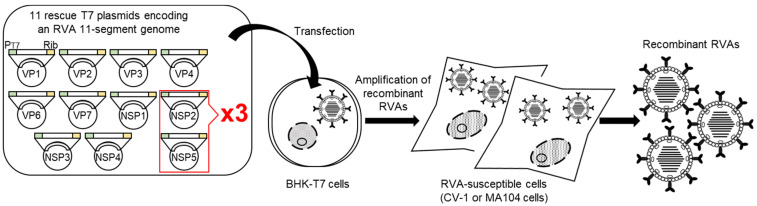
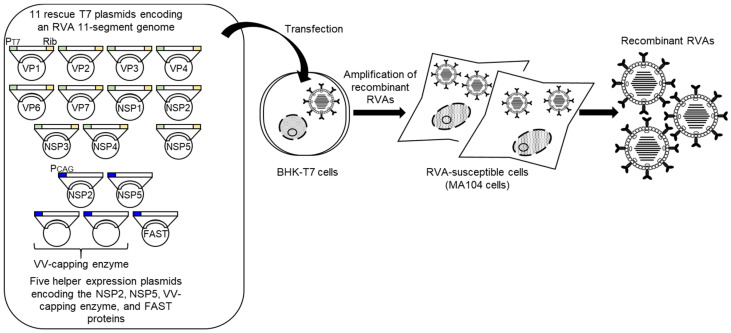
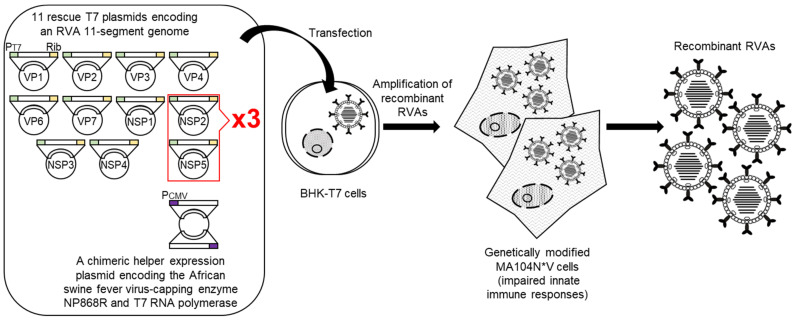
Human rotaviruses (HuRVAs) are highly important causes of acute gastroenteritis in infants and young children worldwide. A lack of reliable and reproducible reverse genetics systems for HuRVAs has limited a proper understanding of HuRVA biology and also the rational design of live-attenuated vaccines. Since the development of the first reverse genetics system for RVAs (partially plasmid-based reverse genetics system) in 2006, there have been many efforts with the goal of generating infectious recombinant HuRVAs entirely from cloned cDNAs. However, the establishment of a HuRVA reverse genetics system was very challenging until 2019. This review article provides an overview of the historical background of the recent development of long-awaited HuRVA reverse genetics systems, beginning with the generation of recombinant human-simian reassortant RVAs with the aid of a helper virus in 2006 and the generation of recombinant animal (simian) RVAs in a helper virus-free manner in 2017, and culminating in the generation of recombinant HuRVAs entirely from plasmid cDNAs in 2019. Notably, the original HuRVA reverse genetics system has already been optimized to increase the efficiency of virus generation. Although the application of HuRVA reverse genetics systems has only just been initiated, these technologies will help to answer HuRVA research questions regarding viral replication and pathogenicity that could not be addressed before, and to develop next-generation vaccines and intestine-specific rotaviral vectors.
人轮状病毒(HuRVAs)是全球婴幼儿急性肠胃炎的重要病因。由于缺乏可靠且可重现的 HuRVAs 反向遗传学系统,人们对 HuRVA 生物学的认识受到了限制,也无法合理设计减毒活疫苗。自 2006 年开发出第一个 RVAs 的反向遗传学系统(部分基于质粒的反向遗传学系统)以来,人们一直致力于从克隆 cDNA 中完全生成感染性重组 HuRVAs。然而,直到 2019 年,建立 HuRVA 反向遗传学系统才具有挑战性。本文综述了备受期待的 HuRVA 反向遗传学系统的最新发展历程,包括 2006 年在辅助病毒的帮助下生成重组人-猿猴嵌合 RVAs、2017 年在无辅助病毒的情况下生成重组动物(猿猴)RVAs,以及 2019 年完全从质粒 cDNA 中生成重组 HuRVAs。值得注意的是,原始 HuRVA 反向遗传学系统已经过优化,以提高病毒生成效率。尽管 HuRVA 反向遗传学系统的应用才刚刚开始,但这些技术将有助于回答以前无法解决的关于病毒复制和致病性的 HuRVA 研究问题,并开发下一代疫苗和肠道特异性轮状病毒载体。