Wetzel Alexandre Emmanuel, Del Castillo Iniesta Nuria, Engay Einstom, Mandsberg Nikolaj Kofoed, Schou Dinesen Celine, Hanif Bilal Rashid, Berg-Sørensen Kirstine, Bunea Ada-Ioana, Taboryski Rafael
National Centre for Nano Fabrication and Characterization (DTU Nanolab), Technical University of Denmark, Ørsted Plads 347, 2800 Kongens Lyngby, Denmark.
Center for Intelligent Drug Delivery and Sensing Using Microcontainers and Nanomechanics (IDUN), Technical University of Denmark, Ørsted Plads 345C, 2800 Kongens Lyngby, Denmark.
Nanomaterials (Basel). 2021 Sep 4;11(9):2298. doi: 10.3390/nano11092298.
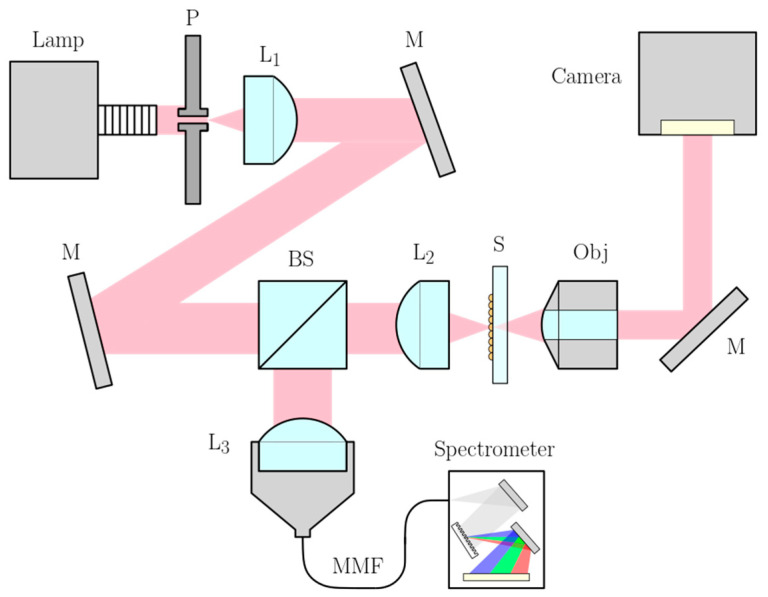
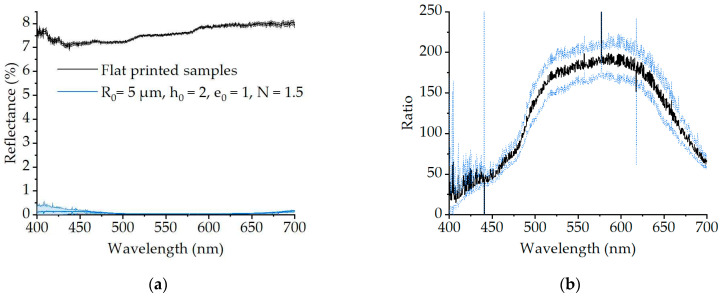
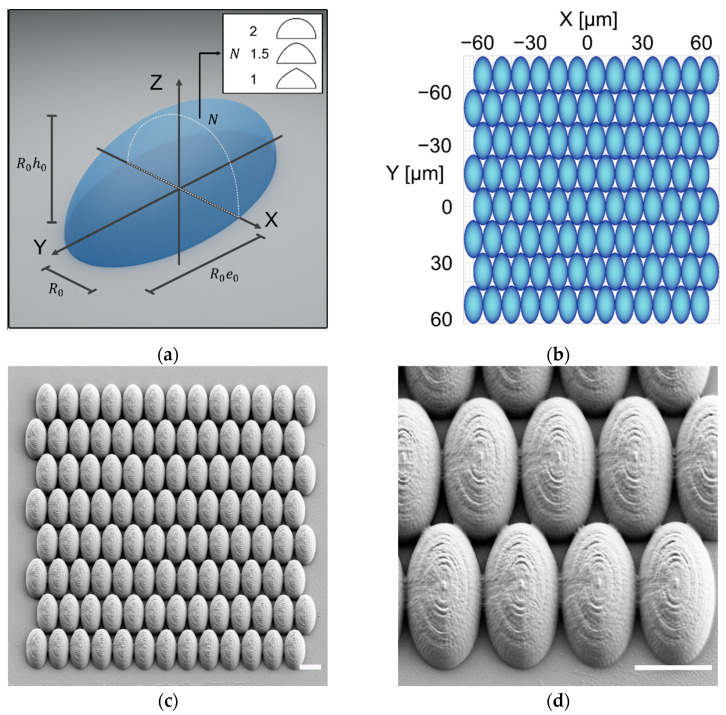
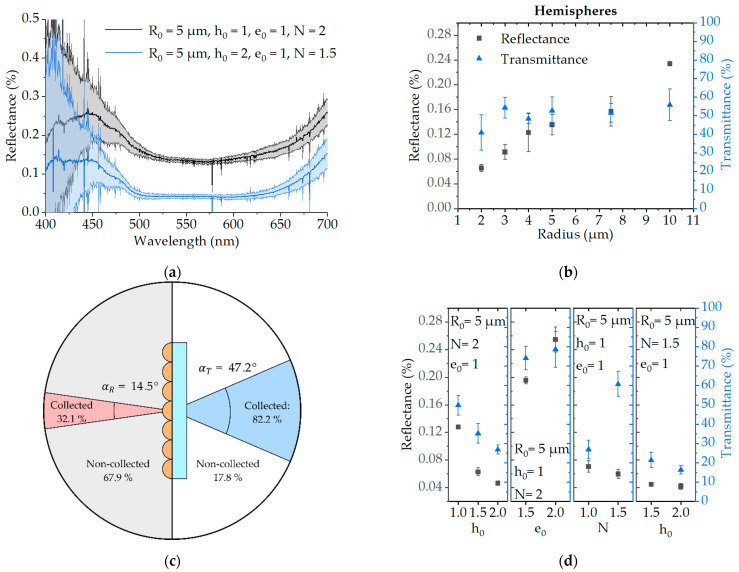
Over the years, different approaches to obtaining antireflective surfaces have been explored, such as using index-matching, interference, or micro- and nanostructures. Structural super black colors are ubiquitous in nature, and biomimicry thus constitutes an interesting way to develop antireflective surfaces. Moth-eye nanostructures, for example, are well known and have been successfully replicated using micro- and nanofabrication. However, other animal species, such as birds of paradise and peacock spiders, have evolved to display larger structures with antireflective features. In peacock spiders, the antireflective properties of their super black patches arise from relatively simple microstructures with lens-like shapes organized in tightly packed hexagonal arrays, which makes them a good candidate for cheap mass replication techniques. In this paper, we present the fabrication and characterization of antireflective microarrays inspired by the peacock spider's super black structures encountered in nature. Firstly, different microarrays 3D models are generated from a surface equation. Secondly, the arrays are fabricated in a polyacrylate resin by super-resolution 3D printing using two-photon polymerization. Thirdly, the resulting structures are inspected using a scanning electron microscope. Finally, the reflectance and transmittance of the printed structures are characterized at normal incidence with a dedicated optical setup. The bioinspired microlens arrays display excellent antireflective properties, with a measured reflectance as low as 0.042 ± 0.004% for normal incidence, a wavelength of 550 nm, and a collection angle of 14.5°. These values were obtained using a tightly-packed array of slightly pyramidal lenses with a radius of 5 µm and a height of 10 µm.
多年来,人们探索了多种获得抗反射表面的方法,例如使用折射率匹配、干涉或微纳结构。结构超黑色在自然界中无处不在,因此仿生学成为开发抗反射表面的一种有趣方式。例如,蛾眼纳米结构广为人知,并已通过微纳制造成功复制。然而,其他动物物种,如极乐鸟和孔雀蜘蛛,已经进化出具有抗反射特征的更大结构。在孔雀蜘蛛中,其超黑色斑块的抗反射特性源于相对简单的微结构,这些微结构呈透镜状,排列成紧密堆积的六边形阵列,这使得它们成为廉价大规模复制技术的理想选择。在本文中,我们展示了受自然界中孔雀蜘蛛超黑色结构启发的抗反射微阵列的制造和表征。首先,从表面方程生成不同的微阵列三维模型。其次,通过双光子聚合的超分辨率三维打印在聚丙烯酸酯树脂中制造阵列。第三,使用扫描电子显微镜检查所得结构。最后,使用专用光学装置在正入射下表征打印结构的反射率和透射率。这种受生物启发的微透镜阵列具有出色的抗反射性能,在正入射、波长为550 nm和收集角度为14.5°时,测得的反射率低至0.042±0.004%。这些值是使用半径为5 µm、高度为10 µm的紧密排列的略呈金字塔形的透镜阵列获得的。