Department of Pediatrics, Section of Nutrition, Anschutz Medical Campus, School of Medicine, University of Colorado, Aurora, CO 80045, USA.
Arkansas Children's Nutrition Center, Little Rock, AR 72202, USA.
Nutrients. 2021 Sep 21;13(9):3295. doi: 10.3390/nu13093295.
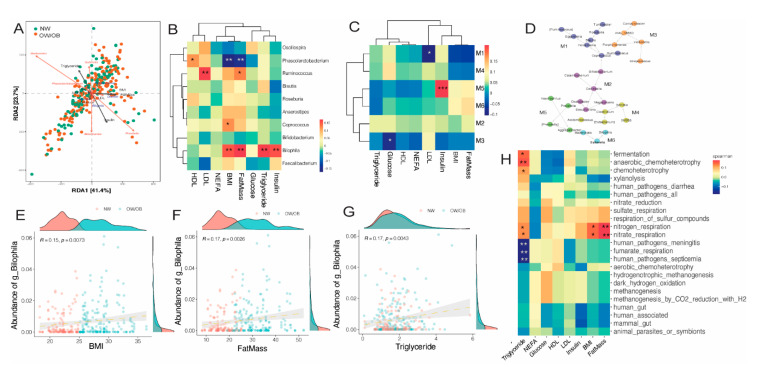
Maternal body composition, gestational weight gain (GWG) and diet quality influence offspring obesity risk. While the gut microbiome is thought to play a crucial role, it is understudied in pregnancy. Using a longitudinal pregnancy cohort, maternal anthropometrics, body composition, fecal microbiome and dietary intake were assessed at 12, 24 and 36 weeks of gestation. Fecal samples ( = 101, 98 and 107, at each trimester, respectively) were utilized for microbiome analysis via 16S rRNA amplicon sequencing. Data analysis included alpha- and beta-diversity measures and assessment of compositional changes using . Correlation analyses of serum metabolic and anthropometric markers were performed against bacterial abundance and predicted functional pathways. α-diversity was unaltered by pregnancy stage or maternal obesity status. Actinobacteria, , , , and abundances were associated with gestation stage. Maternal obesity status was associated with increased abundance , , and . Maternal BMI, fat mass, triglyceride and insulin levels were positively associated with . Correlations of bacterial abundance with diet intake showed that and were associated with total fat and unsaturated fatty acid intake, while and were associated with protein intake. While causal relationships remain unclear, collectively, these findings indicate pregnancy- and maternal obesity-dependent interactions between dietary factors and the maternal gut microbiome.
母体的身体成分、妊娠体重增加(GWG)和饮食质量会影响后代肥胖的风险。虽然肠道微生物群被认为起着至关重要的作用,但在怀孕期间对其研究还很不足。本研究使用纵向妊娠队列,在妊娠 12、24 和 36 周时评估了母体人体测量学、身体成分、粪便微生物群和饮食摄入量。利用 16S rRNA 扩增子测序对粪便样本(每个孕期分别为 101、98 和 107 个样本)进行了微生物组分析。数据分析包括 alpha 和 beta 多样性测量,并使用 评估组成变化。对血清代谢和人体测量标记物与细菌丰度和预测功能途径进行了相关分析。妊娠阶段或母体肥胖状况并未改变 alpha 多样性。厚壁菌门、拟杆菌门、变形菌门、放线菌门、梭杆菌门和疣微菌门的丰度与妊娠阶段有关。母体肥胖状况与 增加的丰度有关。母体 BMI、脂肪量、甘油三酯和胰岛素水平与 呈正相关。虽然细菌丰度与饮食摄入的相关性仍然不清楚,但这些发现表明,饮食因素与母体肠道微生物群之间存在与妊娠阶段和母体肥胖相关的相互作用。