Division of Pulmonary and Critical Care Medicine, Department of Medicine, University of California, San Francisco, CA, USA.
Institute for Global Health Sciences, University of California, San Francisco, CA, USA.
BMC Infect Dis. 2021 Sep 27;21(1):1011. doi: 10.1186/s12879-021-06609-3.
Contact investigation, the systematic evaluation of individuals in close contact with an infectious tuberculosis (TB) patient, is a key active case-finding strategy for global TB control. Better estimates of the yield of contact investigation can guide strategies to reduce the number of underreported and underdiagnosed TB cases, approximately three million cases per year globally. A systematic review (Prospero ID # CRD42019133380) and meta-analysis was conducted to update and enhance the estimates of the yield of TB contact investigation in low- and middle-income countries (LMIC). Pubmed, Web of Science, Embase and the WHO Global Index Medicus were searched for peer-reviewed studies (published between January 2006-April 2019); studies reporting the number of active TB or latent tuberculosis infection (LTBI) found through contact investigation were included. Pooled data were meta-analyzed using a random effects model and risk of bias was assessed.
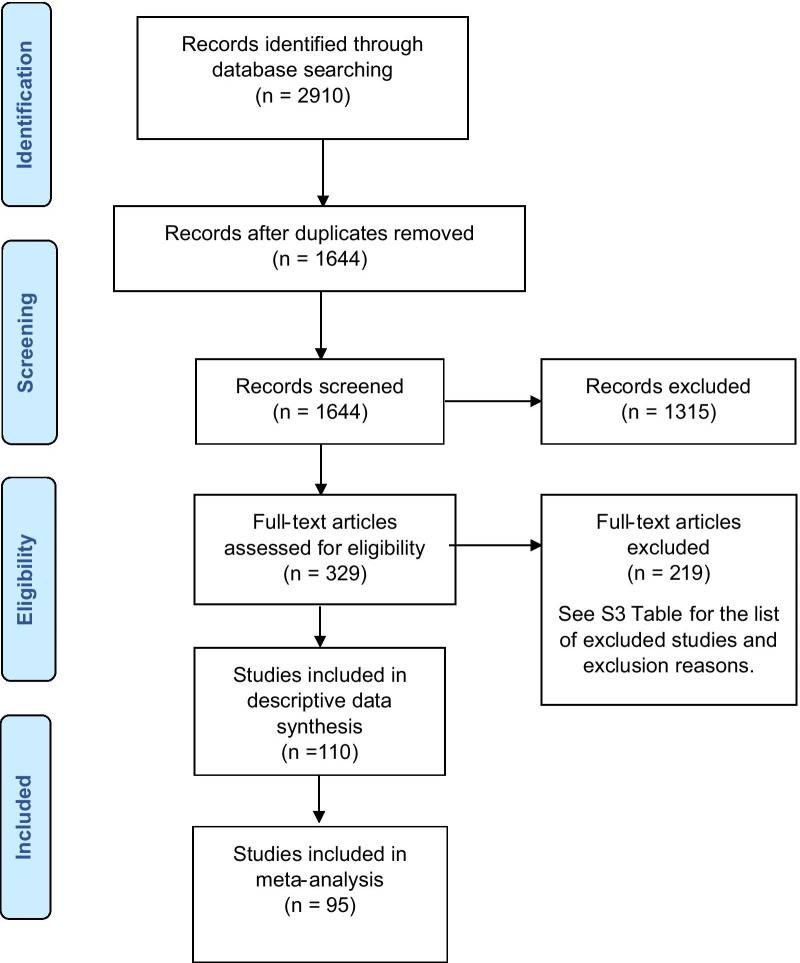
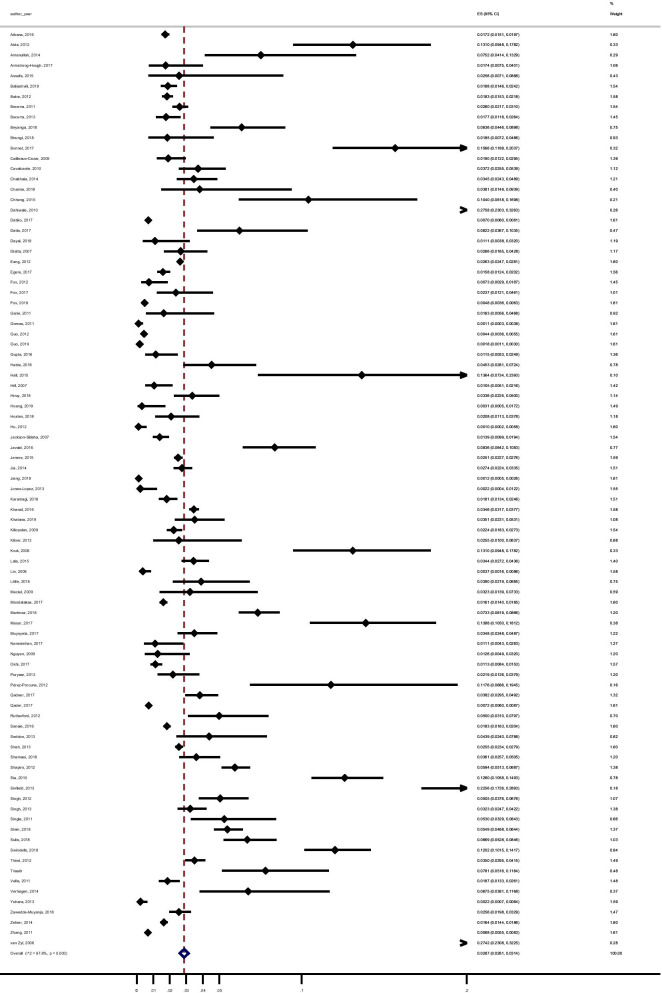
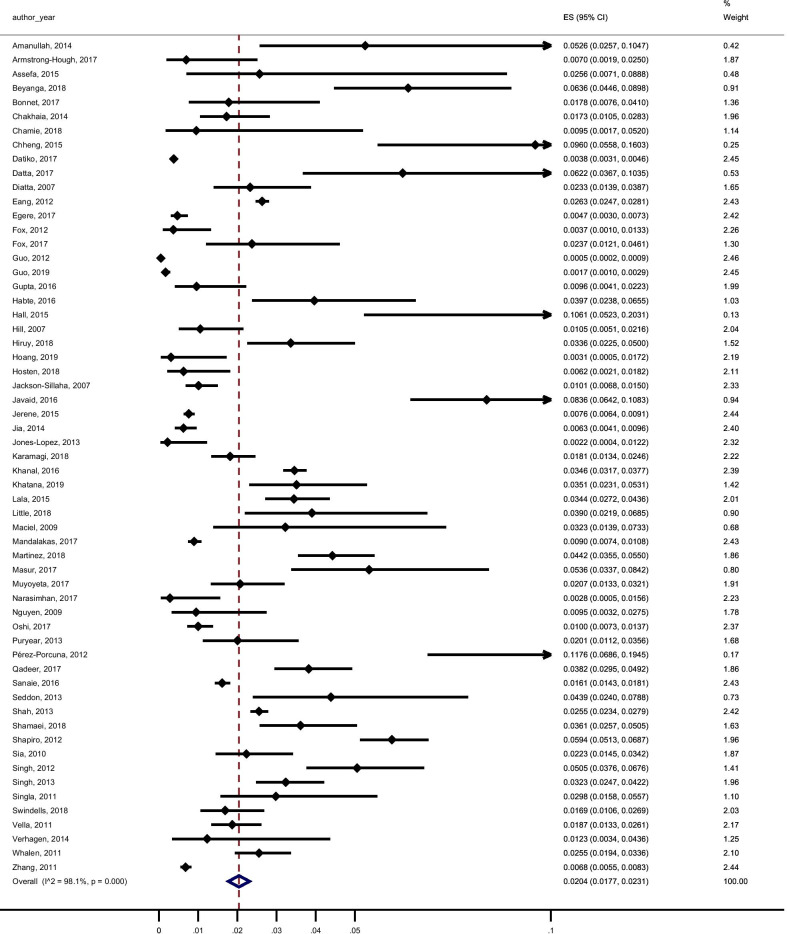
Of 1,644 unique citations obtained from database searches, 110 studies met eligibility criteria for descriptive data synthesis and 95 for meta-analysis. The pooled yields of contact investigation activities for different outcomes were: secondary cases of all active TB (defined as those bacteriologically confirmed or clinically diagnosed) 2.87% (2.61-3.14, I 97.79%), bacteriologically confirmed active TB 2.04% (1.77-2.31, I 98.06%), and LTBI 43.83% (38.11-49.55, I 99.36%). Yields are interpreted as the percent of contacts screened who are diagnosed with active TB as a result of TB contact investigation activities. Pooled estimates were substantially heterogenous (I ≥ 75%).
This study provides methodologically rigorous and up-to-date estimates for the yield of TB contact investigation activities in low- and middle-income countries (LMIC). While the data are heterogenous, these findings can inform strategic and programmatic planning for scale up of TB contact investigation activities.
接触者调查是对与传染性肺结核(TB)患者密切接触的个体进行系统评估的一种关键的主动病例发现策略,是全球结核病控制的关键策略。更好地估计接触者调查的效果可以指导减少全球每年约 300 万例漏报和漏诊结核病病例的策略。本系统评价(Prospéro 注册号:CRD42019133380)和荟萃分析更新并增强了对中低收入国家(LMIC)TB 接触者调查效果的估计。检索了同行评议研究(发表于 2006 年 1 月至 2019 年 4 月)的 Pubmed、Web of Science、Embase 和世界卫生组织全球医学索引;包括通过接触者调查发现的活动性结核病或潜伏性结核感染(LTBI)的数量报告。使用随机效应模型对汇总数据进行荟萃分析,并评估偏倚风险。
从数据库检索中获得的 1644 个独特引用中,有 110 项研究符合描述性数据综合的入选标准,95 项研究符合荟萃分析的入选标准。不同结局的接触者调查活动的汇总效果为:所有活动性 TB 的二级病例(定义为经细菌学证实或临床诊断的病例)为 2.87%(2.61-3.14,I 97.79%),经细菌学证实的活动性 TB 为 2.04%(1.77-2.31,I 98.06%),LTBI 为 43.83%(38.11-49.55,I 99.36%)。效果被解释为通过 TB 接触者调查活动筛查的接触者中诊断为活动性 TB 的百分比。汇总估计存在很大的异质性(I≥75%)。
本研究提供了中低收入国家(LMIC)TB 接触者调查效果的方法学严格且最新的估计。虽然数据存在异质性,但这些发现可以为扩大 TB 接触者调查活动的规模提供战略和规划信息。