Institute of Health and Wellbeing, University of Glasgow, Glasgow, UK.
British Heart Foundation Glasgow Cardiovascular Research Centre, Institute of Cardiovascular and Medical Sciences, College of Medical, Veterinary and Life Sciences, University of Glasgow, Glasgow, G12 8TA, UK.
BMC Med. 2020 Nov 10;18(1):355. doi: 10.1186/s12916-020-01822-4.
Frailty has been associated with worse prognosis following COVID-19 infection. While several studies have reported the association between frailty and COVID-19 mortality or length of hospital stay, there have been no community-based studies on the association between frailty and risk of severe infection. Considering that different definitions have been identified to assess frailty, this study aimed to compare the association between frailty and severe COVID-19 infection in UK Biobank using two frailty classifications: the frailty phenotype and the frailty index.
A total of 383,845 UK Biobank participants recruited 2006-2010 in England (211,310 [55.1%] women, baseline age 37-73 years) were included. COVID-19 test data were provided by Public Health England (available up to 28 June 2020). An adapted version of the frailty phenotype derived by Fried et al. was used to define frailty phenotype (robust, pre-frail, or frail). A previously validated frailty index was derived from 49 self-reported questionnaire items related to health, disease and disability, and mental wellbeing (robust, mild frailty, and moderate/severe frailty). Both classifications were derived from baseline data (2006-2010). Poisson regression models with robust standard errors were used to analyse the associations between both frailty classifications and severe COVID-19 infection (resulting in hospital admission or death), adjusted for sociodemographic and lifestyle factors.
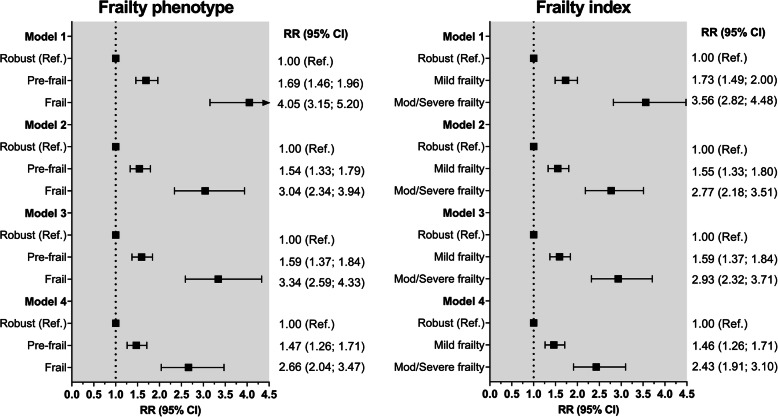
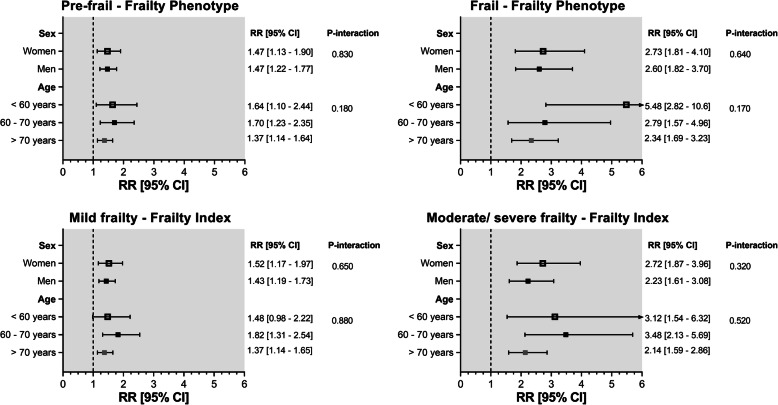
Of UK Biobank participants included, 802 were admitted to hospital with and/or died from COVID19 (323 deaths and 479 hospitalisations). After analyses were adjusted for sociodemographic and lifestyle factors, a higher risk of COVID-19 was observed for pre-frail (risk ratio (RR) 1.47 [95% CI 1.26; 1.71]) and frail (RR 2.66 [95% CI 2.04; 3.47]) individuals compared to those classified as robust using the frailty phenotype. Similar results were observed when the frailty index was used (RR mildly frail 1.46 [95% CI 1.26; 1.71] and RR moderate/severe frailty 2.43 [95% CI 1.91; 3.10]).
Frailty was associated with a higher risk of severe COVID-19 infection resulting in hospital admission or death, irrespective of how it was measured and independent of sociodemographic and lifestyle factors. Public health strategies need to consider the additional risk that COVID-19 poses in individuals with frailty, including which additional preventive measures might be required.
虚弱与 COVID-19 感染后的预后较差有关。虽然有几项研究报告了虚弱与 COVID-19 死亡率或住院时间之间的关系,但尚无针对社区人群中虚弱与严重感染风险之间关系的研究。考虑到已经确定了不同的定义来评估虚弱,本研究旨在使用两种虚弱分类方法(虚弱表型和虚弱指数)比较 UK Biobank 中虚弱与严重 COVID-19 感染之间的关系。
共纳入 383845 名于 2006-2010 年在英格兰招募的 UK Biobank 参与者(211310 名女性[55.1%],基线年龄 37-73 岁)。英格兰公共卫生部(Public Health England)提供了 COVID-19 检测数据(截至 2020 年 6 月 28 日可用)。使用由 Fried 等人推导的虚弱表型的改编版本来定义虚弱表型(强壮、前期虚弱或虚弱)。以前验证过的虚弱指数是由 49 个与健康、疾病和残疾以及心理健康相关的自我报告问卷项目得出的(强壮、轻度虚弱和中度/重度虚弱)。这两种分类都是从基线数据(2006-2010 年)中得出的。使用泊松回归模型(具有稳健标准差)分析了两种虚弱分类与严重 COVID-19 感染(导致住院或死亡)之间的关联,调整了社会人口统计学和生活方式因素。
在纳入的 UK Biobank 参与者中,有 802 人因 COVID19 住院和/或死亡(323 人死亡,479 人住院)。在调整了社会人口统计学和生活方式因素后,与被归类为强壮的人相比,前期虚弱(RR 1.47[95%CI 1.26;1.71])和虚弱(RR 2.66[95%CI 2.04;3.47])个体患 COVID-19 的风险更高。当使用虚弱指数时,观察到了类似的结果(RR 轻度虚弱 1.46[95%CI 1.26;1.71]和 RR 中度/重度虚弱 2.43[95%CI 1.91;3.10])。
虚弱与严重 COVID-19 感染导致住院或死亡的风险增加有关,无论如何测量,都与社会人口统计学和生活方式因素无关。公共卫生策略需要考虑 COVID-19 对虚弱个体构成的额外风险,包括可能需要采取哪些额外的预防措施。