Human Immunobiology and Pathogenesis Group, Lisboa, Portugal.
iNOVA4Health | CEDOC, NOVA Medical School | Faculdade de Ciências Médicas, NOVA University of Lisbon, Lisboa, Portugal.
Commun Biol. 2021 Sep 27;4(1):1135. doi: 10.1038/s42003-021-02659-0.
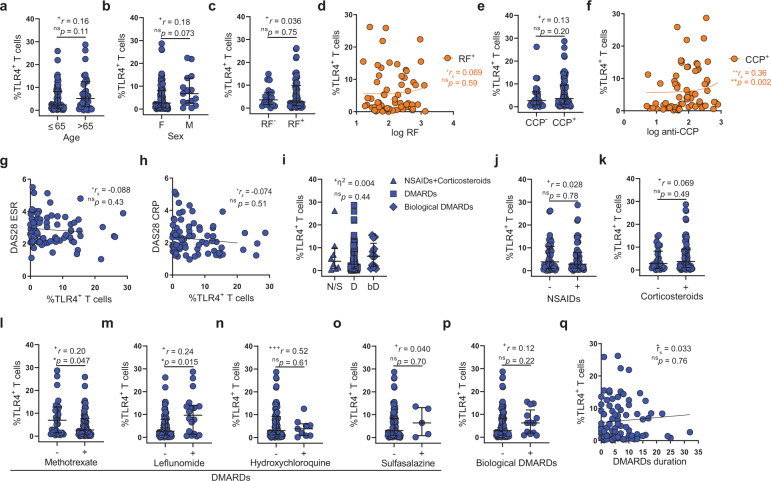
CD4 T cells mediate rheumatoid arthritis (RA) pathogenesis through both antibody-dependent and independent mechanisms. It remains unclear how synovial microenvironment impinges on CD4 T cells pathogenic functions. Here, we identified a TLR4 follicular helper T (Tfh) cell-like population present in the blood and expanded in synovial fluid. TLR4 T cells possess a two-pronged pathogenic activity whereby direct TLR4 engagement by endogenous ligands in the arthritic joint reprograms them from an IL-21 response, known to sponsor antibody production towards an IL-17 inflammatory program recognized to fuel tissue damage. Ex vivo, synovial fluid TLR4 T cells produced IL-17, but not IL-21. Blocking TLR4 signaling with a specific inhibitor impaired IL-17 production in response to synovial fluid recognition. Mechanistically, we unveiled that T-cell HLA-DR regulates their TLR4 expression. TLR4 T cells appear to uniquely reconcile an ability to promote systemic antibody production with a local synovial driven tissue damage program.
CD4 T 细胞通过抗体依赖和非依赖机制介导类风湿关节炎(RA)的发病机制。滑膜微环境如何影响 CD4 T 细胞的致病功能仍不清楚。在这里,我们在血液中鉴定出一种存在于滑膜液中的 TLR4 滤泡辅助 T(Tfh)细胞样群体,并在滑膜液中扩增。TLR4 T 细胞具有双重致病活性,即关节内内源性配体直接与 TLR4 结合,将其从已知促进抗体产生的 IL-21 反应重新编程为已知促进组织损伤的 IL-17 炎症程序。在体外,滑膜液 TLR4 T 细胞产生 IL-17,但不产生 IL-21。用特异性抑制剂阻断 TLR4 信号通路可抑制对滑膜液识别的 IL-17 产生。从机制上讲,我们揭示了 T 细胞 HLA-DR 调节其 TLR4 表达。TLR4 T 细胞似乎独特地协调了促进全身抗体产生的能力与局部滑膜驱动的组织损伤程序。