Infectious Diseases and Tropical Medicine Research Center, Health Research Institute, Babol University of Medical Sciences, Babol, Iran.
Department of Biostatistics and Epidemiology, School of Public Health, Babol University of Medical Sciences, Babol, Iran.
Clin Microbiol Infect. 2021 Dec;27(12):1762-1771. doi: 10.1016/j.cmi.2021.09.019. Epub 2021 Sep 25.
With limited vaccine supplies, an informed position on the status of SARS-CoV-2 infection in people can assist the prioritization of vaccine deployment.
We performed a systematic review and meta-analysis to estimate the global and regional SARS-CoV-2 seroprevalences around the world.
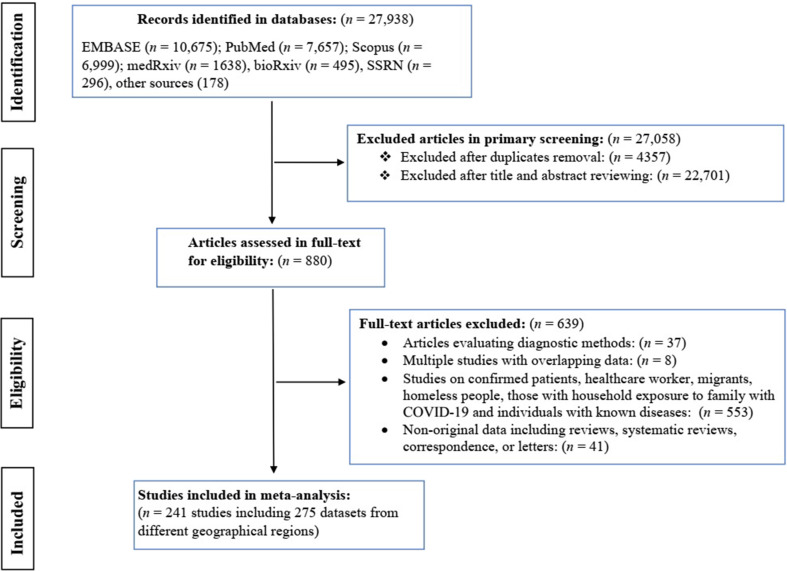
We systematically searched peer-reviewed databases (PubMed, Embase and Scopus), and preprint servers (medRxiv, bioRxiv and SSRN) for articles published between 1 January 2020 and 30 March 2021.
Population-based studies reporting the SARS-CoV-2 seroprevalence in the general population were included.
People of different age groups, occupations, educational levels, ethnic backgrounds and socio-economic status from the general population.
There were no interventions.
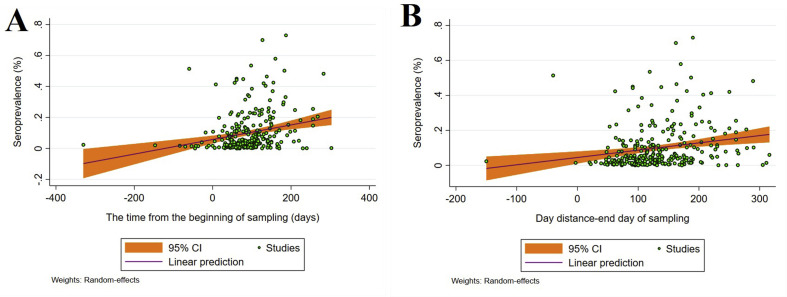
We used the random-effects meta-analyses and empirical Bayesian method to estimate the pooled seroprevalence and conducted subgroup and meta-regression analyses to explore potential sources of heterogeneity as well as the relationship between seroprevalence and socio-demographics.
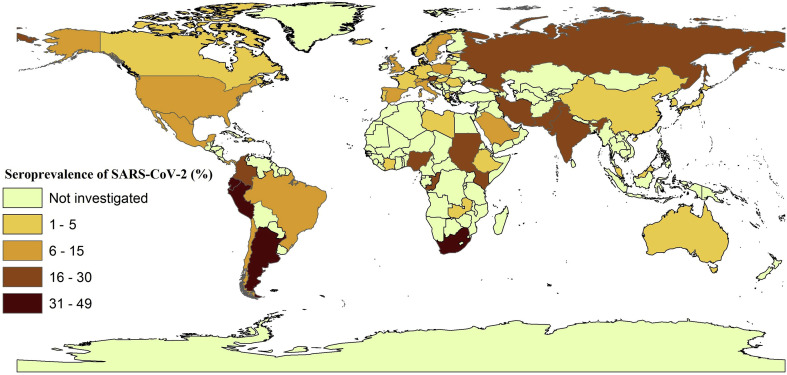
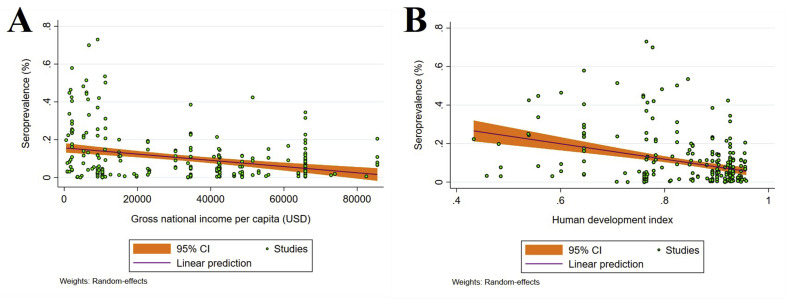
We identified 241 eligible studies involving 6.3 million individuals from 60 countries. The global pooled seroprevalence was 9.47% (95% CI 8.99-9.95%), although the heterogeneity among studies was significant (I = 99.9%). We estimated that ∼738 million people had been infected with SARS-CoV-2 (as of December 2020). Highest and lowest seroprevalences were recorded in Central and Southern Asia (22.91%, 19.11-26.72%) and Eastern and South-eastern Asia (1.62%, 1.31-1.95%), respectively. Seroprevalence estimates were higher in males, persons aged 20-50 years, in minority ethnic groups living in countries or regions with low income and human development indices.
The present study indicates that the majority of the world's human population was still highly susceptible to SARS-CoV-2 infection in mid-2021, emphasizing the need for vaccine deployment to vulnerable groups of people, particularly in developing countries, and for the implementation of enhanced preventive measures until 'herd immunity' to SARS-CoV-2 has developed.
鉴于疫苗供应有限,了解 SARS-CoV-2 感染在人群中的状况有助于优先部署疫苗。
我们进行了系统评价和荟萃分析,以估计全球和区域 SARS-CoV-2 的血清流行率。
我们系统地检索了同行评议数据库(PubMed、Embase 和 Scopus)和预印本服务器(medRxiv、bioRxiv 和 SSRN),以获取 2020 年 1 月 1 日至 2021 年 3 月 30 日期间发表的文章。
纳入了报告一般人群中 SARS-CoV-2 血清流行率的基于人群的研究。
来自一般人群的不同年龄组、职业、教育水平、种族背景和社会经济地位的人群。
无干预措施。
我们使用随机效应荟萃分析和经验贝叶斯方法来估计合并血清流行率,并进行亚组和荟萃回归分析,以探索潜在的异质性来源以及血清流行率与社会人口统计学之间的关系。
我们确定了 241 项符合条件的研究,涉及来自 60 个国家的 630 万人。全球合并血清流行率为 9.47%(95% CI 8.99-9.95%),尽管研究之间的异质性非常显著(I=99.9%)。我们估计,截至 2020 年 12 月,约有 7.38 亿人感染了 SARS-CoV-2。血清流行率最高和最低的地区分别为中亚和南亚(22.91%,19.11-26.72%)和东亚和东南亚(1.62%,1.31-1.95%)。男性、20-50 岁人群、生活在低收入和人类发展指数较低国家或地区的少数民族中,血清流行率估计值较高。
本研究表明,2021 年中期,世界上大多数人口仍极易感染 SARS-CoV-2,这强调了需要向弱势群体,特别是发展中国家的人群部署疫苗,并实施强化预防措施,直到 SARS-CoV-2 建立“群体免疫”。