Hernández-Rivero Isabel, Blechert Jens, Miccoli Laura, Eichin Katharina Naomi, Fernández-Santaella M Carmen, Delgado-Rodríguez Rafael
Mind, Brain, and Behavior Research Center (CIMCYC), University of Granada, Campus de Cartuja s/n, 18071, Granada, España.
Department of Psychology, Centre for Cognitive Neuroscience, Paris-Lodron-University of Salzburg, Hellbrunnerstraße 34, 5020, Salzburg, Austria.
J Eat Disord. 2021 Sep 28;9(1):120. doi: 10.1186/s40337-021-00475-9.
Studies on food cue reactivity have documented that altered responses to high-calorie food are associated with bulimic symptomatology, however, alterations in sexual motivations and behaviors are also associated clinical features in this population, which justify their inclusion as a research target. Here, we study responses to erotic cues-alongside food, neutral and aversive cues-to gain an understanding of specificity to food versus a generalized sensitivity to primary reinforcers.
We recorded peripheral psychophysiological indices -the startle reflex, zygomaticus, and corrugator responses-and self-reported emotional responses (valence, arousal, and dominance) in 75 women completing the Bulimia Test-Revised (BULIT-R). Multiple regression analysis tested whether BULIT-R symptoms were predicted by self-reported and psychophysiological responses to food versus neutral and erotic versus neutral images.
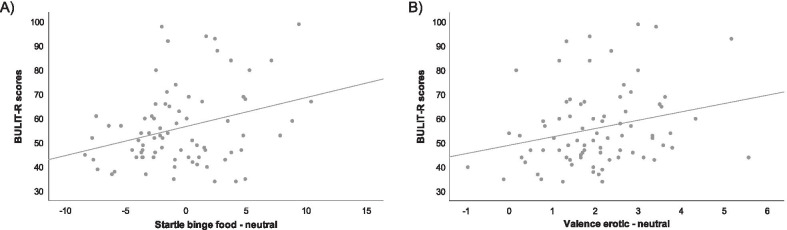
The results showed that individuals with higher bulimic symptoms were characterized by potentiated eye blink startle response during binge food (vs. neutral images) and more positive valence ratings during erotic (vs. neutral) cues.
The results highlight the negative emotional reactivity of individuals with elevated bulimic symptoms toward food cues, which could be related to the risk of progression to full bulimia nervosa and thereby addressed in prevention efforts. Results also point to the potential role of reactivity to erotic content, at least on a subjective level. Theoretical models of eating disorders should widen their conceptual scope to consider reactivity to a broader spectrum of primary reinforcers, which would have implications for cue exposure-based treatments. We examined appetitive and aversive cue responses in college women to investigate how bulimic symptoms relate to primary reinforcers such as food and erotic images. We recorded peripheral psychophysiological indices (the startle reflex, zygomaticus, and corrugator responses) and self-reported emotional responses (valence, arousal, and dominance) in 75 college women that were presented with the Spanish version of the Bulimia Test-Revised. The results showed that bulimic symptoms increase both psychophysiological defensiveness toward food cues and subjective pleasure toward erotic cues. The findings suggest a generalized sensitivity to primary reinforcers in the presence of bulimic symptoms, and emphasize the relevance of adopting a wider framework in research and treatment on bulimia nervosa.
关于食物线索反应性的研究表明,对高热量食物反应的改变与暴食症状有关,然而,性动机和行为的改变也是该人群的相关临床特征,这使得将其纳入研究目标具有合理性。在此,我们研究对色情线索以及食物、中性和厌恶线索的反应,以了解对食物的特异性反应与对主要强化物的普遍敏感性。
我们记录了75名完成修订版暴食测试(BULIT-R)的女性的外周心理生理指标——惊跳反射、颧肌和皱眉肌反应——以及自我报告的情绪反应(效价、唤醒和支配性)。多元回归分析测试了BULIT-R症状是否由对食物与中性图像、色情与中性图像的自我报告和心理生理反应预测。
结果显示,暴食症状较高的个体的特征是在暴食食物(与中性图像相比)期间眨眼惊跳反应增强,以及在色情(与中性相比)线索期间有更积极的效价评分。
结果突出了暴食症状升高的个体对食物线索的负面情绪反应性,这可能与发展为完全神经性贪食症的风险有关,因此在预防工作中应予以关注。结果还指出了对色情内容反应性的潜在作用,至少在主观层面上是如此。饮食失调的理论模型应拓宽其概念范围,以考虑对更广泛的主要强化物的反应性,这将对基于线索暴露的治疗产生影响。我们研究了大学女性对食欲和厌恶线索的反应,以调查暴食症状与食物和色情图像等主要强化物之间的关系。我们记录了75名接受西班牙语版修订版暴食测试的大学女性的外周心理生理指标(惊跳反射、颧肌和皱眉肌反应)和自我报告的情绪反应(效价、唤醒和支配性)。结果表明,暴食症状会增加对食物线索的心理生理防御性以及对色情线索的主观愉悦感。研究结果表明在存在暴食症状的情况下对主要强化物具有普遍敏感性,并强调在神经性贪食症的研究和治疗中采用更广泛框架的相关性。