Hiluy Joao C, David Isabel A, Daquer Adriana F C, Duchesne Monica, Volchan Eliane, Appolinario Jose C
Obesity and Eating Disorders Group, Institute of Psychiatry, Federal University of Rio de Janeiro, Rio de Janeiro, Brazil.
Laboratory of Behavioral Neurophysiology, Physiology and Pharmacology Department, Biomedical Institute, Federal Fluminense University, Niteroi, Brazil.
Front Psychol. 2021 Apr 29;12:619780. doi: 10.3389/fpsyg.2021.619780. eCollection 2021.
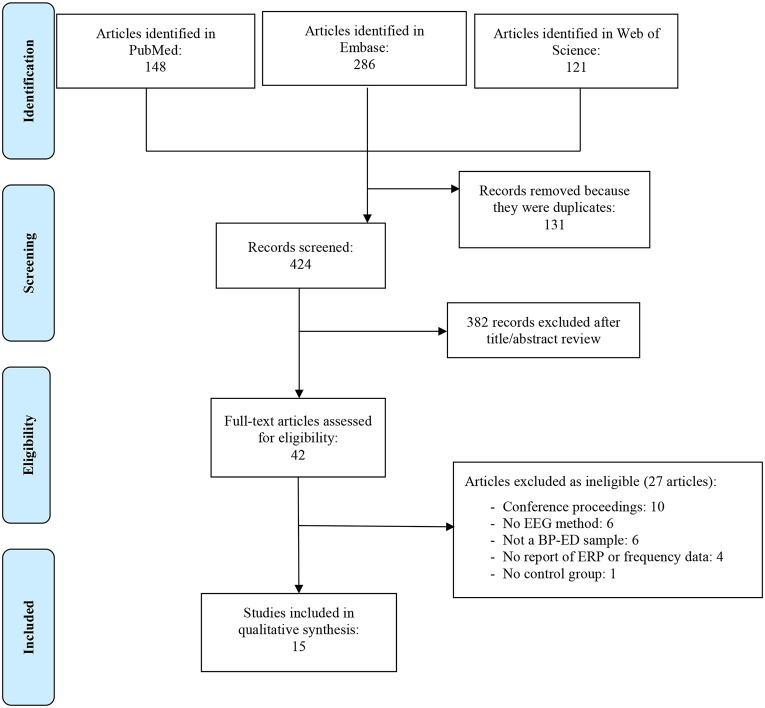
Binge-purge eating disorders (BP-ED), such as bulimia nervosa and binge eating disorder, may share some neurobiological features. Electroencephalography (EEG) is a non-invasive measurement modality that may aid in research and diagnosis of BP-ED. We conducted a systematic review of the literature on EEG findings in BP-ED, seeking to summarize and analyze the current evidence, as well as identify shortcomings and gaps to inform new perspectives for future studies. Following PRISMA Statement recommendations, the PubMed, Embase, and Web of Science databases were searched using terms related to "electroencephalography" and "binge-purge" eating disorders. Of 555 articles retrieved, 15 met predefined inclusion criteria and were included for full-text analysis. Eleven studies investigated EEG by means of event-related potentials (ERP) in BP-ED individuals: 7 using eating disorder-related stimuli (i.e., food, body image) and 4 using non-eating disorder-related stimuli (i.e., facial expressions or auditory clicks). These studies found significant differences in the N200, P200, P300, and LPP components in BP-ED participants compared to controls, indicating that this population exhibits impairments in selective attention, attentional allocation/processing, and allocation of motivational or emotion-based attention. Five studies investigated EEG using frequency analysis; reporting significant differences in beta activity in fronto-temporal and occipito-temporo-parietal areas in BP-ED individuals compared to controls, revealing a dysfunctional brain network. However, the small number of studies, the heterogeneity of samples, study paradigms, stimulus types, and the lack of an adequate assessment of neuropsychological parameters are some limitations of the current literature. Although some EEG data are promising and consistent with neuroimaging and neuropsychological findings in individuals with BP-ED, future studies need to overcome current methodological shortcomings.
暴饮暴食型进食障碍(BP-ED),如神经性贪食症和暴饮暴食症,可能具有一些共同的神经生物学特征。脑电图(EEG)是一种非侵入性测量方法,可能有助于BP-ED的研究和诊断。我们对有关BP-ED脑电图研究结果的文献进行了系统综述,旨在总结和分析当前证据,并找出不足之处和差距,为未来研究提供新的视角。按照PRISMA声明的建议,我们在PubMed、Embase和科学网数据库中搜索了与“脑电图”和“暴饮暴食型”进食障碍相关的术语。在检索到的555篇文章中,有15篇符合预定义的纳入标准,并被纳入全文分析。11项研究通过事件相关电位(ERP)对BP-ED个体进行脑电图研究:7项使用与进食障碍相关的刺激(即食物、身体形象),4项使用与进食障碍无关的刺激(即面部表情或听觉点击)。这些研究发现,与对照组相比,BP-ED参与者的N200、P200、P300和LPP成分存在显著差异,表明该人群在选择性注意、注意力分配/处理以及基于动机或情感的注意力分配方面存在障碍。5项研究使用频率分析进行脑电图研究;报告称,与对照组相比,BP-ED个体额颞叶和枕颞顶叶区域的β活动存在显著差异,揭示了大脑网络功能失调。然而,研究数量较少、样本的异质性、研究范式、刺激类型以及对神经心理学参数缺乏充分评估是当前文献的一些局限性。尽管一些脑电图数据很有前景,并且与BP-ED个体的神经影像学和神经心理学研究结果一致,但未来的研究需要克服当前的方法学缺陷。