Akhavanhezaveh Ardalan, Abbasi-Kesbi Reza
Faculty of Engineering Monash University Melbourne Australia.
MEMS & NEMS Department Faculty of New Sciences and Technologies University of Tehran Tehran Iran.
Healthc Technol Lett. 2021 Jun 14;8(5):118-127. doi: 10.1049/htl2.12015. eCollection 2021 Oct.
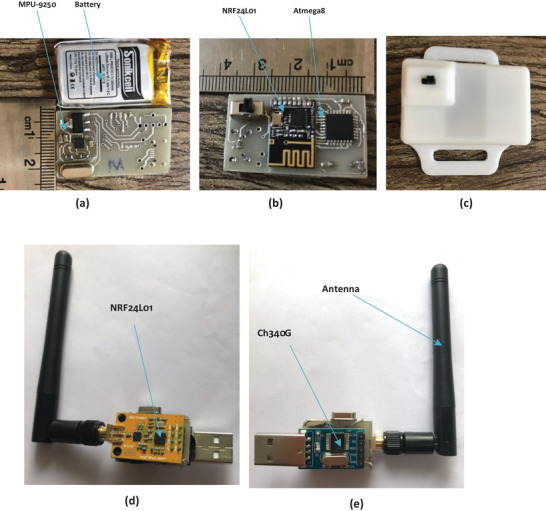
Here, a sensory motion system is developed to diagnose gait disorders using the estimation of angular variations in the knee and ankle joints. The sensory system includes two transmitter sensors and a central node, where each transmitter comprises three sensors of accelerometer, gyroscopes, and magnetometer to estimate the angular movements in the ankle and knee joints. By using a proposed filter, the angular variation is estimated in a personal computer employing the raw data of the motion sensors that are sent by the central node. The obtained results of the presented filter in comparison to an actual reference illustrate that the root mean square error is less than 1.01, 1.34, and 1.61 degrees, respectively, for the angles of and and that illustrate an improvement of 40% than the previous work. Moreover, a quantity value is defined based on the correlation between knee and ankle angles that show the amount of correctness in gating. Thus, the proposed system can be utilized for people who suffer problems in gait and help them to improve their movements.
在此,开发了一种感觉运动系统,通过估计膝关节和踝关节的角度变化来诊断步态障碍。该感觉系统包括两个发射传感器和一个中央节点,其中每个发射传感器包括加速度计、陀螺仪和磁力计这三个传感器,用于估计踝关节和膝关节的角度运动。通过使用所提出的滤波器,利用中央节点发送的运动传感器的原始数据,在个人计算机中估计角度变化。与实际参考相比,所提出滤波器的所得结果表明,对于 、 和 的角度,均方根误差分别小于1.01度、1.34度和1.61度,这表明比之前的工作有40%的改进。此外,基于膝关节和踝关节角度之间的相关性定义了一个量值,该量值显示了步态的正确程度。因此,所提出的系统可用于患有步态问题的人群,并帮助他们改善运动。