Shanghai Key Laboratory of Maternal Fetal Medicine, Clinical and Translational Research Center of Shanghai First Maternity and Infant Hospital, School of Life Sciences and Technology, Tongji University, Shanghai, China.
Anhui Toneker Biotechnology Co., Ltd., Jinzhai, China.
Cell Prolif. 2021 Nov;54(11):e13133. doi: 10.1111/cpr.13133. Epub 2021 Sep 28.
Maternal factors that are enriched in oocytes have attracted great interest as possible key factors in somatic cell reprogramming. We found that surfeit locus protein 4 (Surf4), a maternal factor, can facilitate the generation of induced pluripotent stem cells (iPSCs) previously, but the mechanism remains elusive.
In this study, we investigated the function and mechanism of Surf4 in somatic cell reprogramming using a secondary reprogramming system. Alkaline phosphatase (AP) staining, qPCR and immunofluorescence (IF) staining of expression of related markers were used to evaluate efficiency of iPSCs derived from mouse embryonic fibroblasts. Embryoid body and teratoma formation assays were performed to evaluate the differentiation ability of the iPSC lines. RNA-seq, qPCR and western blot analysis were applied to validate the downstream targets of Surf4.
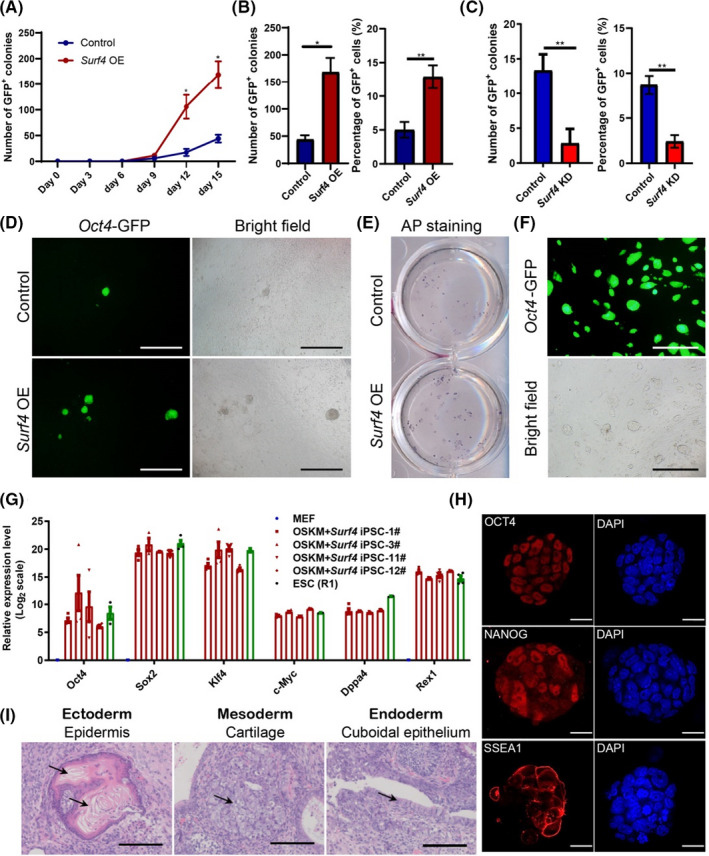
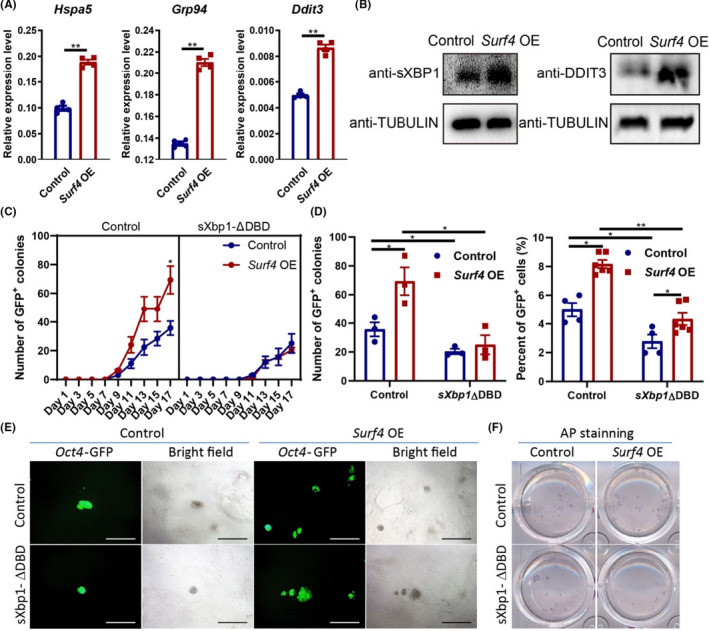
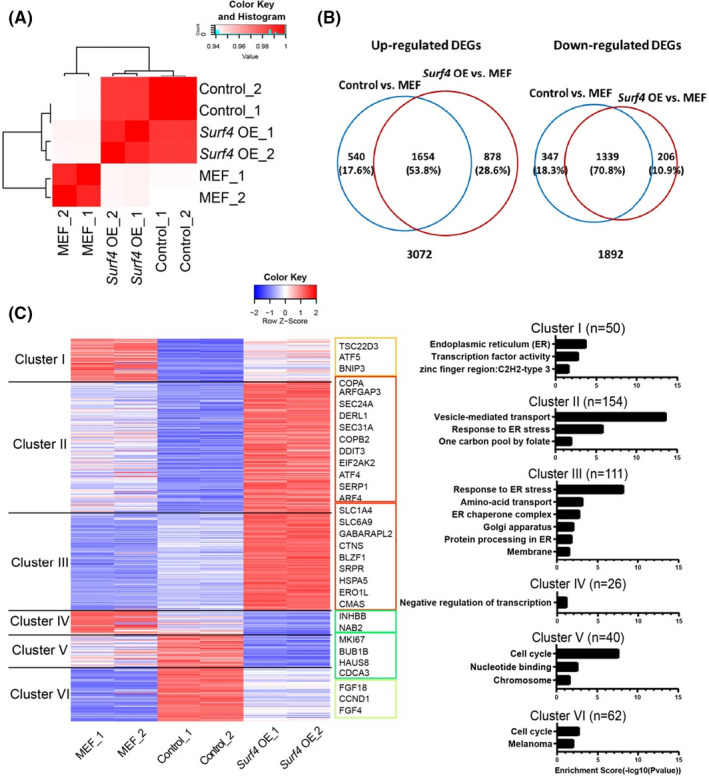
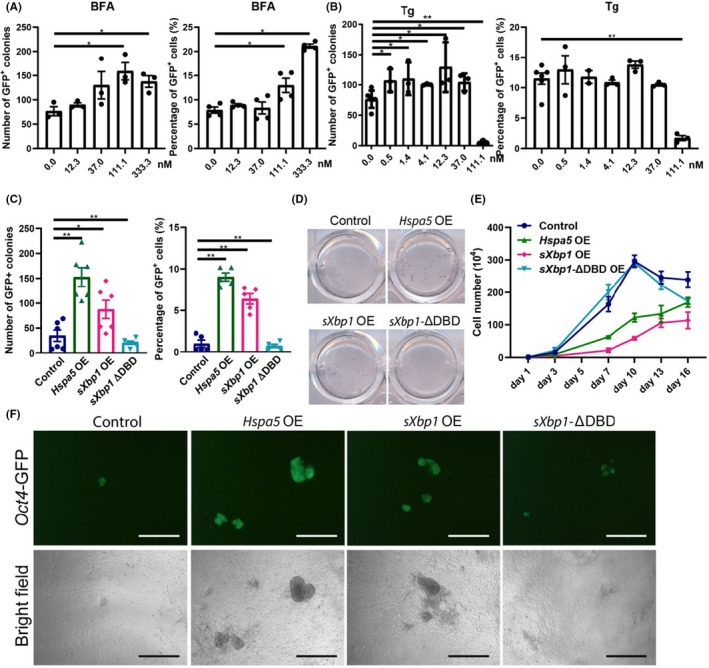
Surf4 can significantly facilitate the generation of iPSCs in a proliferation-independent manner. When co-expressed with Oct4, Sox2, Klf4 and c-Myc (OSKM), Surf4 can activate the response to endoplasmic reticulum (ER) stress at the early stage of reprogramming. We further demonstrated that Hspa5, a major ER chaperone, and the active spliced form of Xbp1 (sXbp1), a major mediator of ER stress, can mimic the effects of Surf4 on somatic cell reprogramming. Concordantly, blocking the unfolded protein response compromises the effect of Surf4 on reprogramming.
Surf4 promotes somatic cell reprogramming by activating the response to ER stress.
卵母细胞中富含的母体因子作为体细胞重编程的可能关键因子引起了极大的兴趣。我们发现,先前过剩基因座蛋白 4(Surf4)作为一种母体因子,可促进诱导多能干细胞(iPSCs)的产生,但机制尚不清楚。
在这项研究中,我们使用次级重编程系统研究了 Surf4 在体细胞重编程中的功能和机制。碱性磷酸酶(AP)染色、qPCR 和免疫荧光(IF)染色表达相关标记物用于评估从小鼠胚胎成纤维细胞中获得的 iPSCs 的效率。胚胎体和畸胎瘤形成测定用于评估 iPSC 系的分化能力。RNA-seq、qPCR 和 Western blot 分析用于验证 Surf4 的下游靶标。
Surf4 可以在非增殖依赖性方式中显著促进 iPSC 的产生。当与 Oct4、Sox2、Klf4 和 c-Myc(OSKM)共表达时,Surf4 可以在重编程的早期激活对内质网(ER)应激的反应。我们进一步证明,Hspa5(一种主要的 ER 伴侣蛋白)和 Xbp1(ER 应激的主要介质)的活性剪接形式(sXbp1)可以模拟 Surf4 对体细胞重编程的作用。一致地,阻断未折叠蛋白反应会损害 Surf4 对重编程的作用。
Surf4 通过激活 ER 应激反应促进体细胞重编程。