Department of Orthopaedics, The Frist Affiliated Hospital of Soochow University, No. 188 Shizi Street, Suzhou, Jiangsu, 215006, People's Republic of China.
Key Laboratory of Animal Breeding Reproduction and Molecular Design for Jiangsu Province, College of Animal Science and Technology, Yangzhou University, 88 South University Ave., Yangzhou, Jiangsu, 225009, People's Republic of China.
BMC Biotechnol. 2017 Feb 13;17(1):11. doi: 10.1186/s12896-017-0336-7.
Traditional approaches for generating goat pluripotent stem cells (iPSCs) suffer from complexity and low preparation efficiency. Therefore, we tried to derive goat iPSCs with a new method by transfecting exogenous Oct4, Sox2, Klf4 and c-Myc mRNAs into goat embryonic fibroblasts (GEFs), and explore the mechanisms regarding the transcription regulation of the reprogramming factors in goat iPSCs induction.
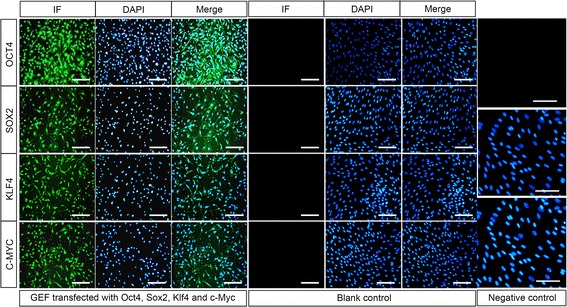
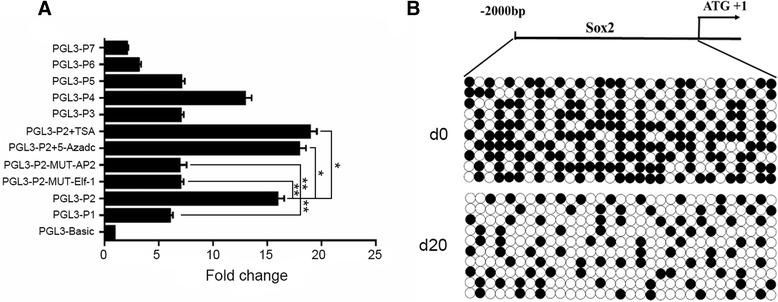
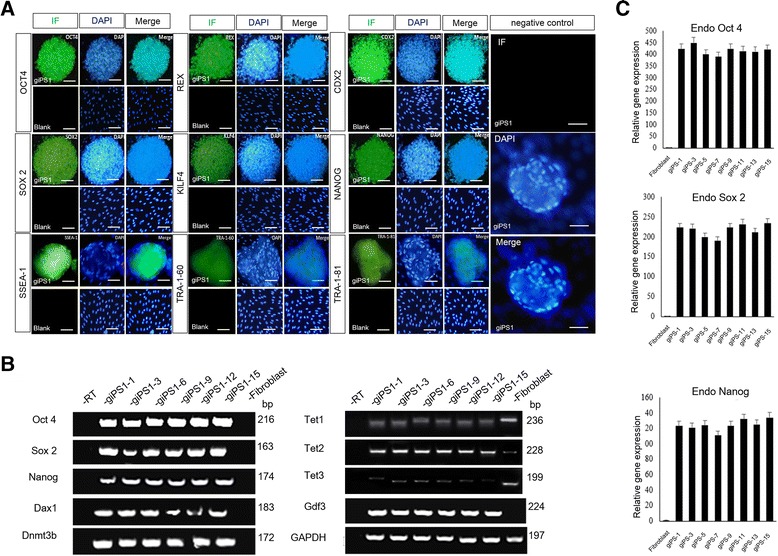
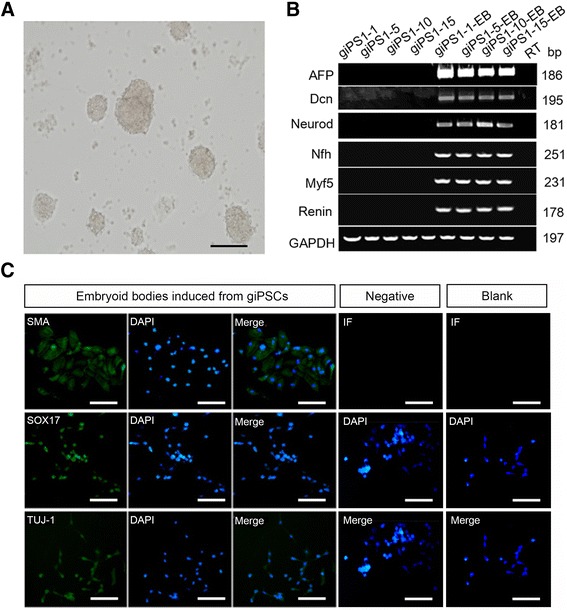
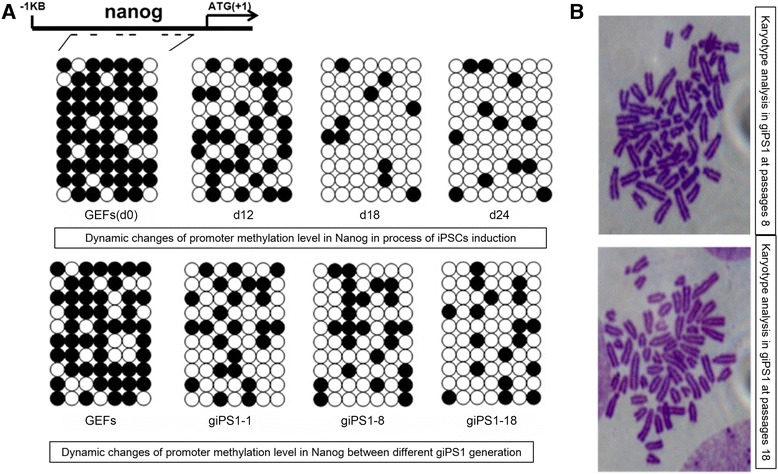
mRNAs of the four reprogramming factors were transfected into GEFs, and were localized in nucleus with approximately 90% transfection efficiency. After five consecutive transfections, GEFs tended to aggregate by day 10. Clones appeared on day 15-18, and typical embryonic stem cell -like clones formed on day 20. One thousand AKP staining positive clones were achieved in 10 GEFs, with approximately 1.0% induction efficiency. Immunofluorescence staining and qRT-PCR detection of the ESCs markers confirmed the properties of the goat iPSCs. The achieved goat iPSCs could be cultured to 22nd passage, which showed normal karyotype. The goat iPSCs were able to differentiate into embryoid bodies with three germ layers. qRT-PCR and western blot showed activated endogenous pluripotent factors expression in the later phase of mRNA-induced goat iPSCs induction. Epigenetic analysis of the endogenous pluripotent gene Nanog revealed its demethylation status in derived goat iPSCs. Core promoter regions of the four reprogramming factors were determined. Transcription factor binding sites, including Elf-1, AP-2, SP1, C/EBP and MZF1, were identified to be functional in the core promoter regions of these reprogramming genes. Demethylation and deacetylation of the promoters enhanced their transcription activities.
We successfully generated goat iPSCs by transfection of Oct4, Sox2, Klf4 and c-Myc mRNAs into GEFs, which initiated the endogenous reprogramming network and altered the methylation status of pluripotent genes. Core promoter regions and functional transcription binding sites of the four reprogramming genes were identified. Epigenetic regulation was revealed to participate in mRNA induced iPSCs formation. Our study provides a safe and efficient approach for goat. iPSCs generation.
传统的方法来产生山羊多能干细胞(iPSCs)遭受的复杂性和低准备效率。因此,我们试图通过转染外源Oct4、Sox2、Klf4 和 c-Myc mRNAs 到山羊胚胎成纤维细胞(GEFs)中,用一种新的方法来获得山羊 iPSCs,并探讨在山羊 iPSCs 诱导过程中重编程因子转录调控的机制。
四种重编程因子的 mRNAs 转染到 GEFs 中,约 90%的转染效率使其定位于细胞核。经过连续五次转染,GEFs 在第 10 天趋于聚集。第 15-18 天出现克隆,第 20 天形成典型的胚胎干细胞样克隆。在 10 个 GEFs 中获得了 1000 个碱性磷酸酶(AKP)染色阳性克隆,诱导效率约为 1.0%。ESCs 标志物的免疫荧光染色和 qRT-PCR 检测证实了山羊 iPSCs 的特性。获得的山羊 iPSCs 可以培养到第 22 代,显示出正常的核型。山羊 iPSCs 能够分化为具有三个胚层的胚状体。qRT-PCR 和 Western blot 显示,在 mRNA 诱导山羊 iPSCs 诱导的后期,内源性多能因子表达被激活。对衍生的山羊 iPSCs 中内源性多能基因 Nanog 的表观遗传分析显示其处于去甲基化状态。确定了四个重编程因子的核心启动子区域。鉴定了转录因子结合位点,包括 Elf-1、AP-2、SP1、C/EBP 和 MZF1,它们在这些重编程基因的核心启动子区域中具有功能。启动子的去甲基化和去乙酰化增强了它们的转录活性。
我们通过转染 Oct4、Sox2、Klf4 和 c-Myc mRNAs 到 GEFs 中成功地生成了山羊 iPSCs,这启动了内源性重编程网络,并改变了多能基因的甲基化状态。确定了四个重编程基因的核心启动子区域和功能转录结合位点。表观遗传调控被揭示参与了 mRNA 诱导的 iPSCs 形成。我们的研究为山羊提供了一种安全、高效的 iPSCs 生成方法。