Department of Surgery, College of Medicine, Central Michigan University, 912 S Washington Ave, Suite 1, Saginaw, MI, 48601, USA.
Department of Psychology, Education and Teacher Training, Faculty of Psychology and Education Sciences, Transylvania University, 56 Nicolae Balcescu, 500019, Brasov, BV, Romania.
BMC Med Educ. 2021 Sep 29;21(1):514. doi: 10.1186/s12909-021-02950-y.
Residency training exposes young physicians to a challenging and high-stress environment, making them vulnerable to burnout. Burnout syndrome not only compromises the health and wellness of resident physicians but has also been linked to prescription errors, reduction in the quality of medical care, and decreased professionalism. This study explored burnout and factors influencing resilience among U.S. resident physicians.
A cross-sectional study was conducted through an online survey, which was distributed to all accredited residency programs by Accreditation Council of Graduate Medical Education (ACGME). The survey included the Connor-Davidson Resilience Scale (CD-RISC 25), Abbreviated Maslach Burnout Inventory, and socio-demographic characteristics questions. The association between burnout, resilience, and socio-demographic characteristics were examined.
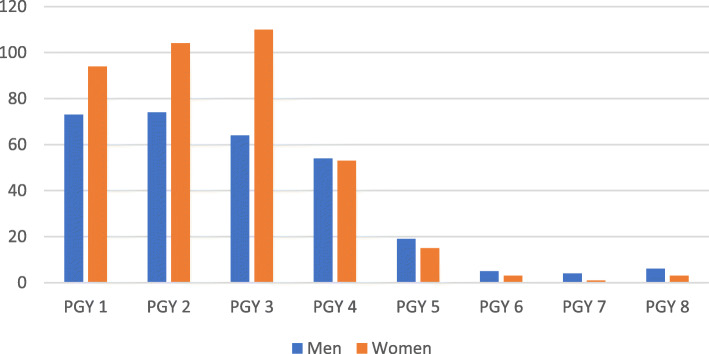
The 682 respondents had a mean CD-RISC score of 72.41 (Standard Deviation = 12.1), which was equivalent to the bottom 25th percentile of the general population. Males and upper-level trainees were more resilient than females and junior residents. No significant differences in resilience were found associated with age, race, marital status, or training program type. Resilience positively correlated with personal achievement, family, and institutional support (p < 0.001) and negatively associated with emotional exhaustion and depersonalization (p < 0.001).
High resilience, family, and institutional support were associated with a lower risk of burnout, supporting the need for developing a resilience training program to promote a lifetime of mental wellness for future physicians.
住院医师培训使年轻医生置身于充满挑战和高压力的环境中,使他们容易出现倦怠。倦怠综合征不仅损害住院医师的健康和幸福,还与处方错误、医疗质量下降和职业素养降低有关。本研究探讨了美国住院医师的倦怠和影响其韧性的因素。
通过在线调查进行了一项横断面研究,该调查由研究生医学教育认证委员会(ACGME)分发给所有认可的住院医师培训计划。该调查包括 Connor-Davidson 韧性量表(CD-RISC 25)、简化 Maslach 倦怠量表和社会人口统计学特征问题。检查了倦怠、韧性和社会人口统计学特征之间的关联。
682 名受访者的 CD-RISC 平均得分为 72.41(标准差=12.1),相当于一般人群的第 25 个百分位数。男性和高级学员比女性和初级住院医师更有韧性。韧性与年龄、种族、婚姻状况或培训计划类型无关。韧性与个人成就、家庭和机构支持呈正相关(p<0.001),与情绪耗竭和去个性化呈负相关(p<0.001)。
高韧性、家庭和机构支持与倦怠风险降低相关,支持制定韧性培训计划以促进未来医生的终身心理健康。