Department of Biological Sciences, National University of Singapore, Singapore, Singapore.
Research Institute for Microbial Diseases, Osaka University, Osaka, Japan.
BMC Biol. 2021 Sep 29;19(1):217. doi: 10.1186/s12915-021-01141-x.
DNA barcodes are a useful tool for discovering, understanding, and monitoring biodiversity which are critical tasks at a time of rapid biodiversity loss. However, widespread adoption of barcodes requires cost-effective and simple barcoding methods. We here present a workflow that satisfies these conditions. It was developed via "innovation through subtraction" and thus requires minimal lab equipment, can be learned within days, reduces the barcode sequencing cost to < 10 cents, and allows fast turnaround from specimen to sequence by using the portable MinION sequencer.
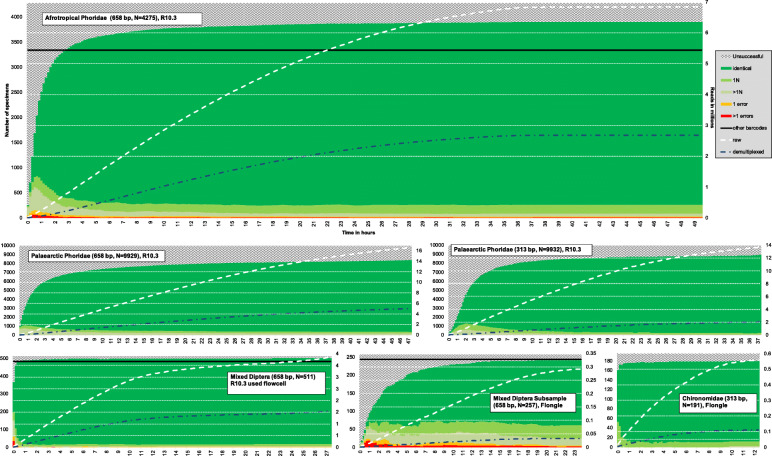
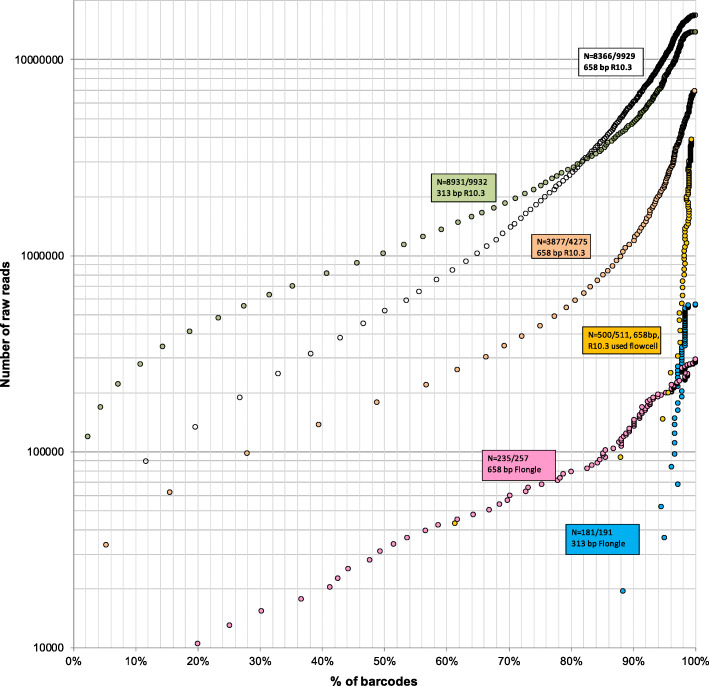
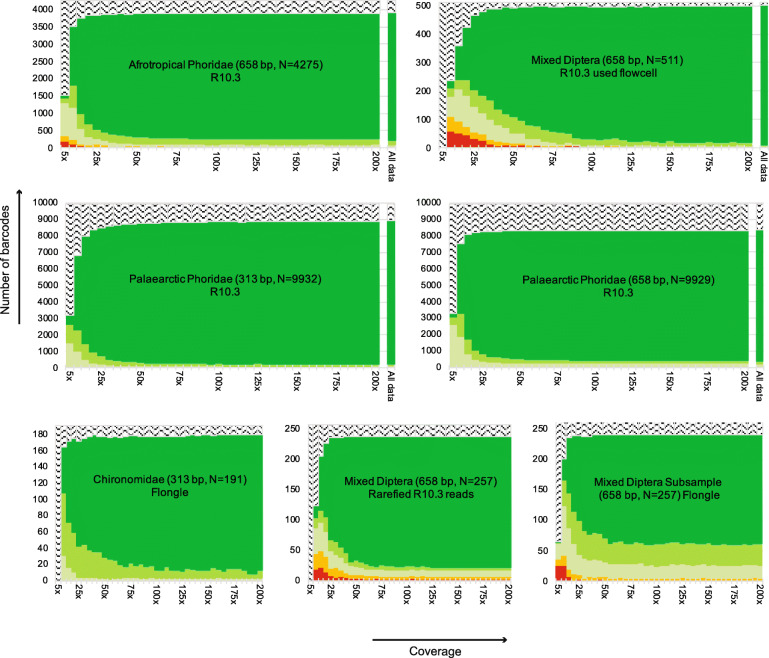
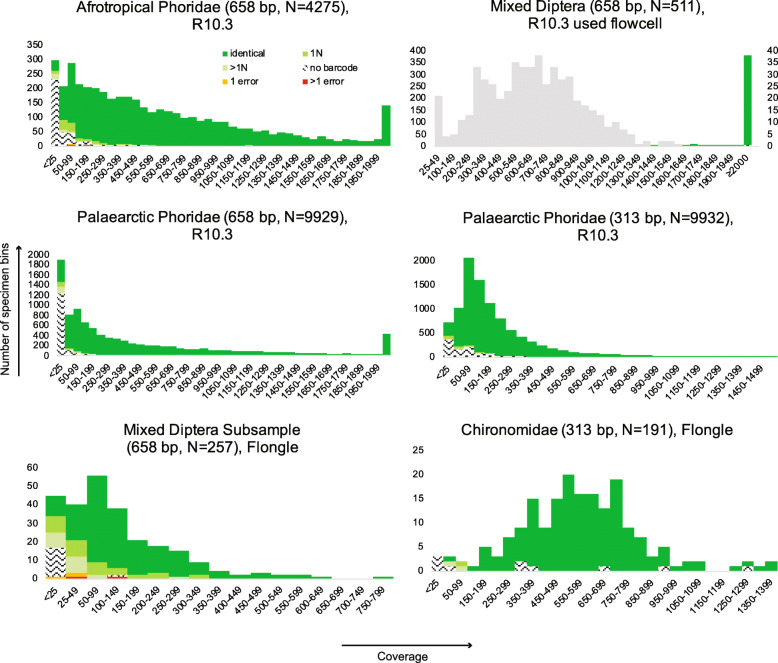
We describe how tagged amplicons can be obtained and sequenced with the real-time MinION sequencer in many settings (field stations, biodiversity labs, citizen science labs, schools). We also provide amplicon coverage recommendations that are based on several runs of the latest generation of MinION flow cells ("R10.3") which suggest that each run can generate barcodes for > 10,000 specimens. Next, we present a novel software, ONTbarcoder, which overcomes the bioinformatics challenges posed by MinION reads. The software is compatible with Windows 10, Macintosh, and Linux, has a graphical user interface (GUI), and can generate thousands of barcodes on a standard laptop within hours based on only two input files (FASTQ, demultiplexing file). We document that MinION barcodes are virtually identical to Sanger and Illumina barcodes for the same specimens (> 99.99%) and provide evidence that MinION flow cells and reads have improved rapidly since 2018.
We propose that barcoding with MinION is the way forward for government agencies, universities, museums, and schools because it combines low consumable and capital cost with scalability. Small projects can use the flow cell dongle ("Flongle") while large projects can rely on MinION flow cells that can be stopped and re-used after collecting sufficient data for a given project.
DNA 条码是发现、理解和监测生物多样性的有用工具,而生物多样性的快速丧失是当前面临的关键任务。然而,条码的广泛采用需要具有成本效益和简单的条码方法。我们在此提出了一种满足这些条件的工作流程。该流程是通过“减法创新”开发的,因此所需的实验室设备最少,只需几天即可掌握,将条码测序成本降低到<10 美分,并通过使用便携式 MinION 测序仪实现从标本到序列的快速周转。
我们描述了如何在许多环境(野外工作站、生物多样性实验室、公民科学实验室、学校)中使用实时 MinION 测序仪获得和测序标记的扩增子。我们还提供了基于最新一代 MinION 流动池(“R10.3”)的几次运行的扩增子覆盖范围建议,这些建议表明每次运行都可以为>10000 个标本生成条码。接下来,我们介绍了一种新的软件 ONTbarcoder,它克服了 MinION 读数带来的生物信息学挑战。该软件与 Windows 10、Macintosh 和 Linux 兼容,具有图形用户界面(GUI),仅基于两个输入文件(FASTQ、解复用文件),即可在标准笔记本电脑上数小时内生成数千个条码。我们证明 MinION 条码与相同标本的 Sanger 和 Illumina 条码几乎相同(>99.99%),并提供了证据表明 MinION 流动池和读数自 2018 年以来已经迅速改进。
我们建议使用 MinION 进行条码编码是政府机构、大学、博物馆和学校的未来方向,因为它结合了低耗材和资本成本与可扩展性。小型项目可以使用流动池加密狗(“Flongle”),而大型项目可以依赖于 MinION 流动池,这些流动池可以在为特定项目收集足够的数据后停止并重新使用。