Baune Bernhard T, Florea Ioana, Ebert Bjarke, Touya Maëlys, Ettrup Anders, Hadi Monica, Ren Hongye
Department of Psychiatry and Psychotherapy, University of Münster, Münster, Germany.
Department of Psychiatry, Melbourne Medical School, University of Melbourne, Melbourne, VIC, Australia.
Neuropsychiatr Dis Treat. 2021 Sep 23;17:2995-3006. doi: 10.2147/NDT.S325954. eCollection 2021.
This qualitative study explored patient perceptions of the most burdensome symptoms of major depressive disorder (MDD), the impact of symptoms on patients' daily lives, and patient expectations and experiences regarding the timing of onset of antidepressant pharmacotherapy.
Data were collected through facilitated, patient focus-group sessions in the USA between May and June 2019. Participants were adults with confirmed MDD who reported a major depressive episode within the past 2 years, for which they had received pharmacologic treatment for ≥6 weeks. The semi-structured discussion focused on the key topics of bothersome symptoms of MDD, the impact of symptoms on quality of life, and the effects of antidepressant treatment. Interviews were audio-recorded; findings were summarized using a content-analysis approach.
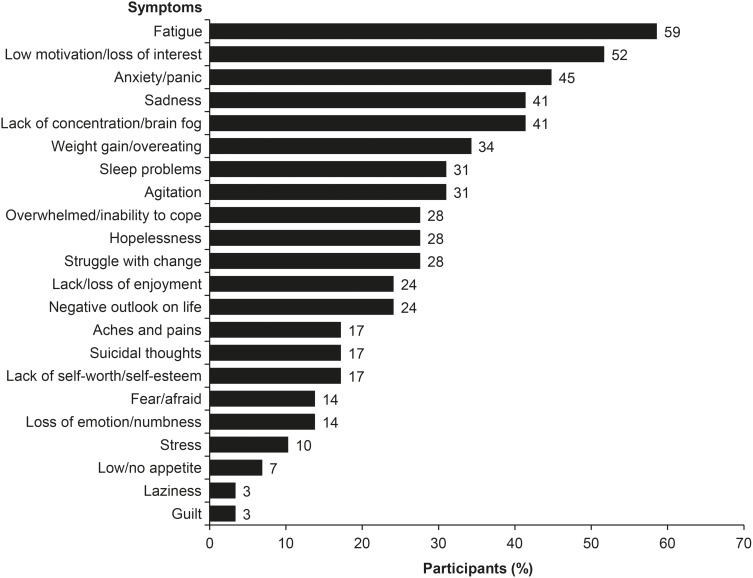
Five focus-group sessions were undertaken, involving a total of 29 patients (each attended one session; mean age, 43.4 years; 72.4% female). Mean time since confirmed diagnosis of MDD was 13.1 years. The most commonly prescribed antidepressants received were bupropion (41.4% of participants), escitalopram (34.5%), and sertraline (34.5%). The most frequently reported bothersome MDD symptoms were fatigue (mentioned by 58.6% of participants), lack of motivation/loss of interest (51.7%), anxiety/panic (44.8%), sadness (41.4%), and lack of concentration/brain fog (41.4%). Socialization, family life, and work were the areas in which quality of life was most impacted. Participants expressed dissatisfaction with their antidepressant treatment. Fast symptom resolution was mentioned as a priority (defined as <1 week by 38.5% of participants and ≤1 month by 65.4%). Most participants had not experienced fast relief from their symptoms with current or previous antidepressant medications.
Results of this qualitative study suggest that fatigue, anhedonia, cognitive symptoms, and anxiety are some of the most bothersome symptoms for patients with MDD and highlight the importance of obtaining rapid relief from these symptoms in order to improve outcomes and patient satisfaction with antidepressant medication.
本定性研究探讨了患者对重度抑郁症(MDD)最具负担的症状的看法、症状对患者日常生活的影响,以及患者对抗抑郁药物治疗起效时间的期望和体验。
2019年5月至6月期间,在美国通过便利的患者焦点小组会议收集数据。参与者为确诊患有MDD的成年人,他们在过去2年内报告有重度抑郁发作,且已接受了≥6周的药物治疗。半结构化讨论聚焦于MDD令人烦恼的症状、症状对生活质量的影响以及抗抑郁治疗的效果等关键主题。访谈进行了录音;采用内容分析方法总结研究结果。
共进行了5次焦点小组会议,涉及29名患者(每人参加一次会议;平均年龄43.4岁;72.4%为女性)。自确诊MDD以来的平均时间为13.1年。最常开具的抗抑郁药物是安非他酮(41.4%的参与者)、艾司西酞普兰(34.5%)和舍曲林(34.5%)。最常报告的令人烦恼的MDD症状是疲劳(58.6%的参与者提及)、缺乏动力/兴趣丧失(51.7%)、焦虑/惊恐(44.8%)、悲伤(41.4%)以及注意力不集中/头脑不清醒(41.4%)。社交、家庭生活和工作是生活质量受影响最大的领域。参与者对他们的抗抑郁治疗表示不满。快速缓解症状被视为优先事项(38.5%的参与者定义为<1周,65.4%定义为≤1个月)。大多数参与者在使用当前或以前的抗抑郁药物时,症状并未得到快速缓解。
本定性研究结果表明,疲劳、快感缺失、认知症状和焦虑是MDD患者最令人烦恼的一些症状,并强调了快速缓解这些症状对于改善治疗效果和患者对抗抑郁药物满意度的重要性。