Zamm Anna, Palmer Caroline, Bauer Anna-Katharina R, Bleichner Martin G, Demos Alexander P, Debener Stefan
Sequence Production Laboratory, Department of Psychology, McGill University, Montreal, QC, Canada.
Neuropsychology Laboratory, Institute for Psychology, European Medical School, University of Oldenburg, Oldenburg, Germany.
Front Hum Neurosci. 2021 Sep 13;15:717810. doi: 10.3389/fnhum.2021.717810. eCollection 2021.
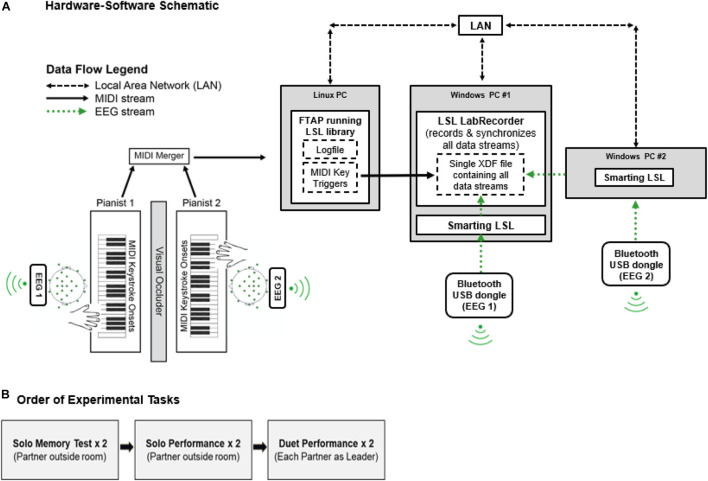
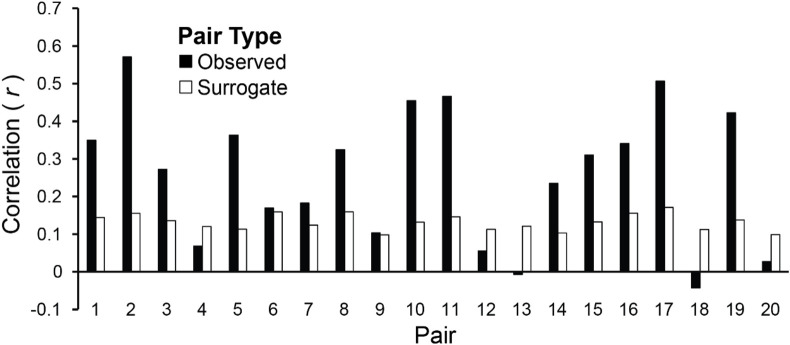
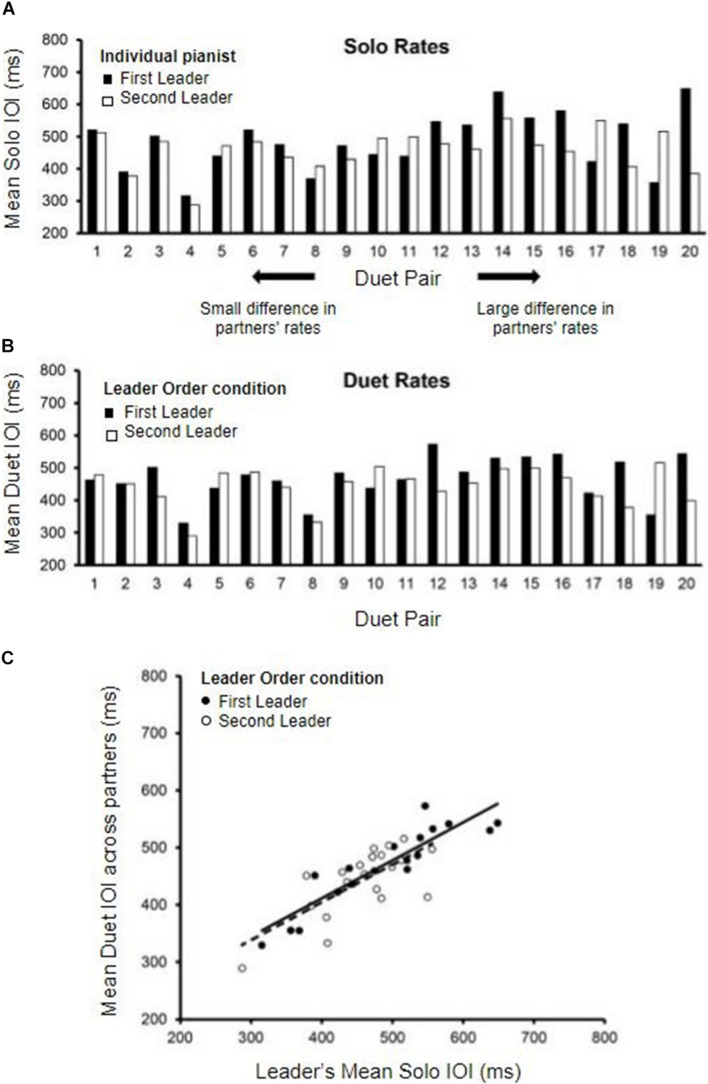
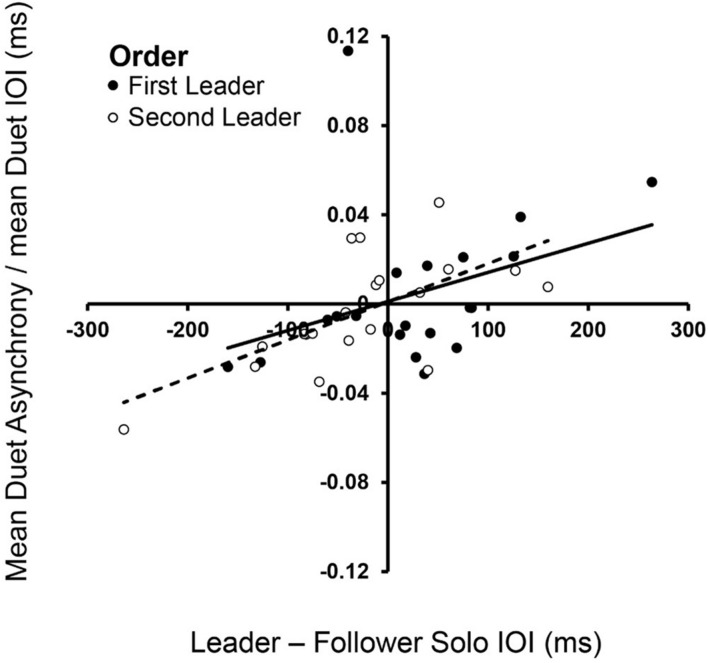
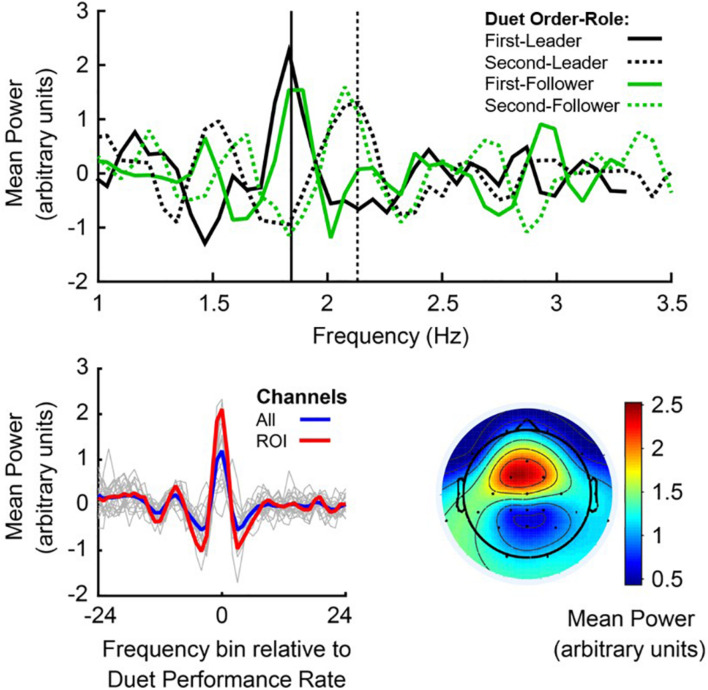
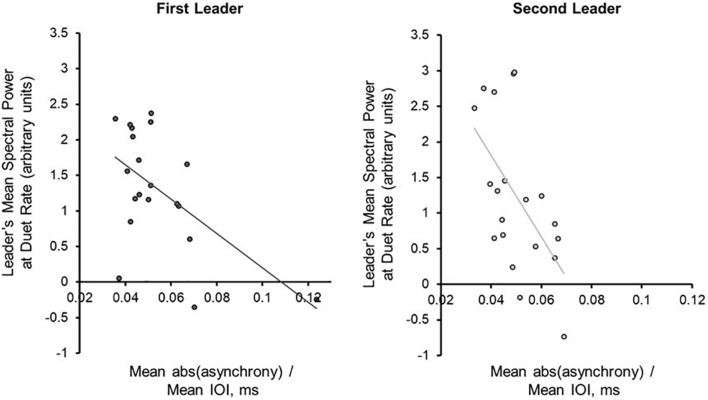
Interpersonal synchrony refers to the temporal coordination of actions between individuals and is a common feature of social behaviors, from team sport to ensemble music performance. Interpersonal synchrony of many rhythmic (periodic) behaviors displays dynamics of coupled biological oscillators. The current study addresses oscillatory dynamics on the levels of brain and behavior between music duet partners performing at spontaneous (uncued) rates. Wireless EEG was measured from = 20 pairs of pianists as they performed a melody first in Solo performance (at their spontaneous rate of performance), and then in Duet performances at each partner's spontaneous rate. Influences of partners' spontaneous rates on interpersonal synchrony were assessed by correlating differences in partners' spontaneous rates of Solo performance with Duet tone onset asynchronies. Coupling between partners' neural oscillations was assessed by correlating amplitude envelope fluctuations of cortical oscillations at the Duet performance frequency between observed partners and between surrogate (re-paired) partners, who performed the same melody but at different times. Duet synchronization was influenced by partners' spontaneous rates in Solo performance. The size and direction of the difference in partners' spontaneous rates were mirrored in the size and direction of the Duet asynchronies. Moreover, observed Duet partners showed greater inter-brain correlations of oscillatory amplitude fluctuations than did surrogate partners, suggesting that performing in synchrony with a musical partner is reflected in coupled cortical dynamics at the performance frequency. The current study provides evidence that dynamics of oscillator coupling are reflected in both behavioral and neural measures of temporal coordination during musical joint action.
人际同步是指个体之间行动的时间协调,是社会行为的一个共同特征,从团队运动到合奏音乐表演皆是如此。许多有节奏(周期性)行为的人际同步表现出耦合生物振荡器的动态。当前的研究探讨了在以自发(无提示)速度进行表演的音乐二重奏伙伴之间,大脑和行为层面的振荡动态。在20对钢琴家演奏旋律时测量无线脑电图,他们先是进行独奏表演(以各自自发的演奏速度),然后以每个伙伴自发的速度进行二重奏表演。通过将伙伴独奏表演的自发速度差异与二重奏音调起始异步性进行关联,评估伙伴自发速度对人际同步的影响。通过将观察到的伙伴之间以及替代(重新配对)伙伴之间在二重奏表演频率下皮质振荡的幅度包络波动进行关联,评估伙伴神经振荡之间的耦合,替代伙伴演奏相同旋律但时间不同。二重奏同步受到伙伴独奏表演时自发速度的影响。伙伴自发速度差异的大小和方向反映在二重奏异步性的大小和方向上。此外,观察到的二重奏伙伴在振荡幅度波动的脑间相关性上比替代伙伴更强,这表明与音乐伙伴同步表演反映在表演频率下耦合的皮质动态中。当前的研究提供了证据,证明振荡器耦合的动态在音乐联合行动期间的时间协调的行为和神经测量中都有体现。