Wang Xuan, Zhang Tongyangzi, Guo Zizhen, Pu Jincheng, Riaz Farooq, Feng Run, Fang Xingxing, Song Jiamin, Liang Yuanyuan, Wu Zhenzhen, Pan Shengnan, Tang Jianping
Department of Rheumatology and Immunology, Tongji Hospital, Tongji University School of Medicine, Shanghai, China.
Department of Immunology, Shanghai Jiaotong University School of Medicine, Shanghai, China.
Front Pharmacol. 2021 Sep 7;12:693796. doi: 10.3389/fphar.2021.693796. eCollection 2021.
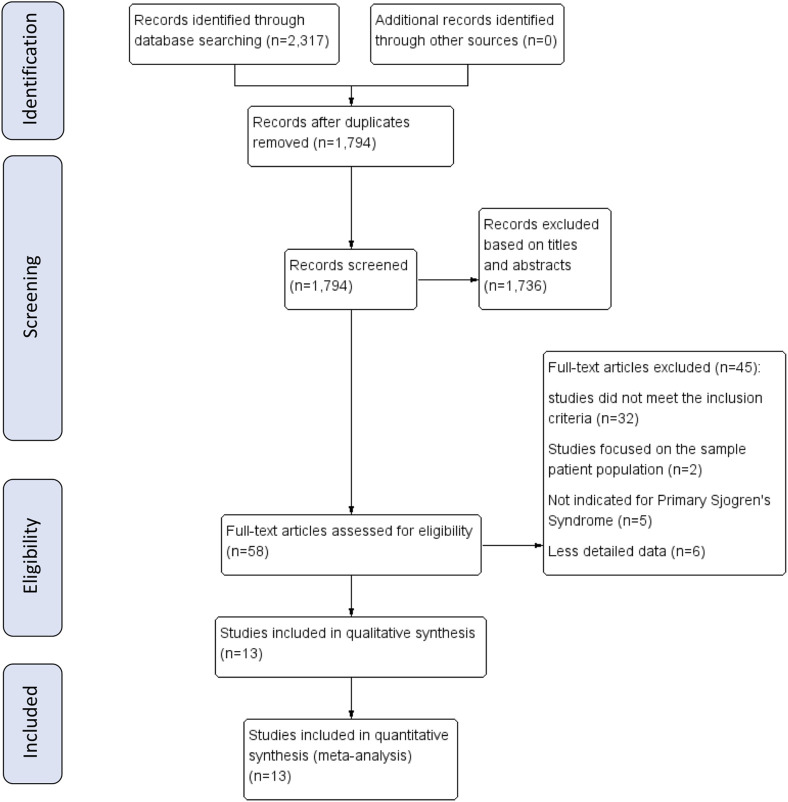
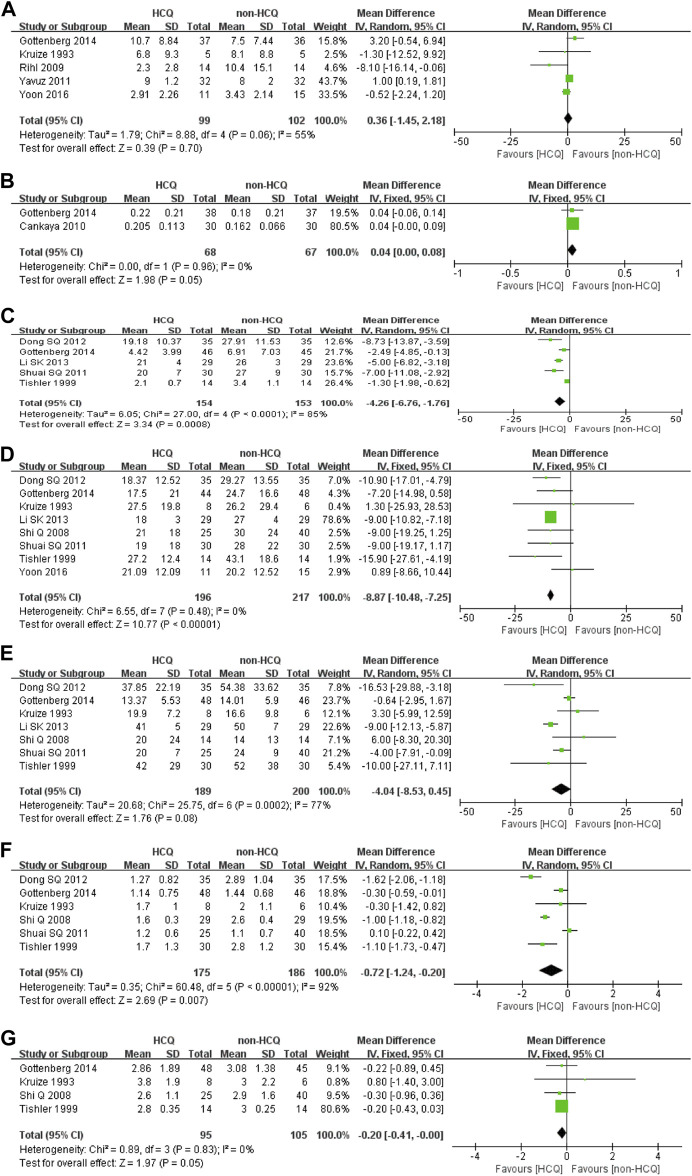
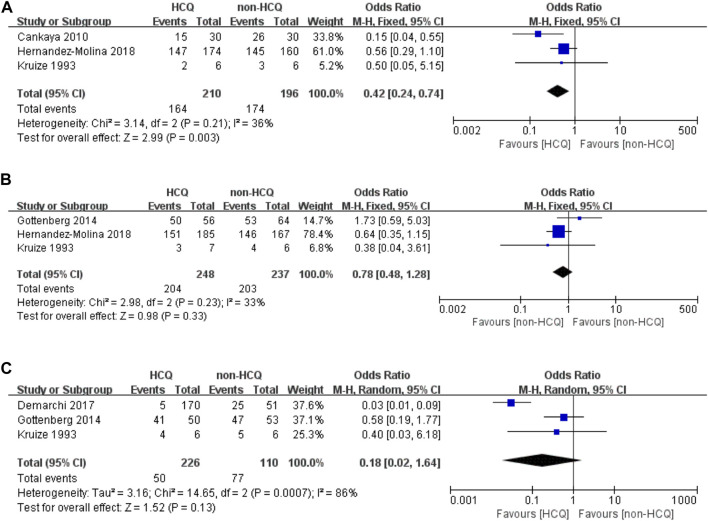
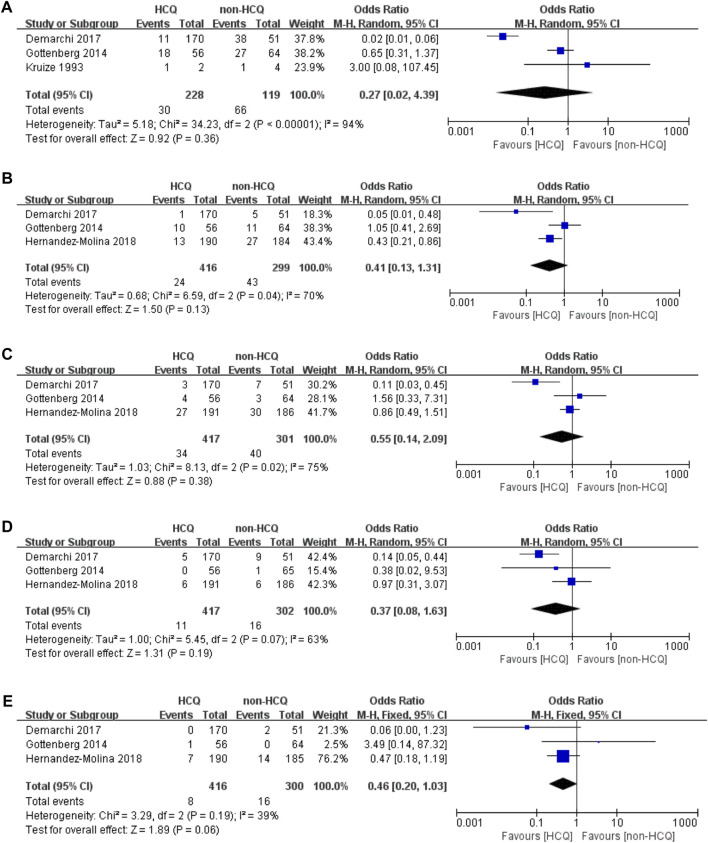
This meta-analysis was conducted to evaluate the effects of hydroxychloroquine (HCQ) in the treatment of primary Sjögren's syndrome (pSS). Nine databases were searched for data collection. We used clinical features, including involvement in superficial tissues and visceral systems, and experimental findings, including Schirmer's test, unstimulated salivary flow rate (uSFR), C-reactive protein (CRP), erythrocyte sedimentation rate (ESR) and immunoglobulins (IgG, IgM and IgA) as major outcome measures. The Downs and Black quality assessment tool and RevMan 5.3 were used to assess the methodological quality and statistical analysis, respectively. Thirteen studies with pSS patients, consisting of two randomized controlled studies, four retrospective studies and seven prospective studies were analyzed. Results showed that HCQ treatment significantly improved the oral symptoms of pSS patients compared to non-HCQ treatment ( = 0.003). Similar trends favoring HCQ treatment were observed for uSFR ( = 0.05), CRP ( = 0.0008), ESR ( < 0.00001), IgM ( = 0.007) and IgA ( = 0.05). However, no significant improvement was observed in other clinical features, including ocular involvement, fatigue, articular lesions, pulmonary, neurological and lymphoproliferative symptoms, renal organs and other experimental parameters in the HCQ treatment group compared to the non-HCQ treatment group. HCQ treatment showed moderate efficacy to improve oral symptoms, uSFR, ESR, CRP, IgM and IgA. However, HCQ could not alleviate organ-specific systemic involvement. We have registered on the PROSPERO [https://www.crd.york.ac.uk/PROSPERO/], and the registration number is identifier [CRD42020205624].
本荟萃分析旨在评估羟氯喹(HCQ)治疗原发性干燥综合征(pSS)的效果。检索了九个数据库以收集数据。我们将临床特征(包括浅表组织和内脏系统受累情况)以及实验结果(包括泪液分泌试验、非刺激性唾液流速(uSFR)、C反应蛋白(CRP)、红细胞沉降率(ESR)和免疫球蛋白(IgG、IgM和IgA))作为主要结局指标。分别使用唐斯和布莱克质量评估工具及RevMan 5.3来评估方法学质量和进行统计分析。对13项针对pSS患者的研究进行了分析,其中包括两项随机对照研究、四项回顾性研究和七项前瞻性研究。结果显示,与非HCQ治疗相比,HCQ治疗显著改善了pSS患者的口腔症状(P = 0.003)。在uSFR(P = 0.05)、CRP(P = 0.0008)、ESR(P < 0.00001)、IgM(P = 0.007)和IgA(P = 0.05)方面也观察到了有利于HCQ治疗的类似趋势。然而,与非HCQ治疗组相比,HCQ治疗组在其他临床特征方面未观察到显著改善,包括眼部受累、疲劳、关节病变、肺部、神经和淋巴增殖症状、肾脏器官以及其他实验参数。HCQ治疗在改善口腔症状、uSFR、ESR、CRP、IgM和IgA方面显示出中等疗效。然而,HCQ无法缓解器官特异性的全身受累情况。我们已在国际前瞻性系统评价注册库[https://www.crd.york.ac.uk/PROSPERO/]上注册,注册号为标识符[CRD42020205624]。