Gong Danni, Yu Fei, Zhou Meng, Dong Wei, Yan Dan, Zhang Siyi, Yan Yan, Wang Huijing, Tan Yao, Chen Ying, Feng Bei, Fu Wei, Fu Yao, Lu Yang
Department of Ophthalmology, Ninth People's Hospital, Shanghai Jiao Tong University School of Medicine, Shanghai, China.
Shanghai Key Laboratory of Orbital Diseases and Ocular Oncology, Shanghai, China.
Front Bioeng Biotechnol. 2021 Sep 13;9:740635. doi: 10.3389/fbioe.2021.740635. eCollection 2021.
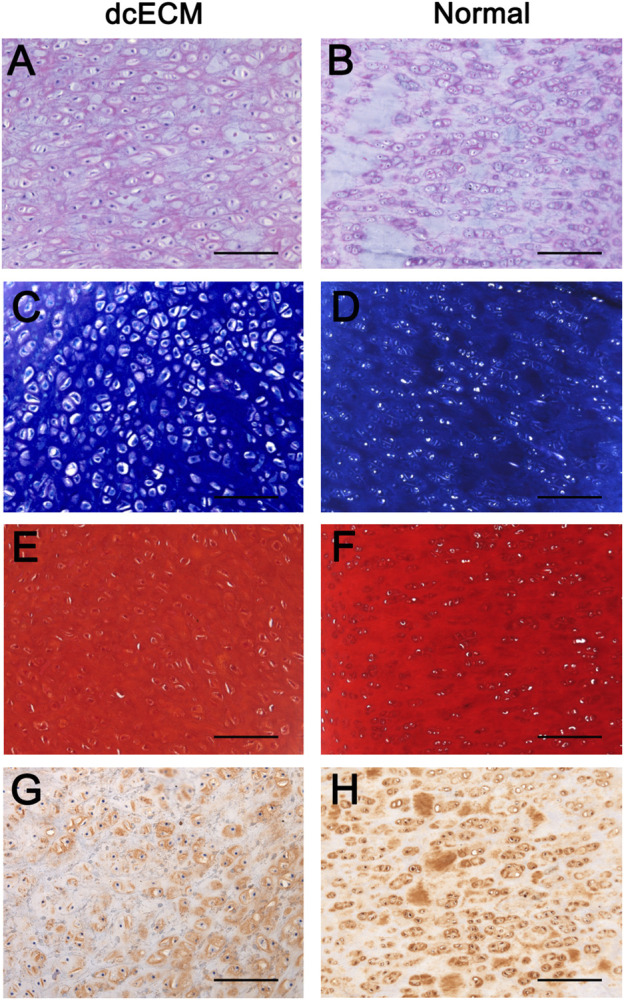
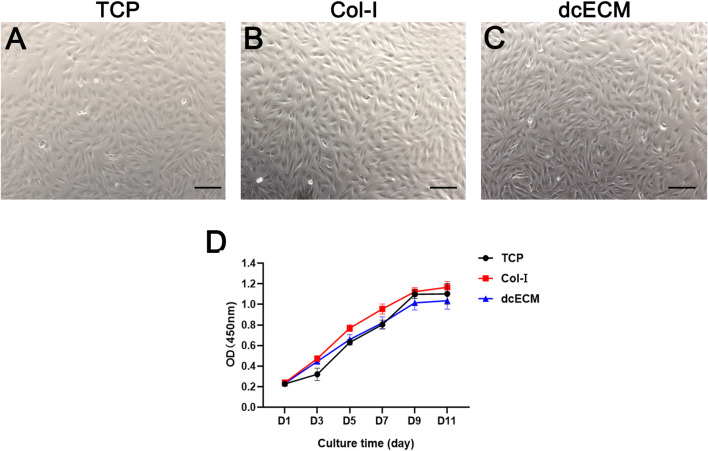
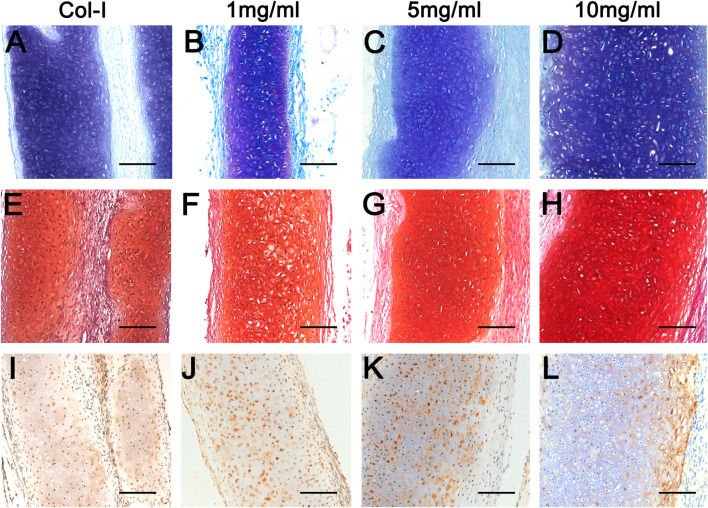
Extracellular matrix (ECM) hydrogels provide advantages such as injectability, the ability to fill an irregularly shaped space, and the adequate bioactivity of native matrix. In this study, we developed decellularized cartilage ECM (dcECM) hydrogels from porcine ears innovatively via the main method of enzymatic digestion and verified good biocompatible properties of dcECM hydrogels to deliver chondrocytes and form subcutaneous cartilage . The scanning electron microscopy and turbidimetric gelation kinetics were used to characterize the material properties and gelation kinetics of the dcECM hydrogels. Then we evaluated the biocompatibility of hydrogels via the culture of chondrocytes . To further explore the dcECM hydrogels , grafts made from the mixture of dcECM hydrogels and chondrocytes were injected subcutaneously in nude mice for the gross and histological analysis. The structural and gelation kinetics of the dcECM hydrogels altered according to the variation in the ECM concentrations. The 10 mg/ml dcECM hydrogels could support the adhesion and proliferation of chondrocytes . , at 4 weeks after transplantation, cartilage-like tissues were detected in all groups with positive staining of toluidine blue, Safranin O, and collagen II, indicating the good gelation of dcECM hydrogels. While with the increasing concentration, the tissue engineering cartilages formed by 10 mg/ml dcECM hydrogel grafts were superior in weights, volumes, collagen, and glycosaminoglycan (GAG) content compared to the dcECM hydrogels of 1 mg/ml and 5 mg/ml. At 8 weeks after grafting, dcECM hydrogel grafts at 10 mg/ml showed very similar qualities to the control, collagen I grafts. After 12 weeks of culture, the histological analysis indicated that 10 mg/ml dcECM hydrogel grafts were similar to the normal cartilage from pig ears, which was the source tissue. In conclusion, dcECM hydrogel showed the promising potential as a tissue engineering biomaterial to improve the regeneration and heal injuries of ear cartilage.
细胞外基质(ECM)水凝胶具有诸如可注射性、填充不规则形状空间的能力以及天然基质的充分生物活性等优点。在本研究中,我们通过酶消化的主要方法创新性地从猪耳中制备了脱细胞软骨ECM(dcECM)水凝胶,并验证了dcECM水凝胶具有良好的生物相容性,可用于递送软骨细胞并形成皮下软骨。使用扫描电子显微镜和比浊法凝胶化动力学来表征dcECM水凝胶的材料特性和凝胶化动力学。然后我们通过软骨细胞培养评估水凝胶的生物相容性。为了进一步探究dcECM水凝胶,将由dcECM水凝胶和软骨细胞混合物制成的移植物皮下注射到裸鼠体内进行大体和组织学分析。dcECM水凝胶的结构和凝胶化动力学根据ECM浓度的变化而改变。10mg/ml的dcECM水凝胶能够支持软骨细胞的黏附和增殖。移植4周后,所有组均检测到类似软骨的组织,甲苯胺蓝、番红O和胶原蛋白II染色呈阳性,表明dcECM水凝胶具有良好的凝胶化性能。随着浓度增加,与1mg/ml和5mg/ml的dcECM水凝胶相比,由10mg/ml dcECM水凝胶移植物形成的组织工程软骨在重量、体积、胶原蛋白和糖胺聚糖(GAG)含量方面更优。移植8周后,10mg/ml的dcECM水凝胶移植物表现出与对照胶原蛋白I移植物非常相似的质量。培养12周后,组织学分析表明,10mg/ml dcECM水凝胶移植物与作为源组织的猪耳正常软骨相似。总之,dcECM水凝胶作为一种组织工程生物材料,在改善耳软骨再生和愈合损伤方面显示出有前景的潜力。