Zhu Senbo, Li Yong, He Zeju, Ji Lichen, Zhang Wei, Tong Yu, Luo Junchao, Yu Dongsheng, Zhang Qiong, Bi Qing
Center for Rehabilitation Medicine, Department of Orthopedics, Zhejiang Provincial People's Hospital (Affiliated People's Hospital, Hangzhou Medical College), Hangzhou, China.
Department of Orthopedics, The Second Affiliated Hospital and Yuying Children's Hospital of Wenzhou Medical University, Wenzhou, China.
Front Bioeng Biotechnol. 2022 Sep 8;10:954501. doi: 10.3389/fbioe.2022.954501. eCollection 2022.
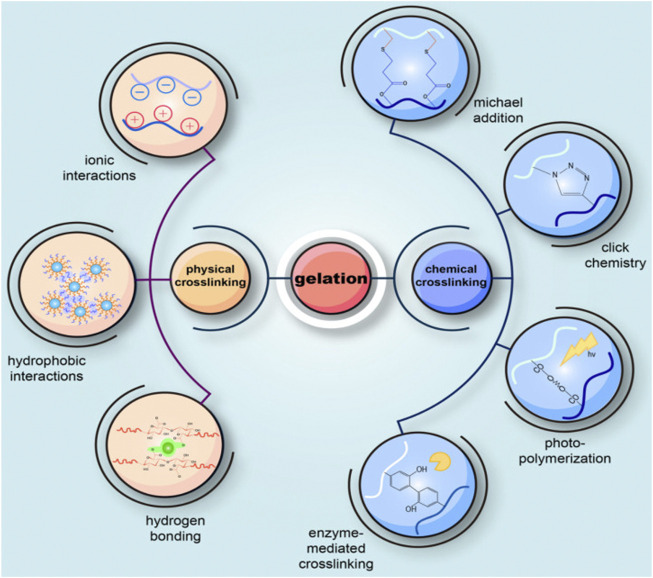
The rapid development of tissue engineering makes it an effective strategy for repairing cartilage defects. The significant advantages of injectable hydrogels for cartilage injury include the properties of natural extracellular matrix (ECM), good biocompatibility, and strong plasticity to adapt to irregular cartilage defect surfaces. These inherent properties make injectable hydrogels a promising tool for cartilage tissue engineering. This paper reviews the research progress on advanced injectable hydrogels. The cross-linking method and structure of injectable hydrogels are thoroughly discussed. Furthermore, polymers, cells, and stimulators commonly used in the preparation of injectable hydrogels are thoroughly reviewed. Finally, we summarize the research progress of the latest advanced hydrogels for cartilage repair and the future challenges for injectable hydrogels.
组织工程的快速发展使其成为修复软骨缺损的有效策略。可注射水凝胶用于软骨损伤的显著优点包括具有天然细胞外基质(ECM)的特性、良好的生物相容性以及适应不规则软骨缺损表面的强可塑性。这些固有特性使可注射水凝胶成为软骨组织工程中有前景的工具。本文综述了先进可注射水凝胶的研究进展。深入讨论了可注射水凝胶的交联方法和结构。此外,还全面综述了制备可注射水凝胶常用的聚合物、细胞和刺激剂。最后,我们总结了用于软骨修复的最新先进水凝胶的研究进展以及可注射水凝胶未来面临的挑战。