Deng Isaac, Corrigan Frances, Zhai Guangxi, Zhou Xin-Fu, Bobrovskaya Larisa
School of Pharmacy and Medical Sciences, Division of Health Sciences, Health and Biomedical Innovation Research Concentration, University of South Australia, Adelaide, South Australia, Australia.
School of Health Sciences, Division of Health Sciences, Health and Biomedical Innovation Research Concentration, University of South Australia, Adelaide, South Australia, Australia.
Brain Behav Immun Health. 2020 Mar 18;4:100060. doi: 10.1016/j.bbih.2020.100060. eCollection 2020 Apr.
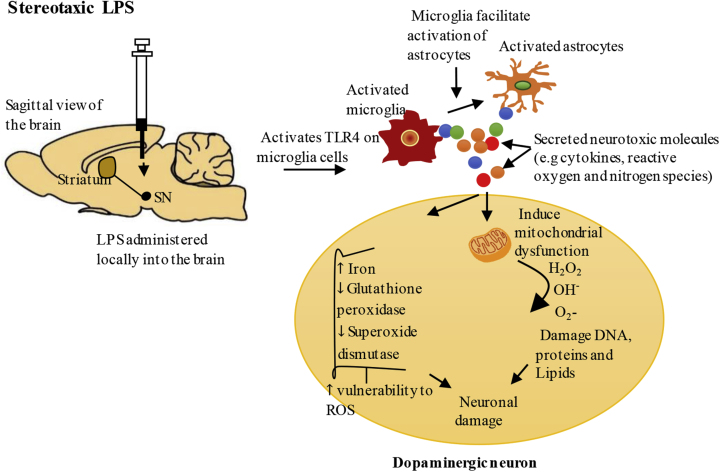
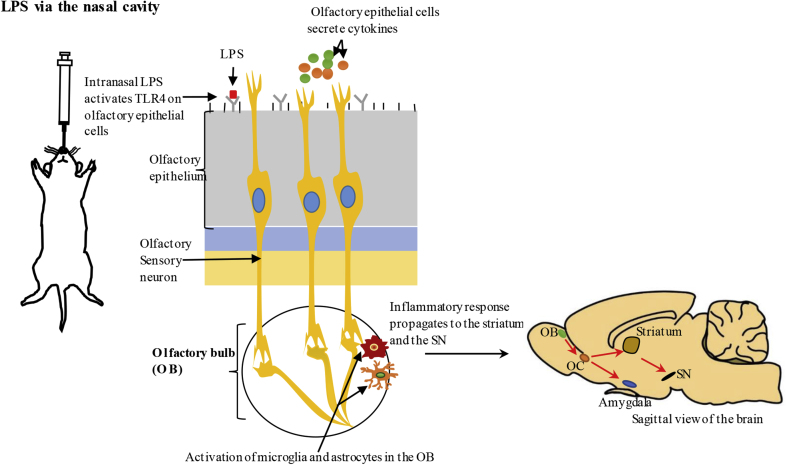
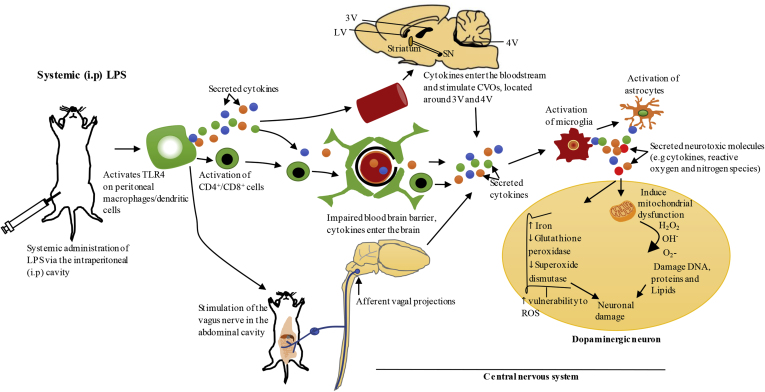
Parkinson's disease (PD) is one of the most common neurodegenerative movement disorders which is characterised neuropathologically by progressive loss of dopaminergic neurons in the substantia nigra pars compacta (SNpc) and the presence of Lewy bodies (made predominately of α-synuclein) in the surviving neurons. Animal models of PD have improved our understanding of the disease and have played a critical role in the development of neuroprotective agents. Neuroinflammation has been strongly implicated in the pathogenesis of PD, and recent studies have used lipopolysaccharide (LPS), a component of gram-negative bacteria and a potent activator of microglia cells, to mimic the inflammatory events in clinical PD. Modulating the inflammatory response could ameliorate PD associated complications and thus, it is essential to understand the extent to which LPS models reflect human PD. This review will outline the routes of administration of LPS such as stereotaxic, systemic and intranasal, their ability to recapitulate neuropathological markers of PD, and mechanisms of LPS induced toxicity. We will also discuss the ability of the models to replicate motor symptoms and non-motor symptoms of PD such as gastrointestinal dysfunction, olfactory dysfunction, anxiety, depression and cognitive dysfunction.
帕金森病(PD)是最常见的神经退行性运动障碍之一,其神经病理学特征是黑质致密部(SNpc)中多巴胺能神经元逐渐丧失,以及存活神经元中存在路易小体(主要由α-突触核蛋白组成)。帕金森病动物模型增进了我们对该疾病的理解,并在神经保护剂的研发中发挥了关键作用。神经炎症与帕金森病的发病机制密切相关,最近的研究使用脂多糖(LPS)(革兰氏阴性菌的一种成分,是小胶质细胞的强效激活剂)来模拟临床帕金森病中的炎症事件。调节炎症反应可以改善与帕金森病相关的并发症,因此,了解LPS模型在多大程度上反映人类帕金森病至关重要。本综述将概述LPS的给药途径,如立体定向、全身和鼻内给药,它们重现帕金森病神经病理学标志物的能力,以及LPS诱导毒性的机制。我们还将讨论这些模型复制帕金森病运动症状和非运动症状(如胃肠功能障碍、嗅觉功能障碍、焦虑、抑郁和认知功能障碍)的能力。