Global Health, Division for Health Services, Norwegian Institute of Public Health, Oslo, Norway
Global Health, Division for Health Services, Norwegian Institute of Public Health, Oslo, Norway.
BMJ Open. 2021 Sep 30;11(9):e049505. doi: 10.1136/bmjopen-2021-049505.
To identify the factors contributing to equitable access to COVID-19 vaccines for low and middle-income countries (LMIC).
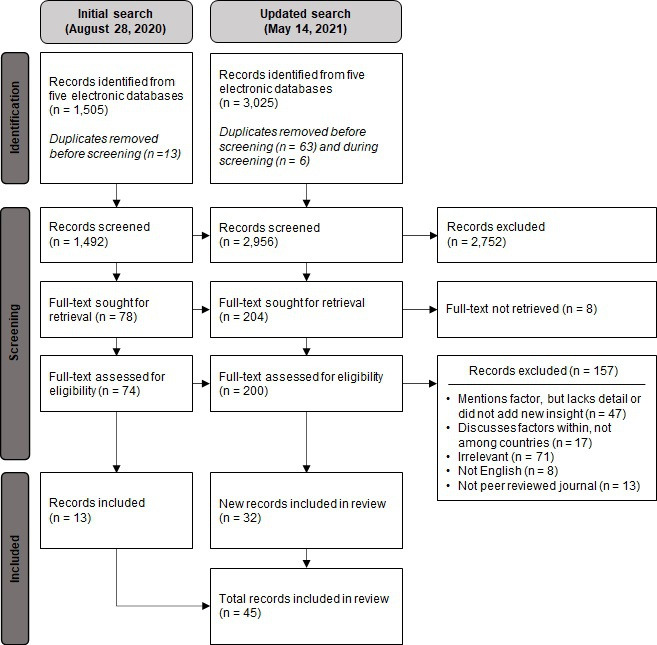
We conducted a scoping review following the guidelines for Preferred Reporting Items for Systematic Reviews and Meta-Analyses extension for Scoping Reviews and a five-stage framework for scoping studies. We performed systematic searches for published peer-reviewed literature in five databases: Medline, Embase, Web of Science, Global Index Medicus and COVID-19 Evidence Epistemonikos (August 2020, updated May 2021).
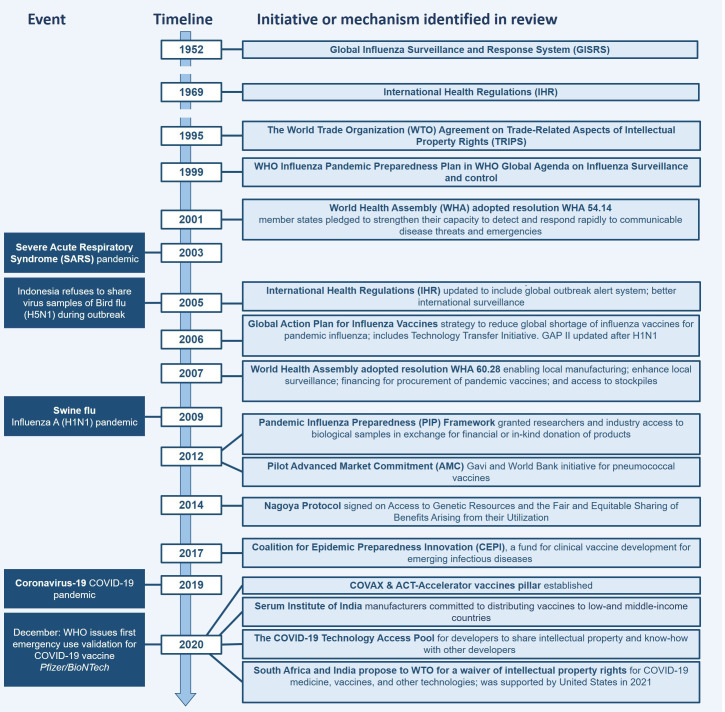
Systematic selection according to predefined criteria resulted in the final inclusion of 45 peer-reviewed articles, with no limitations on study design or publication type. We derived four key factors that potentially influence equitable access to COVID-19 vaccines in LMICs: (1) collectively agreed global mechanisms or frameworks; (2) bilateral purchasing, contracting, and vaccine prices; (3) vaccine manufacturing that is supported by sharing know-how; and (4) countries' strength in implementing vaccination programmes.
This scoping review highlights the ongoing challenges for the international community in ensuring equitable access to COVID-19 vaccines for LMICs. The literature suggests that vaccine manufacturing can influence the supply of vaccines, as can the role of patent holders who can influence global governance through their role in the distribution of COVID-19 vaccines. Our findings indicate that including the principles of equitable access throughout vaccine research and development, procurement, scale-up and distribution processes can support equitable access for LMICs. Advances made with mRNA vaccines may have additional benefits in relation to expanding the manufacturing of other vaccine. Finally, the exploration and scale-up of such capacities of LMICs are likely to prove to be a valuable investment, even after the pandemic.
确定导致中低收入国家(LMIC)公平获得 COVID-19 疫苗的因素。
我们根据系统评价和元分析扩展的首选报告项目指南以及范围研究的五个阶段框架,对已发表的同行评议文献进行了范围审查。我们在五个数据库中进行了系统搜索:Medline、Embase、Web of Science、全球索引医学和 COVID-19 证据 Epistemonikos(2020 年 8 月,2021 年 5 月更新)。
根据预设标准进行系统选择,最终纳入了 45 篇同行评议文章,对研究设计或出版类型没有限制。我们得出了四个潜在影响 LMIC 公平获得 COVID-19 疫苗的关键因素:(1)共同商定的全球机制或框架;(2)双边采购、承包和疫苗价格;(3)通过共享技术支持的疫苗制造;以及(4)国家实施疫苗接种计划的实力。
这项范围审查强调了国际社会在确保中低收入国家公平获得 COVID-19 疫苗方面面临的持续挑战。文献表明,疫苗制造会影响疫苗的供应,专利持有人的作用也会影响全球治理,因为他们在 COVID-19 疫苗的分配中发挥作用。我们的研究结果表明,在疫苗研究和开发、采购、扩大规模和分配过程中纳入公平获取的原则,可以支持中低收入国家的公平获取。mRNA 疫苗的进展可能在扩大其他疫苗的制造方面具有额外的好处。最后,探索和扩大中低收入国家的此类能力可能被证明是一项有价值的投资,即使在大流行之后也是如此。