Institute of Global Health and Human Ecology, The American University in Cairo, New Cairo, Egypt.
The Social Research Center, The American University in Cairo, New Cairo, Egypt.
Front Public Health. 2024 Mar 21;12:1348088. doi: 10.3389/fpubh.2024.1348088. eCollection 2024.
Inequitable access to COVID-19 vaccines among countries is a pressing global health issue. Factors such as economic power, political power, political stability, and health system strength contribute to disparities in vaccine distribution. This study aims to assess the inequality in vaccine distribution among countries based on these factors and identify their relationship with COVID-19 vaccine distribution.
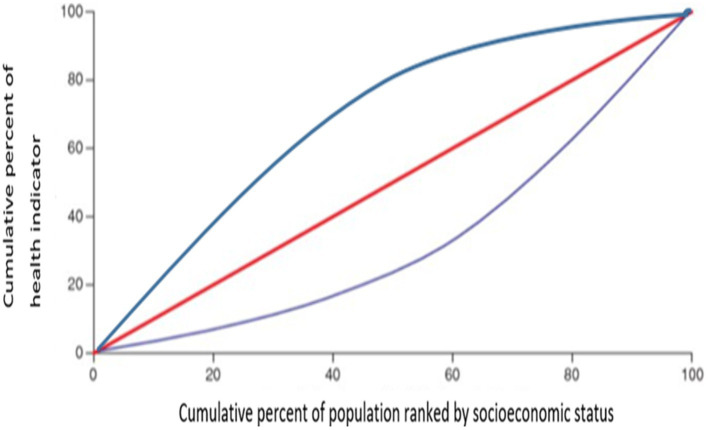
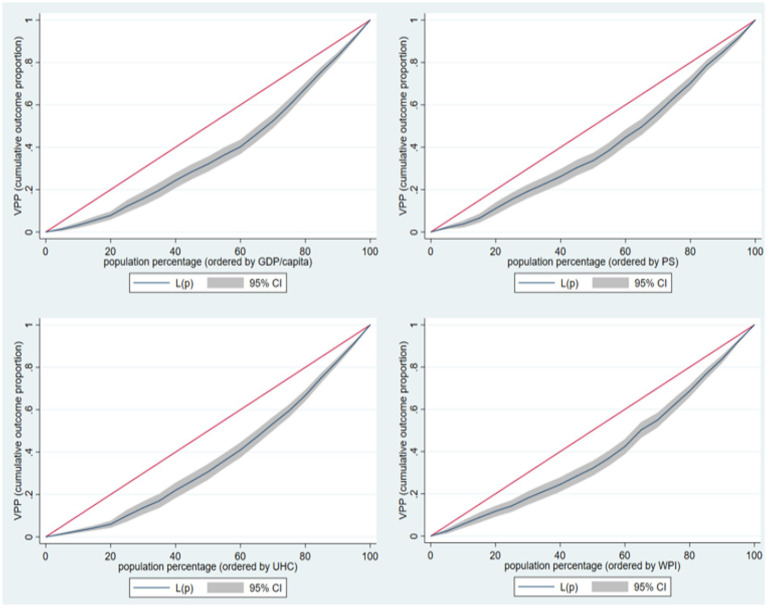
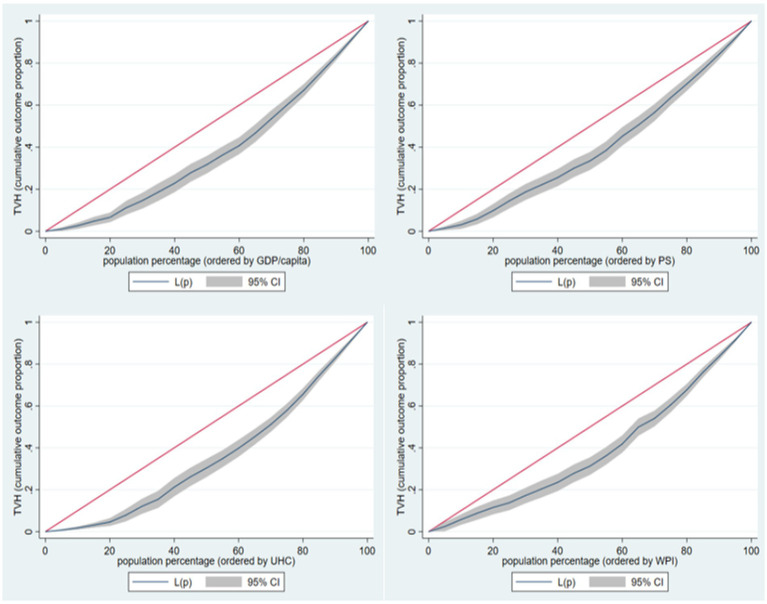
A Concentration Index (CI) analysis was conducted to evaluate inequalities in the distribution of COVID-19 vaccines among countries based on four separate variables: GDP , political stability (PS), World Power Index (WPI), and Universal Health Coverage (UHC). Additionally, Multiple Linear Regression (MLR) analysis was employed to explore the relationship between vaccine distribution and these independent variables. Two vaccine distribution variables were utilized for result reliability.
The analysis revealed significant inequalities in COVID-19 vaccine distribution according to the countries' GDP/capita, PS, WPI, and UHC. However, the multiple linear regression analysis showed that there is no significant relationship between COVID-19 vaccine distribution and the countries' GDP/capita and that UHC is the most influential factor impacting COVID-19 vaccine distribution and accessibility.
The findings underscore the complex interplay between economic, political, and health system factors in shaping vaccine distribution patterns. To improve the accessibility to vaccines in future pandemics, Global Health Governance (GHG) and countries should consider working on three areas; enhance political stabilities in countries, separate the political power from decision-making at the global level and most importantly support countries to achieve UHC.
国家间获得 COVID-19 疫苗的机会不平等是一个紧迫的全球卫生问题。经济实力、政治实力、政治稳定性和卫生系统实力等因素导致疫苗分配存在差异。本研究旨在根据这些因素评估国家间疫苗分配的不平等,并确定它们与 COVID-19 疫苗分配的关系。
采用集中指数(CI)分析评估了基于四个单独变量(GDP、政治稳定性(PS)、世界权力指数(WPI)和全民健康覆盖(UHC))的国家间 COVID-19 疫苗分配的不平等。此外,还采用多元线性回归(MLR)分析探讨了疫苗分配与这些自变量之间的关系。使用了两个疫苗分配变量来提高结果的可靠性。
分析表明,根据国家的 GDP/人均、PS、WPI 和 UHC,COVID-19 疫苗分配存在显著的不平等。然而,多元线性回归分析表明,COVID-19 疫苗分配与国家的 GDP/人均之间没有显著关系,而 UHC 是影响 COVID-19 疫苗分配和可及性的最具影响力的因素。
研究结果强调了经济、政治和卫生系统因素在塑造疫苗分配模式方面的复杂相互作用。为了提高未来大流行中疫苗的可及性,全球卫生治理(GHG)和国家应考虑在三个领域开展工作;增强国家的政治稳定性,将政治权力从全球层面的决策中分离出来,最重要的是支持各国实现全民健康覆盖。