Kasović Mario, Štefan Andro, Štefan Lovro
Faculty of Kinesiology, Department of General and Applied Kinesiology, University of Zagreb, Zagreb, 10 000, Croatia.
Faculty of Sports Studies, Department of Sport Motorics and Methodology in Kinanthropology, Masaryk University, Brno, 625 00, Czech Republic.
Nat Sci Sleep. 2021 Sep 24;13:1663-1668. doi: 10.2147/NSS.S328218. eCollection 2021.
To examine the associations between gait speed and sleep quality in first-year university students, according to gender.
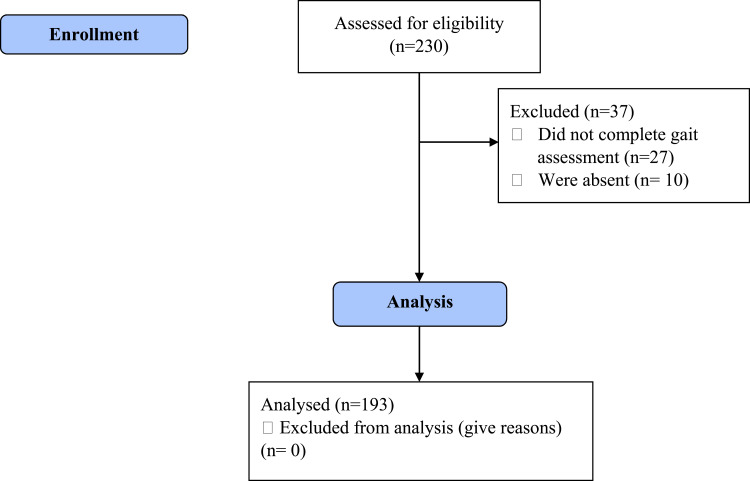
In this cross-sectional study, we recruited 193 first-year university students [mean age±standard deviation (SD): 19.6±1.1 years; mean height: 178.0±10.5 cm; mean weight: 74.0±11.0 kg; 26.9% women). Sleep quality was assessed using the Pittsburgh Sleep Quality questionnaire, with a lower score indicating "better" sleep quality. Gait speed was measured using the Zebris pressure platform. The associations were examined with generalized linear models and multiple regression analysis.
In the unadjusted model, faster participants had significantly "better" sleep quality (=-3.15, 95% CI -3.82 to -2.47, <0.001). When the model was adjusted for sex, age, body-mass index, self-rated health, smoking status, and psychological distress, faster participants remained having "better" sleep quality (=-2.88, 95% CI -3.53 to -2.22, <0.001).
This study shows that sleep quality can be predicted by gait speed in the first-year university students.
根据性别,研究一年级大学生的步态速度与睡眠质量之间的关联。
在这项横断面研究中,我们招募了193名一年级大学生[平均年龄±标准差(SD):19.6±1.1岁;平均身高:178.0±10.5厘米;平均体重:74.0±11.0千克;26.9%为女性]。使用匹兹堡睡眠质量问卷评估睡眠质量,得分越低表明睡眠质量“越好”。使用Zebris压力平台测量步态速度。通过广义线性模型和多元回归分析来研究两者之间的关联。
在未调整的模型中,步态速度较快的参与者睡眠质量显著“更好”(β=-3.15,95%置信区间-3.82至-2.47,P<0.001)。当模型对性别、年龄、体重指数、自我评估健康状况、吸烟状况和心理困扰进行调整后,步态速度较快的参与者仍具有“更好”的睡眠质量(β=-2.88,95%置信区间-3.53至-2.22,P<0.001)。
本研究表明,一年级大学生的睡眠质量可以通过步态速度来预测。